

21 Applications of NIR Techniques in Polymer Coatings …
495
100
0
Conversion [%]
100
0
Conversion [%]
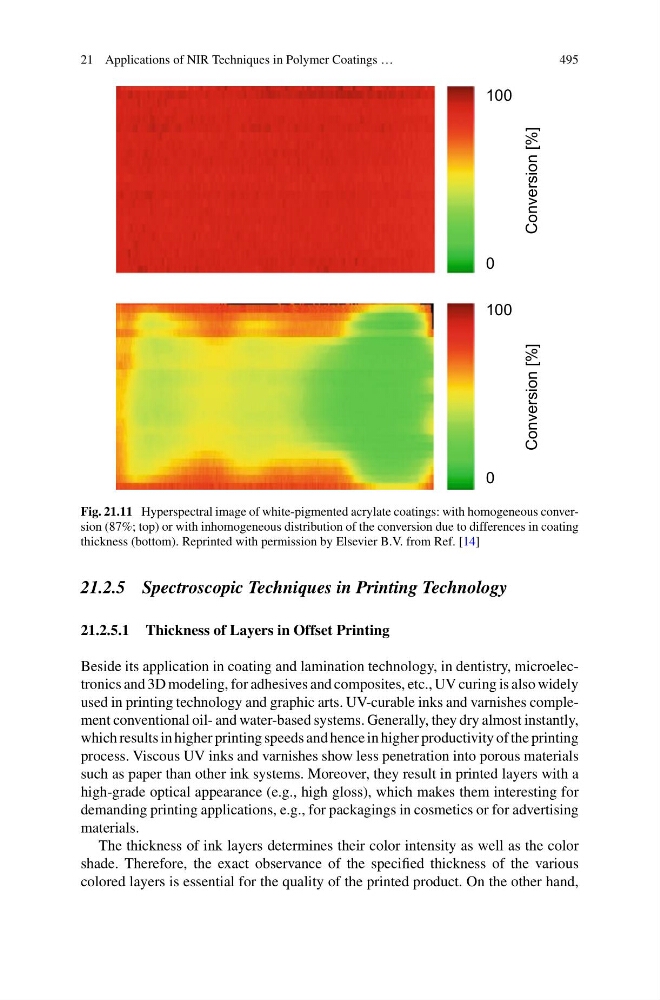
Fig. 21.11 Hyperspectral image of white-pigmented acrylate coatings: with homogeneous conversion (87%; top) or with inhomogeneous distribution of the conversion due to differences in coating
thickness (bottom). Reprinted with permission by Elsevier B.V. from Ref. [14]
21.2.5 Spectroscopic Techniques in Printing Technology
21.2.5.1 Thickness of Layers in Offset Printing
Beside its application in coating and lamination technology, in dentistry, microelectronics and 3D modeling, for adhesives and composites, etc., UV curing is also widely
used in printing technology and graphic arts. UV-curable inks and varnishes complement conventional oil- and water-based systems. Generally, they dry almost instantly,
which results in higher printing speeds and hence in higher productivity of the printing
process. Viscous UV inks and varnishes show less penetration into porous materials
such as paper than other ink systems. Moreover, they result in printed layers with a
high-grade optical appearance (e.g., high gloss), which makes them interesting for
demanding printing applications, e.g., for packagings in cosmetics or for advertising
materials.
The thickness of ink layers determines their color intensity as well as the color
shade. Therefore, the exact observance of the specified thickness of the various
colored layers is essential for the quality of the printed product. On the other hand,
495
100
0
Conversion [%]
100
0
Conversion [%]
Fig. 21.11 Hyperspectral image of white-pigmented acrylate coatings: with homogeneous conversion (87%; top) or with inhomogeneous distribution of the conversion due to differences in coating
thickness (bottom). Reprinted with permission by Elsevier B.V. from Ref. [14]
21.2.5 Spectroscopic Techniques in Printing Technology
21.2.5.1 Thickness of Layers in Offset Printing
Beside its application in coating and lamination technology, in dentistry, microelectronics and 3D modeling, for adhesives and composites, etc., UV curing is also widely
used in printing technology and graphic arts. UV-curable inks and varnishes complement conventional oil- and water-based systems. Generally, they dry almost instantly,
which results in higher printing speeds and hence in higher productivity of the printing
process. Viscous UV inks and varnishes show less penetration into porous materials
such as paper than other ink systems. Moreover, they result in printed layers with a
high-grade optical appearance (e.g., high gloss), which makes them interesting for
demanding printing applications, e.g., for packagings in cosmetics or for advertising
materials.
The thickness of ink layers determines their color intensity as well as the color
shade. Therefore, the exact observance of the specified thickness of the various
colored layers is essential for the quality of the printed product. On the other hand,