

494
T. Scherzer
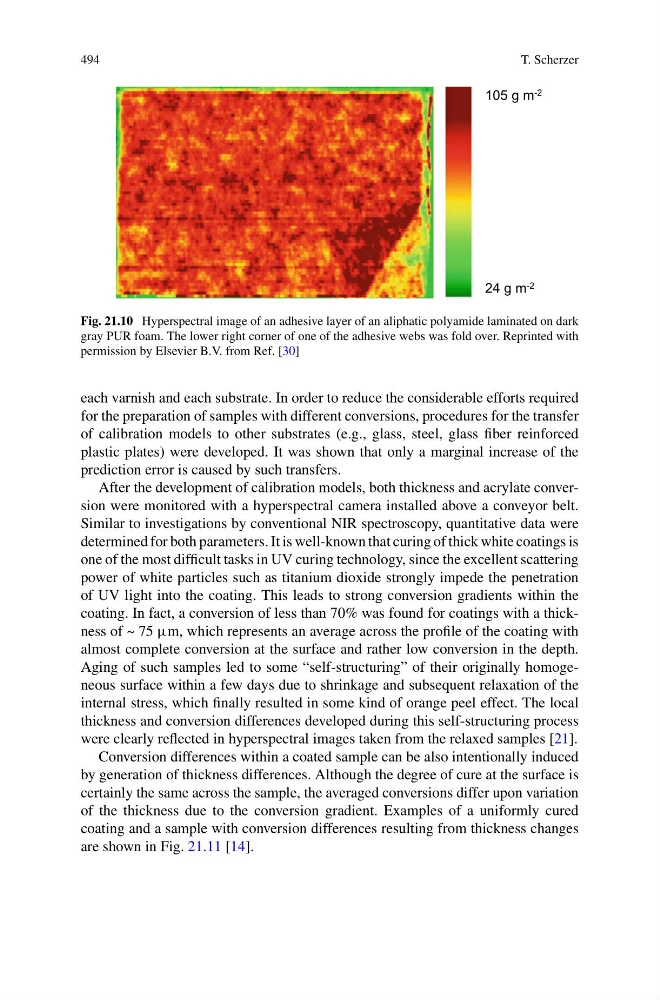
105 g m -2
24 g m -2
Fig. 21.10 Hyperspectral image of an adhesive layer of an aliphatic polyamide laminated on dark
gray PUR foam. The lower right corner of one of the adhesive webs was fold over. Reprinted with
permission by Elsevier B.V. from Ref. [30]
each varnish and each substrate. In order to reduce the considerable efforts required
for the preparation of samples with different conversions, procedures for the transfer
of calibration models to other substrates (e.g., glass, steel, glass fiber reinforced
plastic plates) were developed. It was shown that only a marginal increase of the
prediction error is caused by such transfers.
After the development of calibration models, both thickness and acrylate conversion were monitored with a hyperspectral camera installed above a conveyor belt.
Similar to investigations by conventional NIR spectroscopy, quantitative data were
determined for both parameters. It is well-known that curing of thick white coatings is
one of the most difficult tasks in UV curing technology, since the excellent scattering
power of white particles such as titanium dioxide strongly impede the penetration
of UV light into the coating. This leads to strong conversion gradients within the
coating. In fact, a conversion of less than 70% was found for coatings with a thickness of ~ 75 μm, which represents an average across the profile of the coating with
almost complete conversion at the surface and rather low conversion in the depth.
Aging of such samples led to some “self-structuring” of their originally homogeneous surface within a few days due to shrinkage and subsequent relaxation of the
internal stress, which finally resulted in some kind of orange peel effect. The local
thickness and conversion differences developed during this self-structuring process
were clearly reflected in hyperspectral images taken from the relaxed samples [21].
Conversion differences within a coated sample can be also intentionally induced
by generation of thickness differences. Although the degree of cure at the surface is
certainly the same across the sample, the averaged conversions differ upon variation
of the thickness due to the conversion gradient. Examples of a uniformly cured
coating and a sample with conversion differences resulting from thickness changes
are shown in Fig. 21.11 [14].
T. Scherzer
105 g m -2
24 g m -2
Fig. 21.10 Hyperspectral image of an adhesive layer of an aliphatic polyamide laminated on dark
gray PUR foam. The lower right corner of one of the adhesive webs was fold over. Reprinted with
permission by Elsevier B.V. from Ref. [30]
each varnish and each substrate. In order to reduce the considerable efforts required
for the preparation of samples with different conversions, procedures for the transfer
of calibration models to other substrates (e.g., glass, steel, glass fiber reinforced
plastic plates) were developed. It was shown that only a marginal increase of the
prediction error is caused by such transfers.
After the development of calibration models, both thickness and acrylate conversion were monitored with a hyperspectral camera installed above a conveyor belt.
Similar to investigations by conventional NIR spectroscopy, quantitative data were
determined for both parameters. It is well-known that curing of thick white coatings is
one of the most difficult tasks in UV curing technology, since the excellent scattering
power of white particles such as titanium dioxide strongly impede the penetration
of UV light into the coating. This leads to strong conversion gradients within the
coating. In fact, a conversion of less than 70% was found for coatings with a thickness of ~ 75 μm, which represents an average across the profile of the coating with
almost complete conversion at the surface and rather low conversion in the depth.
Aging of such samples led to some “self-structuring” of their originally homogeneous surface within a few days due to shrinkage and subsequent relaxation of the
internal stress, which finally resulted in some kind of orange peel effect. The local
thickness and conversion differences developed during this self-structuring process
were clearly reflected in hyperspectral images taken from the relaxed samples [21].
Conversion differences within a coated sample can be also intentionally induced
by generation of thickness differences. Although the degree of cure at the surface is
certainly the same across the sample, the averaged conversions differ upon variation
of the thickness due to the conversion gradient. Examples of a uniformly cured
coating and a sample with conversion differences resulting from thickness changes
are shown in Fig. 21.11 [14].