

42
K. D. Dahm and D. J. Dahm
• The experimental arrangement in Fig. 3.2 does not distinguish between the light
that truly was “transmitted” through the entire sample, and light that experienced one or more scattering interactions but still penetrated the entire thickness
of the sample. The “transmission” that is measured is in reality the latter, or a
combination of both.
The remainder of this chapter is broadly divided into two categories. Sections 3.3
through 3.5 discuss light and its microscopic interactions, such as light interacting
with a single particle or a single surface. Sections 3.6 through 3.10 discuss strategies
for modeling the net amounts of light absorbed by, transmitted through, and remitted
from a macroscopic sample.
3.3 The Physics of Light
Light can be understood as electromagnetic radiation propagating through space as a
wave. A changing electric field gives rise to a changing magnetic field, and vice versa,
and the speed of light is the velocity of the resulting waves. The waves have electrical
and magnetic vectors that oscillate, and the maximum extent of the oscillation is
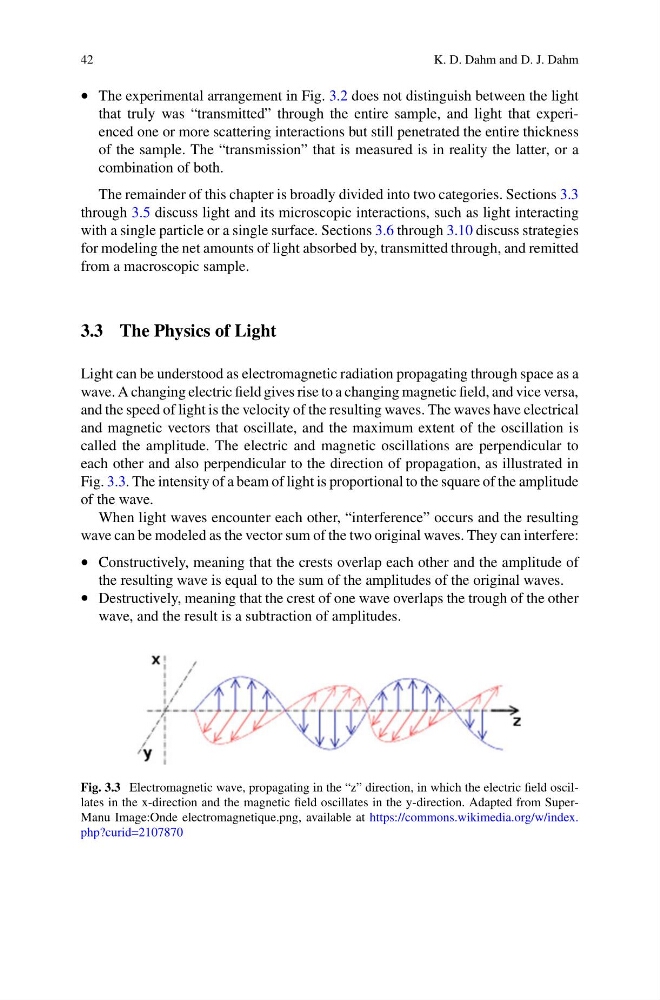
called the amplitude. The electric and magnetic oscillations are perpendicular to
each other and also perpendicular to the direction of propagation, as illustrated in
Fig. 3.3. The intensity of a beam of light is proportional to the square of the amplitude
of the wave.
When light waves encounter each other, “interference” occurs and the resulting
wave can be modeled as the vector sum of the two original waves. They can interfere:
• Constructively, meaning that the crests overlap each other and the amplitude of
the resulting wave is equal to the sum of the amplitudes of the original waves.
• Destructively, meaning that the crest of one wave overlaps the trough of the other
wave, and the result is a subtraction of amplitudes.
Fig. 3.3 Electromagnetic wave, propagating in the “z” direction, in which the electric field oscillates in the x-direction and the magnetic field oscillates in the y-direction. Adapted from SuperManu Image:Onde electromagnetique.png, available at https://commons.wikimedia.org/w/index.
php?curid=2107870
K. D. Dahm and D. J. Dahm
• The experimental arrangement in Fig. 3.2 does not distinguish between the light
that truly was “transmitted” through the entire sample, and light that experienced one or more scattering interactions but still penetrated the entire thickness
of the sample. The “transmission” that is measured is in reality the latter, or a
combination of both.
The remainder of this chapter is broadly divided into two categories. Sections 3.3
through 3.5 discuss light and its microscopic interactions, such as light interacting
with a single particle or a single surface. Sections 3.6 through 3.10 discuss strategies
for modeling the net amounts of light absorbed by, transmitted through, and remitted
from a macroscopic sample.
3.3 The Physics of Light
Light can be understood as electromagnetic radiation propagating through space as a
wave. A changing electric field gives rise to a changing magnetic field, and vice versa,
and the speed of light is the velocity of the resulting waves. The waves have electrical
and magnetic vectors that oscillate, and the maximum extent of the oscillation is
called the amplitude. The electric and magnetic oscillations are perpendicular to
each other and also perpendicular to the direction of propagation, as illustrated in
Fig. 3.3. The intensity of a beam of light is proportional to the square of the amplitude
of the wave.
When light waves encounter each other, “interference” occurs and the resulting
wave can be modeled as the vector sum of the two original waves. They can interfere:
• Constructively, meaning that the crests overlap each other and the amplitude of
the resulting wave is equal to the sum of the amplitudes of the original waves.
• Destructively, meaning that the crest of one wave overlaps the trough of the other
wave, and the result is a subtraction of amplitudes.
Fig. 3.3 Electromagnetic wave, propagating in the “z” direction, in which the electric field oscillates in the x-direction and the magnetic field oscillates in the y-direction. Adapted from SuperManu Image:Onde electromagnetique.png, available at https://commons.wikimedia.org/w/index.
php?curid=2107870