

3 Theoretical Models of Light Scattering and Absorption
41
3.2 The Application of Spectroscopy
Section 3.1 introduced Beer’s Law, which is likely to be the first model a person
learning about spectroscopy will encounter. It is a simple equation that dates from
the nineteenth century and still has practical value. Section 3.1 also introduced some
of the reasons why models that are more complex are needed. In spectroscopy, our
specific interest is in directing light at a sample, making measurements of the light
that penetrates the sample and/or the light that is reflected from the sample, and
then using those measurements to make deductions about the composition of the
sample. Challenges stem from the fact that the sample is macroscopic in scale. A
measurement of light that reaches a detector, such as I in Eqs. 3.1–3.3, is a single
number that actually represents the net effect of countless molecular-level absorption
and scattering interactions. In the context of a macroscopic sample, the phenomena
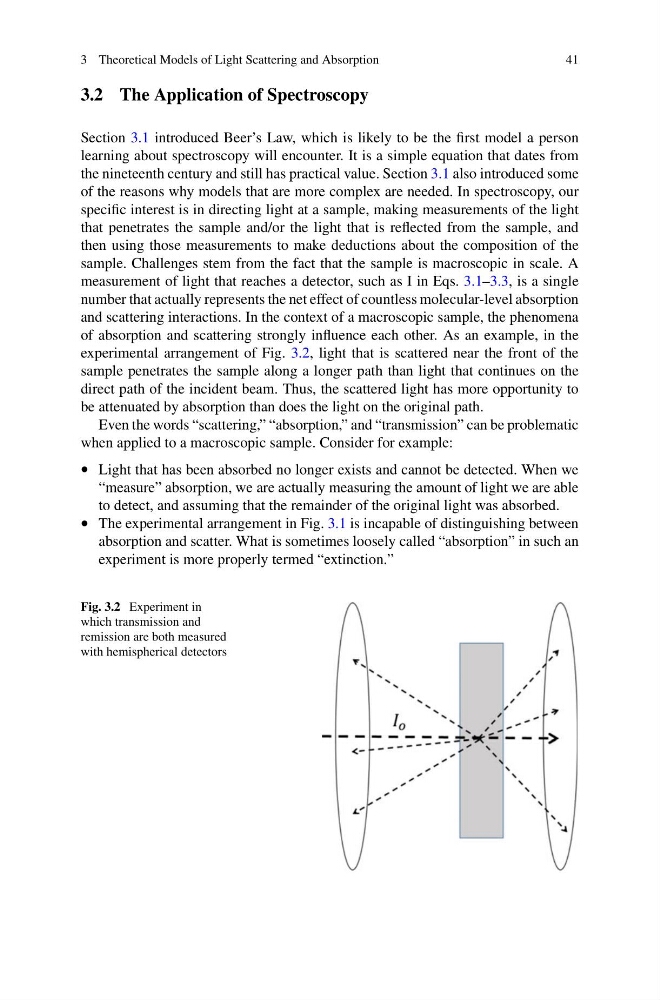
of absorption and scattering strongly influence each other. As an example, in the
experimental arrangement of Fig. 3.2, light that is scattered near the front of the
sample penetrates the sample along a longer path than light that continues on the
direct path of the incident beam. Thus, the scattered light has more opportunity to
be attenuated by absorption than does the light on the original path.
Even the words “scattering,” “absorption,” and “transmission” can be problematic
when applied to a macroscopic sample. Consider for example:
• Light that has been absorbed no longer exists and cannot be detected. When we
“measure” absorption, we are actually measuring the amount of light we are able
to detect, and assuming that the remainder of the original light was absorbed.
• The experimental arrangement in Fig. 3.1 is incapable of distinguishing between
absorption and scatter. What is sometimes loosely called “absorption” in such an
experiment is more properly termed “extinction.”
Fig. 3.2 Experiment in
which transmission and
remission are both measured
with hemispherical detectors
41
3.2 The Application of Spectroscopy
Section 3.1 introduced Beer’s Law, which is likely to be the first model a person
learning about spectroscopy will encounter. It is a simple equation that dates from
the nineteenth century and still has practical value. Section 3.1 also introduced some
of the reasons why models that are more complex are needed. In spectroscopy, our
specific interest is in directing light at a sample, making measurements of the light
that penetrates the sample and/or the light that is reflected from the sample, and
then using those measurements to make deductions about the composition of the
sample. Challenges stem from the fact that the sample is macroscopic in scale. A
measurement of light that reaches a detector, such as I in Eqs. 3.1–3.3, is a single
number that actually represents the net effect of countless molecular-level absorption
and scattering interactions. In the context of a macroscopic sample, the phenomena
of absorption and scattering strongly influence each other. As an example, in the
experimental arrangement of Fig. 3.2, light that is scattered near the front of the
sample penetrates the sample along a longer path than light that continues on the
direct path of the incident beam. Thus, the scattered light has more opportunity to
be attenuated by absorption than does the light on the original path.
Even the words “scattering,” “absorption,” and “transmission” can be problematic
when applied to a macroscopic sample. Consider for example:
• Light that has been absorbed no longer exists and cannot be detected. When we
“measure” absorption, we are actually measuring the amount of light we are able
to detect, and assuming that the remainder of the original light was absorbed.
• The experimental arrangement in Fig. 3.1 is incapable of distinguishing between
absorption and scatter. What is sometimes loosely called “absorption” in such an
experiment is more properly termed “extinction.”
Fig. 3.2 Experiment in
which transmission and
remission are both measured
with hemispherical detectors