

20 Medical Applications of NIR Spectroscopy
441
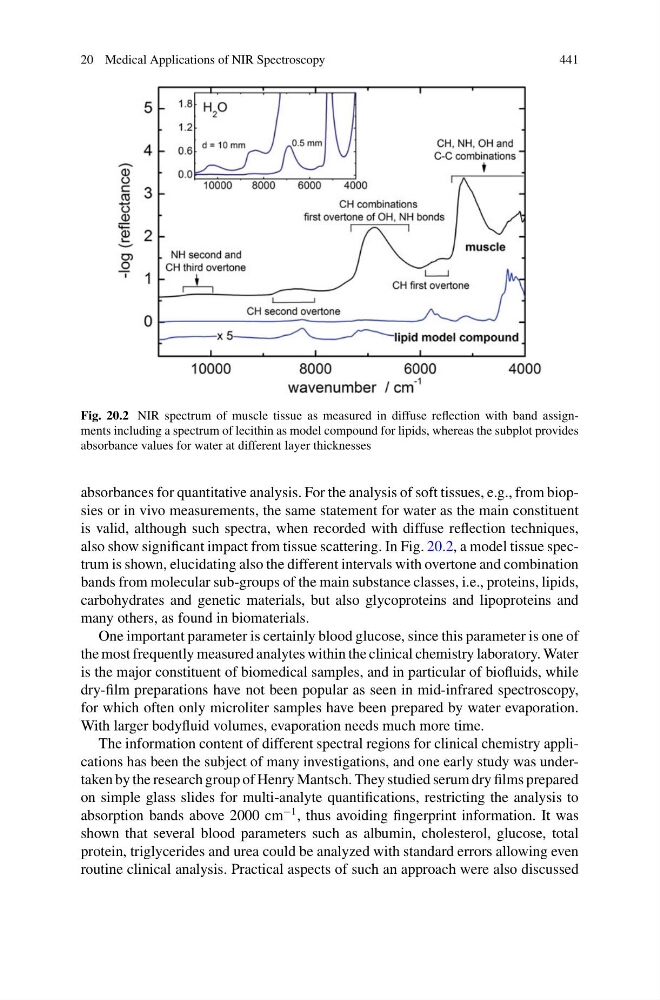
Fig. 20.2 NIR spectrum of muscle tissue as measured in diffuse reflection with band assignments including a spectrum of lecithin as model compound for lipids, whereas the subplot provides
absorbance values for water at different layer thicknesses
absorbances for quantitative analysis. For the analysis of soft tissues, e.g., from biopsies or in vivo measurements, the same statement for water as the main constituent
is valid, although such spectra, when recorded with diffuse reflection techniques,
also show significant impact from tissue scattering. In Fig. 20.2, a model tissue spectrum is shown, elucidating also the different intervals with overtone and combination
bands from molecular sub-groups of the main substance classes, i.e., proteins, lipids,
carbohydrates and genetic materials, but also glycoproteins and lipoproteins and
many others, as found in biomaterials.
One important parameter is certainly blood glucose, since this parameter is one of
the most frequently measured analytes within the clinical chemistry laboratory. Water
is the major constituent of biomedical samples, and in particular of biofluids, while
dry-film preparations have not been popular as seen in mid-infrared spectroscopy,
for which often only microliter samples have been prepared by water evaporation.
With larger bodyfluid volumes, evaporation needs much more time.
The information content of different spectral regions for clinical chemistry applications has been the subject of many investigations, and one early study was undertaken by the research group of Henry Mantsch. They studied serum dry films prepared
on simple glass slides for multi-analyte quantifications, restricting the analysis to
absorption bands above 2000 cm
−1 , thus avoiding fingerprint information. It was
shown that several blood parameters such as albumin, cholesterol, glucose, total
protein, triglycerides and urea could be analyzed with standard errors allowing even
routine clinical analysis. Practical aspects of such an approach were also discussed
441
Fig. 20.2 NIR spectrum of muscle tissue as measured in diffuse reflection with band assignments including a spectrum of lecithin as model compound for lipids, whereas the subplot provides
absorbance values for water at different layer thicknesses
absorbances for quantitative analysis. For the analysis of soft tissues, e.g., from biopsies or in vivo measurements, the same statement for water as the main constituent
is valid, although such spectra, when recorded with diffuse reflection techniques,
also show significant impact from tissue scattering. In Fig. 20.2, a model tissue spectrum is shown, elucidating also the different intervals with overtone and combination
bands from molecular sub-groups of the main substance classes, i.e., proteins, lipids,
carbohydrates and genetic materials, but also glycoproteins and lipoproteins and
many others, as found in biomaterials.
One important parameter is certainly blood glucose, since this parameter is one of
the most frequently measured analytes within the clinical chemistry laboratory. Water
is the major constituent of biomedical samples, and in particular of biofluids, while
dry-film preparations have not been popular as seen in mid-infrared spectroscopy,
for which often only microliter samples have been prepared by water evaporation.
With larger bodyfluid volumes, evaporation needs much more time.
The information content of different spectral regions for clinical chemistry applications has been the subject of many investigations, and one early study was undertaken by the research group of Henry Mantsch. They studied serum dry films prepared
on simple glass slides for multi-analyte quantifications, restricting the analysis to
absorption bands above 2000 cm
−1 , thus avoiding fingerprint information. It was
shown that several blood parameters such as albumin, cholesterol, glucose, total
protein, triglycerides and urea could be analyzed with standard errors allowing even
routine clinical analysis. Practical aspects of such an approach were also discussed