

440
H. M. Heise
fundamental and combination bands from molecular entities, which are not visible
in the near-infrared spectral range. Despite this, the quantification of individual
compounds is still possible and the first step in information gathering for medical
diagnosis.
Another goal for disease diagnostics was not only based on blood analyte concentrations but exploiting the information from whole spectrum analysis aiming at “disease pattern recognition.” A straightforward classification of a bodyfluid sample with
linking to a disease state was then made possible by using multivariate chemometrics.
However, thus applications have mostly been observed for mid-infrared and Raman
spectroscopy.
20.2.1 Analysis of Blood and Other Bodyfluids
The most analyzed body fluid is certainly whole blood of which several fluids can
be derived from such as plasma and serum. This is easily accessible by punctuation or the use of syringes. An important problem with the analysis of biofluids is
certainly associated with the strong absorptions of water and its temperature and
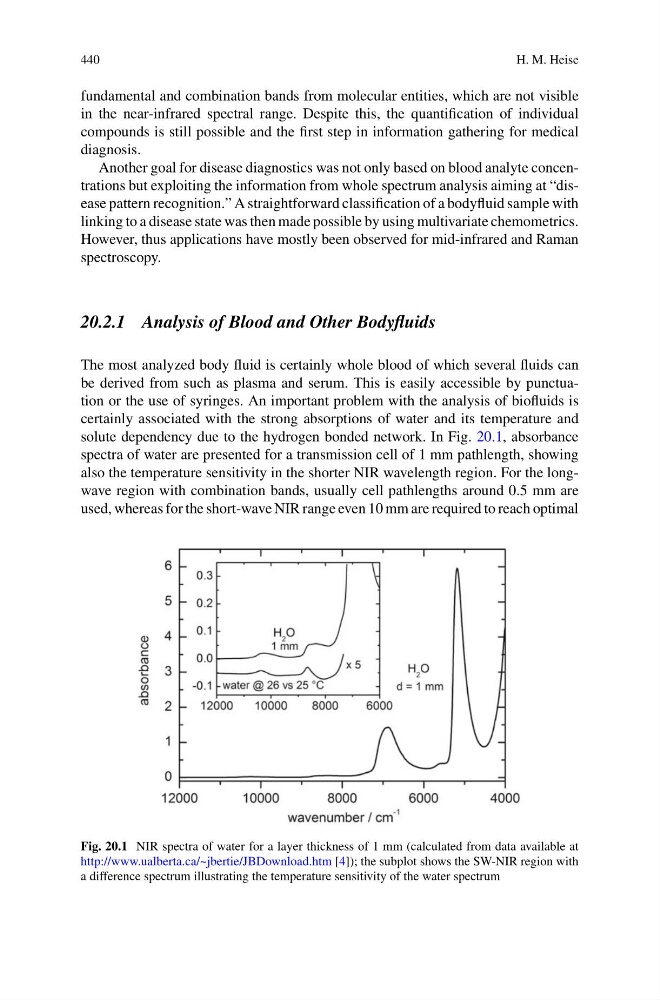
solute dependency due to the hydrogen bonded network. In Fig. 20.1, absorbance
spectra of water are presented for a transmission cell of 1 mm pathlength, showing
also the temperature sensitivity in the shorter NIR wavelength region. For the longwave region with combination bands, usually cell pathlengths around 0.5 mm are
used, whereas for the short-wave NIR range even 10 mm are required to reach optimal
Fig. 20.1 NIR spectra of water for a layer thickness of 1 mm (calculated from data available at
http://www.ualberta.ca/~jbertie/JBDownload.htm [4]); the subplot shows the SW-NIR region with
a difference spectrum illustrating the temperature sensitivity of the water spectrum
H. M. Heise
fundamental and combination bands from molecular entities, which are not visible
in the near-infrared spectral range. Despite this, the quantification of individual
compounds is still possible and the first step in information gathering for medical
diagnosis.
Another goal for disease diagnostics was not only based on blood analyte concentrations but exploiting the information from whole spectrum analysis aiming at “disease pattern recognition.” A straightforward classification of a bodyfluid sample with
linking to a disease state was then made possible by using multivariate chemometrics.
However, thus applications have mostly been observed for mid-infrared and Raman
spectroscopy.
20.2.1 Analysis of Blood and Other Bodyfluids
The most analyzed body fluid is certainly whole blood of which several fluids can
be derived from such as plasma and serum. This is easily accessible by punctuation or the use of syringes. An important problem with the analysis of biofluids is
certainly associated with the strong absorptions of water and its temperature and
solute dependency due to the hydrogen bonded network. In Fig. 20.1, absorbance
spectra of water are presented for a transmission cell of 1 mm pathlength, showing
also the temperature sensitivity in the shorter NIR wavelength region. For the longwave region with combination bands, usually cell pathlengths around 0.5 mm are
used, whereas for the short-wave NIR range even 10 mm are required to reach optimal
Fig. 20.1 NIR spectra of water for a layer thickness of 1 mm (calculated from data available at
http://www.ualberta.ca/~jbertie/JBDownload.htm [4]); the subplot shows the SW-NIR region with
a difference spectrum illustrating the temperature sensitivity of the water spectrum