

400
B. Igne and E. W. Ciurczak
1
2
3
4
5
6
7
8
Time (day)
% w/w
10
12
14
16
18
20
22
24
26
28
30
NIR Control
Standard Temperature Control
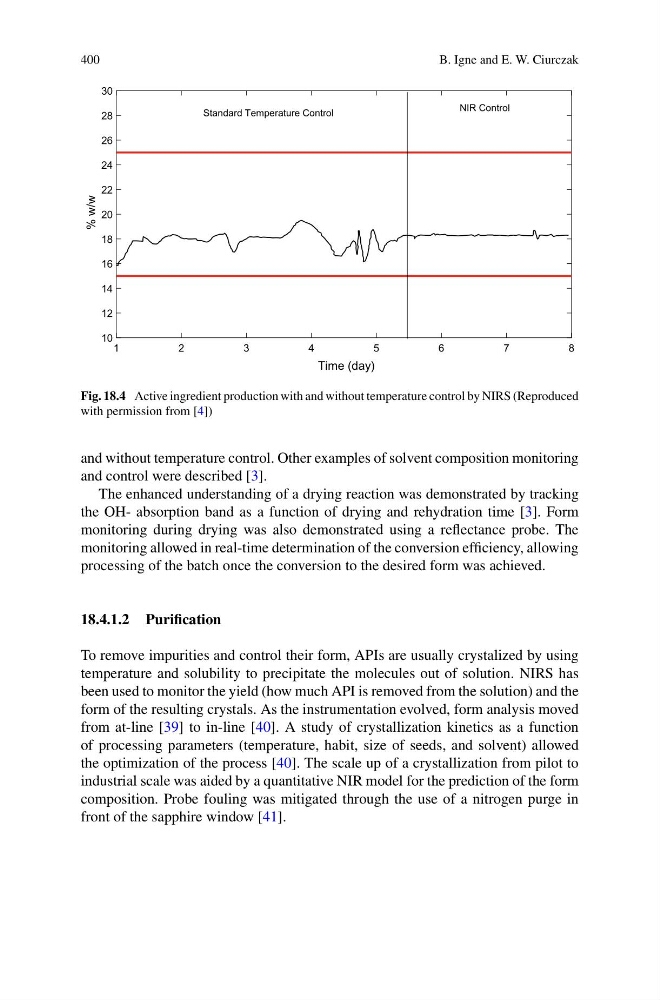
Fig. 18.4 Active ingredient production with and without temperature control by NIRS (Reproduced
with permission from [4])
and without temperature control. Other examples of solvent composition monitoring
and control were described [3].
The enhanced understanding of a drying reaction was demonstrated by tracking
the OH- absorption band as a function of drying and rehydration time [3]. Form
monitoring during drying was also demonstrated using a reflectance probe. The
monitoring allowed in real-time determination of the conversion efficiency, allowing
processing of the batch once the conversion to the desired form was achieved.
18.4.1.2 Purification
To remove impurities and control their form, APIs are usually crystalized by using
temperature and solubility to precipitate the molecules out of solution. NIRS has
been used to monitor the yield (how much API is removed from the solution) and the
form of the resulting crystals. As the instrumentation evolved, form analysis moved
from at-line [39] to in-line [40]. A study of crystallization kinetics as a function
of processing parameters (temperature, habit, size of seeds, and solvent) allowed
the optimization of the process [40]. The scale up of a crystallization from pilot to
industrial scale was aided by a quantitative NIR model for the prediction of the form
composition. Probe fouling was mitigated through the use of a nitrogen purge in
front of the sapphire window [41].
B. Igne and E. W. Ciurczak
1
2
3
4
5
6
7
8
Time (day)
% w/w
10
12
14
16
18
20
22
24
26
28
30
NIR Control
Standard Temperature Control
Fig. 18.4 Active ingredient production with and without temperature control by NIRS (Reproduced
with permission from [4])
and without temperature control. Other examples of solvent composition monitoring
and control were described [3].
The enhanced understanding of a drying reaction was demonstrated by tracking
the OH- absorption band as a function of drying and rehydration time [3]. Form
monitoring during drying was also demonstrated using a reflectance probe. The
monitoring allowed in real-time determination of the conversion efficiency, allowing
processing of the batch once the conversion to the desired form was achieved.
18.4.1.2 Purification
To remove impurities and control their form, APIs are usually crystalized by using
temperature and solubility to precipitate the molecules out of solution. NIRS has
been used to monitor the yield (how much API is removed from the solution) and the
form of the resulting crystals. As the instrumentation evolved, form analysis moved
from at-line [39] to in-line [40]. A study of crystallization kinetics as a function
of processing parameters (temperature, habit, size of seeds, and solvent) allowed
the optimization of the process [40]. The scale up of a crystallization from pilot to
industrial scale was aided by a quantitative NIR model for the prediction of the form
composition. Probe fouling was mitigated through the use of a nitrogen purge in
front of the sapphire window [41].