

17 Information and Communication Technology in Agriculture
387
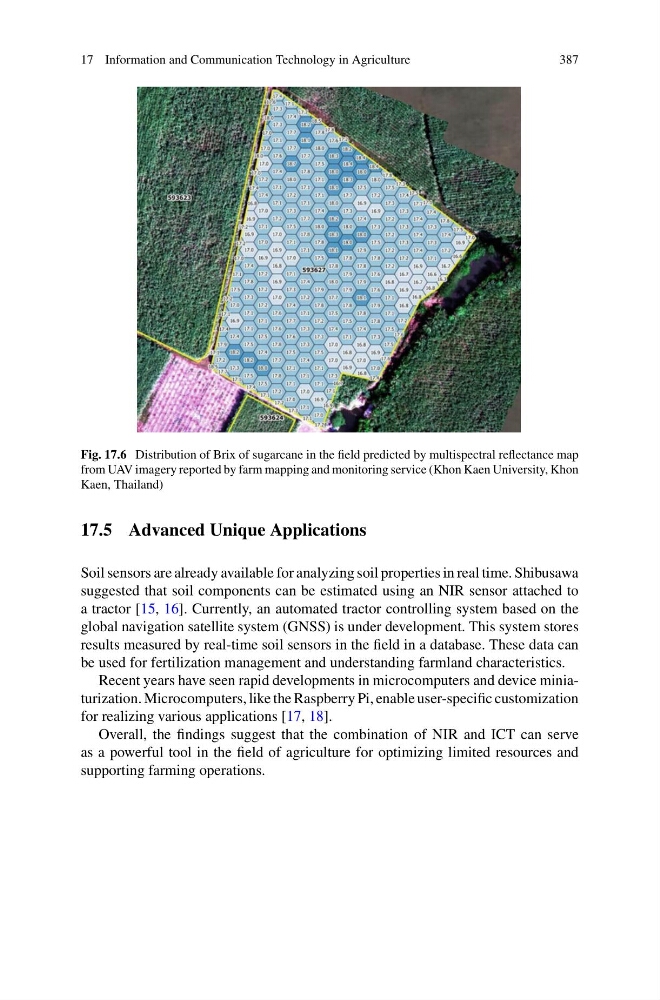
Fig. 17.6 Distribution of Brix of sugarcane in the field predicted by multispectral reflectance map
from UAV imagery reported by farm mapping and monitoring service (Khon Kaen University, Khon
Kaen, Thailand)
17.5 Advanced Unique Applications
Soil sensors are already available for analyzing soil properties in real time. Shibusawa
suggested that soil components can be estimated using an NIR sensor attached to
a tractor [15, 16]. Currently, an automated tractor controlling system based on the
global navigation satellite system (GNSS) is under development. This system stores
results measured by real-time soil sensors in the field in a database. These data can
be used for fertilization management and understanding farmland characteristics.
Recent years have seen rapid developments in microcomputers and device miniaturization. Microcomputers, like the Raspberry Pi, enable user-specific customization
for realizing various applications [17, 18].
Overall, the findings suggest that the combination of NIR and ICT can serve
as a powerful tool in the field of agriculture for optimizing limited resources and
supporting farming operations.
387
Fig. 17.6 Distribution of Brix of sugarcane in the field predicted by multispectral reflectance map
from UAV imagery reported by farm mapping and monitoring service (Khon Kaen University, Khon
Kaen, Thailand)
17.5 Advanced Unique Applications
Soil sensors are already available for analyzing soil properties in real time. Shibusawa
suggested that soil components can be estimated using an NIR sensor attached to
a tractor [15, 16]. Currently, an automated tractor controlling system based on the
global navigation satellite system (GNSS) is under development. This system stores
results measured by real-time soil sensors in the field in a database. These data can
be used for fertilization management and understanding farmland characteristics.
Recent years have seen rapid developments in microcomputers and device miniaturization. Microcomputers, like the Raspberry Pi, enable user-specific customization
for realizing various applications [17, 18].
Overall, the findings suggest that the combination of NIR and ICT can serve
as a powerful tool in the field of agriculture for optimizing limited resources and
supporting farming operations.