

28
Y. Ozaki and Y. Morisawa
frequencies hold truth when certain normal vibrations are determined substantially by
movements of two or more atoms (atomic group). Group frequencies play prominent
roles in analysis of IR and Raman spectra. And even for NIR spectroscopy the idea
of group frequency is useful 1–7 For example, NIR spectra show bands due to the
overtones and combinations of CH 2 and CH 3 groups.
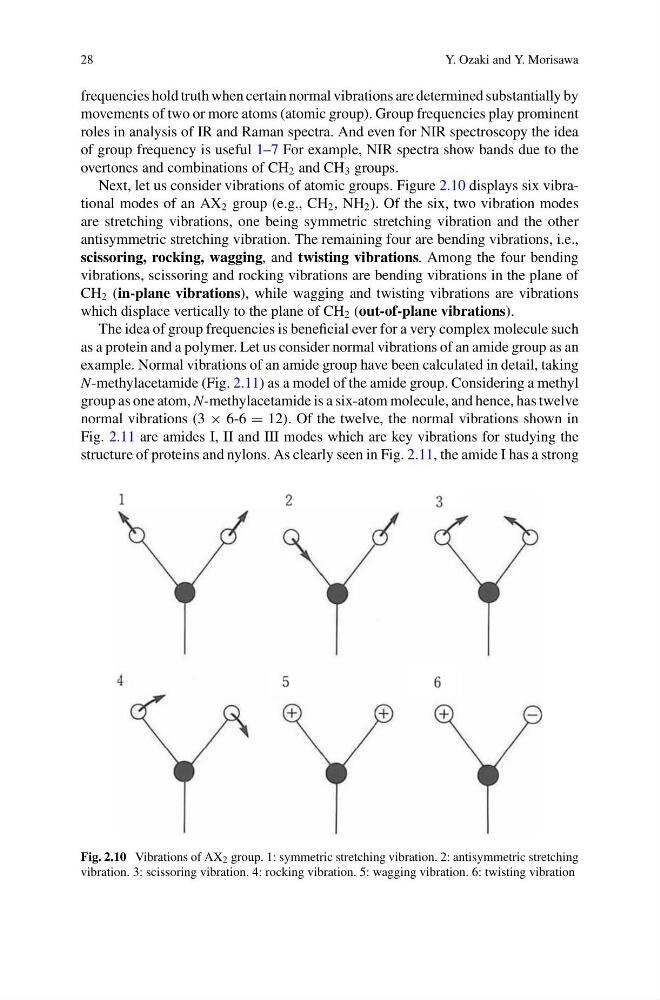
Next, let us consider vibrations of atomic groups. Figure 2.10 displays six vibrational modes of an AX 2 group (e.g., CH 2 , NH 2 ). Of the six, two vibration modes
are stretching vibrations, one being symmetric stretching vibration and the other
antisymmetric stretching vibration. The remaining four are bending vibrations, i.e.,
scissoring, rocking, wagging, and twisting vibrations. Among the four bending
vibrations, scissoring and rocking vibrations are bending vibrations in the plane of
CH 2 (in-plane vibrations), while wagging and twisting vibrations are vibrations
which displace vertically to the plane of CH 2 (out-of-plane vibrations).
The idea of group frequencies is beneficial ever for a very complex molecule such
as a protein and a polymer. Let us consider normal vibrations of an amide group as an
example. Normal vibrations of an amide group have been calculated in detail, taking
N-methylacetamide (Fig. 2.11) as a model of the amide group. Considering a methyl
group as one atom, N-methylacetamide is a six-atom molecule, and hence, has twelve
normal vibrations (3 × 6-6 = 12). Of the twelve, the normal vibrations shown in
Fig. 2.11 are amides I, II and III modes which are key vibrations for studying the
structure of proteins and nylons. As clearly seen in Fig. 2.11, the amide I has a strong
Fig. 2.10 Vibrations of AX 2 group. 1: symmetric stretching vibration. 2: antisymmetric stretching
vibration. 3: scissoring vibration. 4: rocking vibration. 5: wagging vibration. 6: twisting vibration
Y. Ozaki and Y. Morisawa
frequencies hold truth when certain normal vibrations are determined substantially by
movements of two or more atoms (atomic group). Group frequencies play prominent
roles in analysis of IR and Raman spectra. And even for NIR spectroscopy the idea
of group frequency is useful 1–7 For example, NIR spectra show bands due to the
overtones and combinations of CH 2 and CH 3 groups.
Next, let us consider vibrations of atomic groups. Figure 2.10 displays six vibrational modes of an AX 2 group (e.g., CH 2 , NH 2 ). Of the six, two vibration modes
are stretching vibrations, one being symmetric stretching vibration and the other
antisymmetric stretching vibration. The remaining four are bending vibrations, i.e.,
scissoring, rocking, wagging, and twisting vibrations. Among the four bending
vibrations, scissoring and rocking vibrations are bending vibrations in the plane of
CH 2 (in-plane vibrations), while wagging and twisting vibrations are vibrations
which displace vertically to the plane of CH 2 (out-of-plane vibrations).
The idea of group frequencies is beneficial ever for a very complex molecule such
as a protein and a polymer. Let us consider normal vibrations of an amide group as an
example. Normal vibrations of an amide group have been calculated in detail, taking
N-methylacetamide (Fig. 2.11) as a model of the amide group. Considering a methyl
group as one atom, N-methylacetamide is a six-atom molecule, and hence, has twelve
normal vibrations (3 × 6-6 = 12). Of the twelve, the normal vibrations shown in
Fig. 2.11 are amides I, II and III modes which are key vibrations for studying the
structure of proteins and nylons. As clearly seen in Fig. 2.11, the amide I has a strong
Fig. 2.10 Vibrations of AX 2 group. 1: symmetric stretching vibration. 2: antisymmetric stretching
vibration. 3: scissoring vibration. 4: rocking vibration. 5: wagging vibration. 6: twisting vibration