

2 Principles and Characteristics of NIR Spectroscopy
27
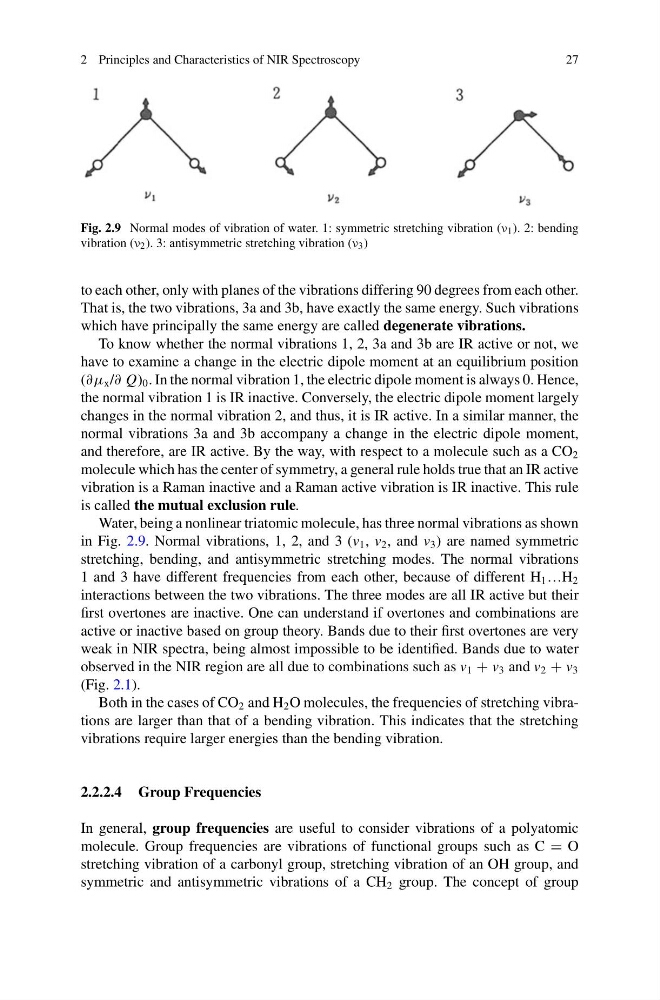
Fig. 2.9 Normal modes of vibration of water. 1: symmetric stretching vibration (ν 1 ). 2: bending
vibration (ν 2 ). 3: antisymmetric stretching vibration (ν 3 )
to each other, only with planes of the vibrations differing 90 degrees from each other.
That is, the two vibrations, 3a and 3b, have exactly the same energy. Such vibrations
which have principally the same energy are called degenerate vibrations.
To know whether the normal vibrations 1, 2, 3a and 3b are IR active or not, we
have to examine a change in the electric dipole moment at an equilibrium position
(∂μ x /∂ Q) 0 . In the normal vibration 1, the electric dipole moment is always 0. Hence,
the normal vibration 1 is IR inactive. Conversely, the electric dipole moment largely
changes in the normal vibration 2, and thus, it is IR active. In a similar manner, the
normal vibrations 3a and 3b accompany a change in the electric dipole moment,
and therefore, are IR active. By the way, with respect to a molecule such as a CO 2
molecule which has the center of symmetry, a general rule holds true that an IR active
vibration is a Raman inactive and a Raman active vibration is IR inactive. This rule
is called the mutual exclusion rule.
Water, being a nonlinear triatomic molecule, has three normal vibrations as shown
in Fig. 2.9. Normal vibrations, 1, 2, and 3 (v 1 , v 2 , and v 3 ) are named symmetric
stretching, bending, and antisymmetric stretching modes. The normal vibrations
1 and 3 have different frequencies from each other, because of different H 1 …H 2
interactions between the two vibrations. The three modes are all IR active but their
first overtones are inactive. One can understand if overtones and combinations are
active or inactive based on group theory. Bands due to their first overtones are very
weak in NIR spectra, being almost impossible to be identified. Bands due to water
observed in the NIR region are all due to combinations such as v 1 + v 3 and v 2 + v 3
(Fig. 2.1).
Both in the cases of CO 2 and H 2 O molecules, the frequencies of stretching vibrations are larger than that of a bending vibration. This indicates that the stretching
vibrations require larger energies than the bending vibration.
2.2.2.4 Group Frequencies
In general, group frequencies are useful to consider vibrations of a polyatomic
molecule. Group frequencies are vibrations of functional groups such as C = O
stretching vibration of a carbonyl group, stretching vibration of an OH group, and
symmetric and antisymmetric vibrations of a CH 2 group. The concept of group
27
Fig. 2.9 Normal modes of vibration of water. 1: symmetric stretching vibration (ν 1 ). 2: bending
vibration (ν 2 ). 3: antisymmetric stretching vibration (ν 3 )
to each other, only with planes of the vibrations differing 90 degrees from each other.
That is, the two vibrations, 3a and 3b, have exactly the same energy. Such vibrations
which have principally the same energy are called degenerate vibrations.
To know whether the normal vibrations 1, 2, 3a and 3b are IR active or not, we
have to examine a change in the electric dipole moment at an equilibrium position
(∂μ x /∂ Q) 0 . In the normal vibration 1, the electric dipole moment is always 0. Hence,
the normal vibration 1 is IR inactive. Conversely, the electric dipole moment largely
changes in the normal vibration 2, and thus, it is IR active. In a similar manner, the
normal vibrations 3a and 3b accompany a change in the electric dipole moment,
and therefore, are IR active. By the way, with respect to a molecule such as a CO 2
molecule which has the center of symmetry, a general rule holds true that an IR active
vibration is a Raman inactive and a Raman active vibration is IR inactive. This rule
is called the mutual exclusion rule.
Water, being a nonlinear triatomic molecule, has three normal vibrations as shown
in Fig. 2.9. Normal vibrations, 1, 2, and 3 (v 1 , v 2 , and v 3 ) are named symmetric
stretching, bending, and antisymmetric stretching modes. The normal vibrations
1 and 3 have different frequencies from each other, because of different H 1 …H 2
interactions between the two vibrations. The three modes are all IR active but their
first overtones are inactive. One can understand if overtones and combinations are
active or inactive based on group theory. Bands due to their first overtones are very
weak in NIR spectra, being almost impossible to be identified. Bands due to water
observed in the NIR region are all due to combinations such as v 1 + v 3 and v 2 + v 3
(Fig. 2.1).
Both in the cases of CO 2 and H 2 O molecules, the frequencies of stretching vibrations are larger than that of a bending vibration. This indicates that the stretching
vibrations require larger energies than the bending vibration.
2.2.2.4 Group Frequencies
In general, group frequencies are useful to consider vibrations of a polyatomic
molecule. Group frequencies are vibrations of functional groups such as C = O
stretching vibration of a carbonyl group, stretching vibration of an OH group, and
symmetric and antisymmetric vibrations of a CH 2 group. The concept of group