

13 Overview of Application of NIR Spectroscopy to Physical …
301
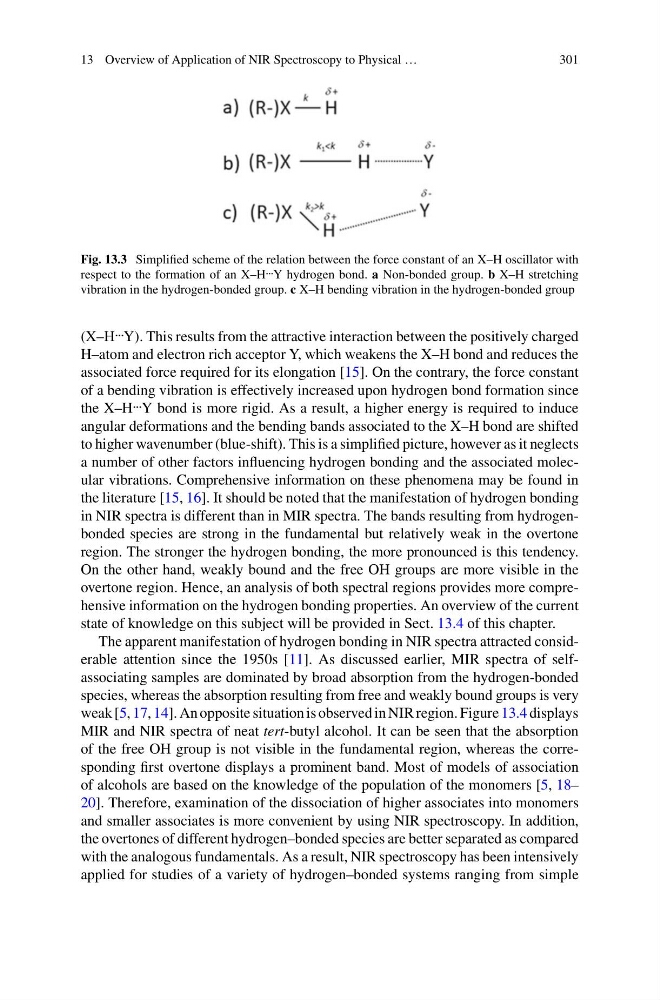
Fig. 13.3 Simplified scheme of the relation between the force constant of an X–H oscillator with
respect to the formation of an X–H:::Y hydrogen bond. a Non-bonded group. b X–H stretching
vibration in the hydrogen-bonded group. c X–H bending vibration in the hydrogen-bonded group
(X–H:::Y). This results from the attractive interaction between the positively charged
H–atom and electron rich acceptor Y, which weakens the X–H bond and reduces the
associated force required for its elongation [15]. On the contrary, the force constant
of a bending vibration is effectively increased upon hydrogen bond formation since
the X–H:::Y bond is more rigid. As a result, a higher energy is required to induce
angular deformations and the bending bands associated to the X–H bond are shifted
to higher wavenumber (blue-shift). This is a simplified picture, however as it neglects
a number of other factors influencing hydrogen bonding and the associated molecular vibrations. Comprehensive information on these phenomena may be found in
the literature [15, 16]. It should be noted that the manifestation of hydrogen bonding
in NIR spectra is different than in MIR spectra. The bands resulting from hydrogenbonded species are strong in the fundamental but relatively weak in the overtone
region. The stronger the hydrogen bonding, the more pronounced is this tendency.
On the other hand, weakly bound and the free OH groups are more visible in the
overtone region. Hence, an analysis of both spectral regions provides more comprehensive information on the hydrogen bonding properties. An overview of the current
state of knowledge on this subject will be provided in Sect. 13.4 of this chapter.
The apparent manifestation of hydrogen bonding in NIR spectra attracted considerable attention since the 1950s [11]. As discussed earlier, MIR spectra of selfassociating samples are dominated by broad absorption from the hydrogen-bonded
species, whereas the absorption resulting from free and weakly bound groups is very
weak [5, 17, 14]. An opposite situation is observed in NIR region. Figure 13.4 displays
MIR and NIR spectra of neat tert-butyl alcohol. It can be seen that the absorption
of the free OH group is not visible in the fundamental region, whereas the corresponding first overtone displays a prominent band. Most of models of association
of alcohols are based on the knowledge of the population of the monomers [5, 18–
20]. Therefore, examination of the dissociation of higher associates into monomers
and smaller associates is more convenient by using NIR spectroscopy. In addition,
the overtones of different hydrogen–bonded species are better separated as compared
with the analogous fundamentals. As a result, NIR spectroscopy has been intensively
applied for studies of a variety of hydrogen–bonded systems ranging from simple
301
Fig. 13.3 Simplified scheme of the relation between the force constant of an X–H oscillator with
respect to the formation of an X–H:::Y hydrogen bond. a Non-bonded group. b X–H stretching
vibration in the hydrogen-bonded group. c X–H bending vibration in the hydrogen-bonded group
(X–H:::Y). This results from the attractive interaction between the positively charged
H–atom and electron rich acceptor Y, which weakens the X–H bond and reduces the
associated force required for its elongation [15]. On the contrary, the force constant
of a bending vibration is effectively increased upon hydrogen bond formation since
the X–H:::Y bond is more rigid. As a result, a higher energy is required to induce
angular deformations and the bending bands associated to the X–H bond are shifted
to higher wavenumber (blue-shift). This is a simplified picture, however as it neglects
a number of other factors influencing hydrogen bonding and the associated molecular vibrations. Comprehensive information on these phenomena may be found in
the literature [15, 16]. It should be noted that the manifestation of hydrogen bonding
in NIR spectra is different than in MIR spectra. The bands resulting from hydrogenbonded species are strong in the fundamental but relatively weak in the overtone
region. The stronger the hydrogen bonding, the more pronounced is this tendency.
On the other hand, weakly bound and the free OH groups are more visible in the
overtone region. Hence, an analysis of both spectral regions provides more comprehensive information on the hydrogen bonding properties. An overview of the current
state of knowledge on this subject will be provided in Sect. 13.4 of this chapter.
The apparent manifestation of hydrogen bonding in NIR spectra attracted considerable attention since the 1950s [11]. As discussed earlier, MIR spectra of selfassociating samples are dominated by broad absorption from the hydrogen-bonded
species, whereas the absorption resulting from free and weakly bound groups is very
weak [5, 17, 14]. An opposite situation is observed in NIR region. Figure 13.4 displays
MIR and NIR spectra of neat tert-butyl alcohol. It can be seen that the absorption
of the free OH group is not visible in the fundamental region, whereas the corresponding first overtone displays a prominent band. Most of models of association
of alcohols are based on the knowledge of the population of the monomers [5, 18–
20]. Therefore, examination of the dissociation of higher associates into monomers
and smaller associates is more convenient by using NIR spectroscopy. In addition,
the overtones of different hydrogen–bonded species are better separated as compared
with the analogous fundamentals. As a result, NIR spectroscopy has been intensively
applied for studies of a variety of hydrogen–bonded systems ranging from simple