

282
B. Igne et al.
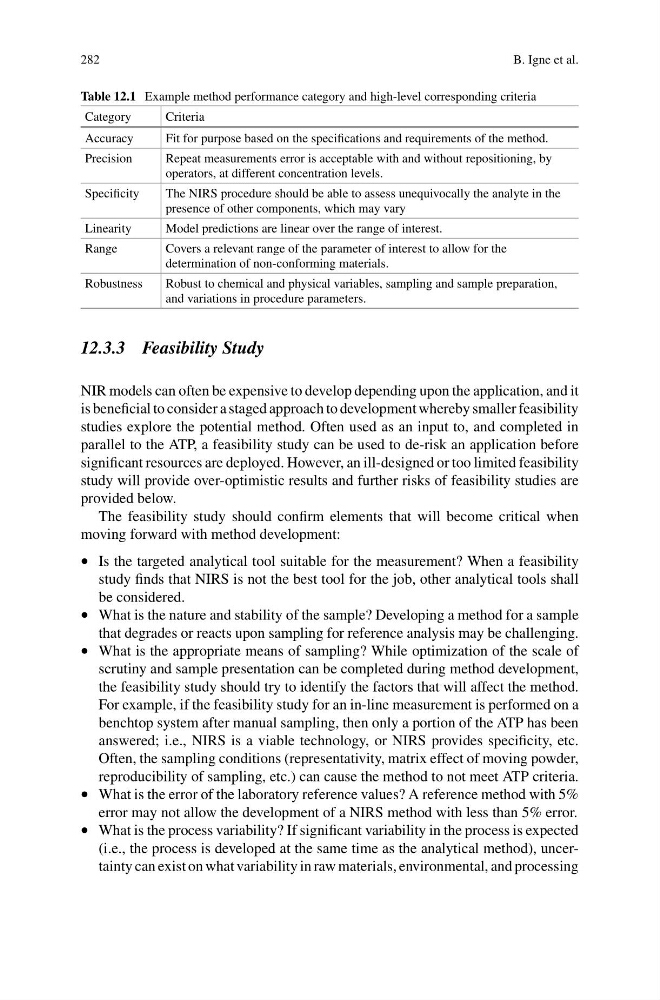
Table 12.1 Example method performance category and high-level corresponding criteria
Category
Criteria
Accuracy
Fit for purpose based on the specifications and requirements of the method.
Precision
Repeat measurements error is acceptable with and without repositioning, by
operators, at different concentration levels.
Specificity
The NIRS procedure should be able to assess unequivocally the analyte in the
presence of other components, which may vary
Linearity
Model predictions are linear over the range of interest.
Range
Covers a relevant range of the parameter of interest to allow for the
determination of non-conforming materials.
Robustness
Robust to chemical and physical variables, sampling and sample preparation,
and variations in procedure parameters.
12.3.3 Feasibility Study
NIR models can often be expensive to develop depending upon the application, and it
is beneficial to consider a staged approach to development whereby smaller feasibility
studies explore the potential method. Often used as an input to, and completed in
parallel to the ATP, a feasibility study can be used to de-risk an application before
significant resources are deployed. However, an ill-designed or too limited feasibility
study will provide over-optimistic results and further risks of feasibility studies are
provided below.
The feasibility study should confirm elements that will become critical when
moving forward with method development:
• Is the targeted analytical tool suitable for the measurement? When a feasibility
study finds that NIRS is not the best tool for the job, other analytical tools shall
be considered.
• What is the nature and stability of the sample? Developing a method for a sample
that degrades or reacts upon sampling for reference analysis may be challenging.
• What is the appropriate means of sampling? While optimization of the scale of
scrutiny and sample presentation can be completed during method development,
the feasibility study should try to identify the factors that will affect the method.
For example, if the feasibility study for an in-line measurement is performed on a
benchtop system after manual sampling, then only a portion of the ATP has been
answered; i.e., NIRS is a viable technology, or NIRS provides specificity, etc.
Often, the sampling conditions (representativity, matrix effect of moving powder,
reproducibility of sampling, etc.) can cause the method to not meet ATP criteria.
• What is the error of the laboratory reference values? A reference method with 5%
error may not allow the development of a NIRS method with less than 5% error.
• What is the process variability? If significant variability in the process is expected
(i.e., the process is developed at the same time as the analytical method), uncertainty can exist on what variability in raw materials, environmental, and processing
B. Igne et al.
Table 12.1 Example method performance category and high-level corresponding criteria
Category
Criteria
Accuracy
Fit for purpose based on the specifications and requirements of the method.
Precision
Repeat measurements error is acceptable with and without repositioning, by
operators, at different concentration levels.
Specificity
The NIRS procedure should be able to assess unequivocally the analyte in the
presence of other components, which may vary
Linearity
Model predictions are linear over the range of interest.
Range
Covers a relevant range of the parameter of interest to allow for the
determination of non-conforming materials.
Robustness
Robust to chemical and physical variables, sampling and sample preparation,
and variations in procedure parameters.
12.3.3 Feasibility Study
NIR models can often be expensive to develop depending upon the application, and it
is beneficial to consider a staged approach to development whereby smaller feasibility
studies explore the potential method. Often used as an input to, and completed in
parallel to the ATP, a feasibility study can be used to de-risk an application before
significant resources are deployed. However, an ill-designed or too limited feasibility
study will provide over-optimistic results and further risks of feasibility studies are
provided below.
The feasibility study should confirm elements that will become critical when
moving forward with method development:
• Is the targeted analytical tool suitable for the measurement? When a feasibility
study finds that NIRS is not the best tool for the job, other analytical tools shall
be considered.
• What is the nature and stability of the sample? Developing a method for a sample
that degrades or reacts upon sampling for reference analysis may be challenging.
• What is the appropriate means of sampling? While optimization of the scale of
scrutiny and sample presentation can be completed during method development,
the feasibility study should try to identify the factors that will affect the method.
For example, if the feasibility study for an in-line measurement is performed on a
benchtop system after manual sampling, then only a portion of the ATP has been
answered; i.e., NIRS is a viable technology, or NIRS provides specificity, etc.
Often, the sampling conditions (representativity, matrix effect of moving powder,
reproducibility of sampling, etc.) can cause the method to not meet ATP criteria.
• What is the error of the laboratory reference values? A reference method with 5%
error may not allow the development of a NIRS method with less than 5% error.
• What is the process variability? If significant variability in the process is expected
(i.e., the process is developed at the same time as the analytical method), uncertainty can exist on what variability in raw materials, environmental, and processing