

12 Method Development
281
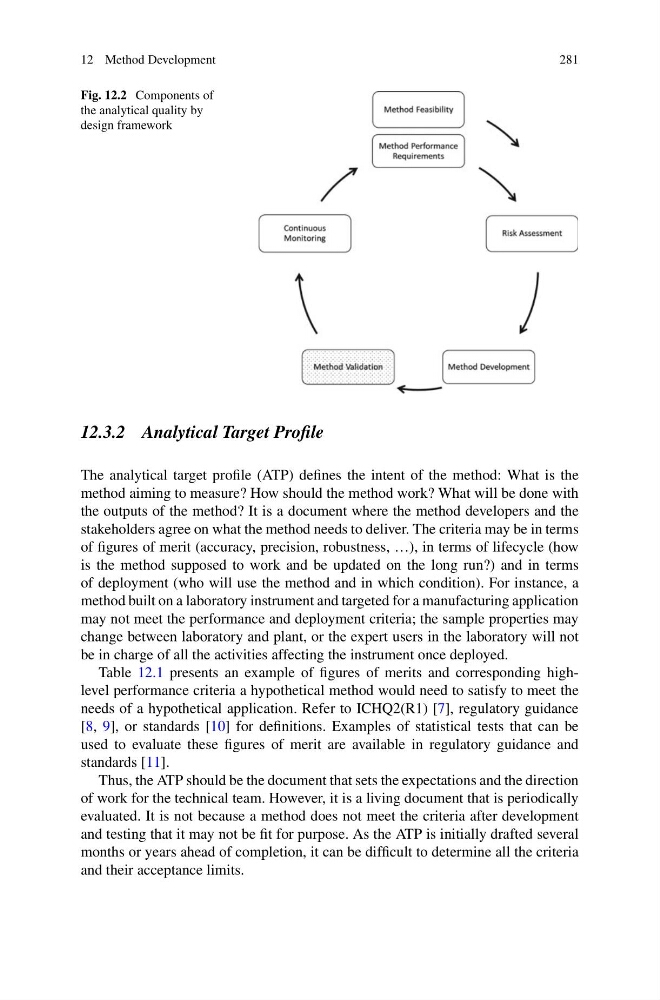
Fig. 12.2 Components of
the analytical quality by
design framework
12.3.2 Analytical Target Profile
The analytical target profile (ATP) defines the intent of the method: What is the
method aiming to measure? How should the method work? What will be done with
the outputs of the method? It is a document where the method developers and the
stakeholders agree on what the method needs to deliver. The criteria may be in terms
of figures of merit (accuracy, precision, robustness, …), in terms of lifecycle (how
is the method supposed to work and be updated on the long run?) and in terms
of deployment (who will use the method and in which condition). For instance, a
method built on a laboratory instrument and targeted for a manufacturing application
may not meet the performance and deployment criteria; the sample properties may
change between laboratory and plant, or the expert users in the laboratory will not
be in charge of all the activities affecting the instrument once deployed.
Table 12.1 presents an example of figures of merits and corresponding highlevel performance criteria a hypothetical method would need to satisfy to meet the
needs of a hypothetical application. Refer to ICHQ2(R1) [7], regulatory guidance
[8, 9], or standards [10] for definitions. Examples of statistical tests that can be
used to evaluate these figures of merit are available in regulatory guidance and
standards [11].
Thus, the ATP should be the document that sets the expectations and the direction
of work for the technical team. However, it is a living document that is periodically
evaluated. It is not because a method does not meet the criteria after development
and testing that it may not be fit for purpose. As the ATP is initially drafted several
months or years ahead of completion, it can be difficult to determine all the criteria
and their acceptance limits.
281
Fig. 12.2 Components of
the analytical quality by
design framework
12.3.2 Analytical Target Profile
The analytical target profile (ATP) defines the intent of the method: What is the
method aiming to measure? How should the method work? What will be done with
the outputs of the method? It is a document where the method developers and the
stakeholders agree on what the method needs to deliver. The criteria may be in terms
of figures of merit (accuracy, precision, robustness, …), in terms of lifecycle (how
is the method supposed to work and be updated on the long run?) and in terms
of deployment (who will use the method and in which condition). For instance, a
method built on a laboratory instrument and targeted for a manufacturing application
may not meet the performance and deployment criteria; the sample properties may
change between laboratory and plant, or the expert users in the laboratory will not
be in charge of all the activities affecting the instrument once deployed.
Table 12.1 presents an example of figures of merits and corresponding highlevel performance criteria a hypothetical method would need to satisfy to meet the
needs of a hypothetical application. Refer to ICHQ2(R1) [7], regulatory guidance
[8, 9], or standards [10] for definitions. Examples of statistical tests that can be
used to evaluate these figures of merit are available in regulatory guidance and
standards [11].
Thus, the ATP should be the document that sets the expectations and the direction
of work for the technical team. However, it is a living document that is periodically
evaluated. It is not because a method does not meet the criteria after development
and testing that it may not be fit for purpose. As the ATP is initially drafted several
months or years ahead of completion, it can be difficult to determine all the criteria
and their acceptance limits.