

20
Y. Ozaki and Y. Morisawa
2.2 Principles of NIR Spectroscopy
Before we study the principle of NIR spectroscopy we have to learn the principle
of IR spectroscopy because IR spectroscopy deals with fundamentals while NIR
spectroscopy treats overtones and combinations which originate from fundamentals [1, 2]. Therefore, learning the fundamentals is the base for understanding NIR
spectroscopy.
2.2.1 Principles of IR Spectroscopy
When a molecule is irradiated with IR light, it absorbs the light under some conditions. The energy hν of the absorbed IR light is equal to an energy difference between a
certain energy level of vibration of the molecule (having an energy E m ) and another
energy level of vibration of a molecule (having an energy E n ). In the form of an
equation,
hv = E n − E m
(2.1)
holds. This equation is known as Bohr frequency condition. In other words, absorption of IR light takes place based on a transition between energy levels of a molecular vibration. Therefore, an IR absorption spectrum is a vibrational spectrum of a
molecule.
Note that satisfying Eq. (2.1) does not always mean the occurrence of IR absorption. There are transitions which are allowed by a selection rule (i.e., allowed transition) and those which are not allowed by the same rule (i.e., forbidden transition).
In general, transitions with a change in the vibrational quantum number by ± 1 are
allowed transitions and other transitions are forbidden transitions under harmonic
approximation. This is one of selection rules of IR absorption. Another IR selection
rule is a selection rule which is defined by the symmetry of a molecule [1, 2].
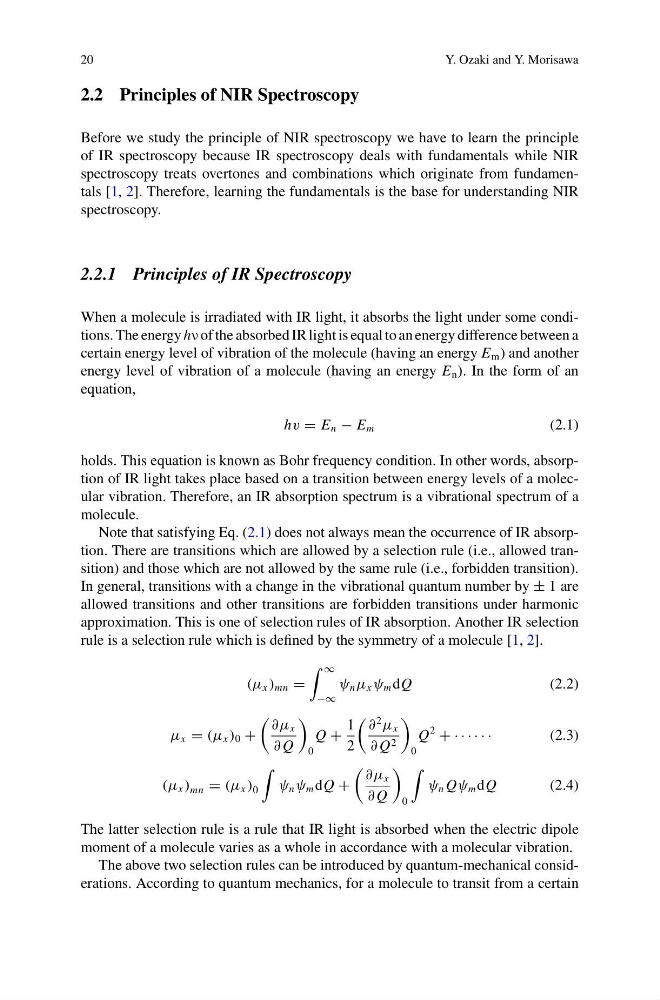
(μ x ) mn =
∞
−∞
ψ n μ x ψ m dQ
(2.2)
μ x = (μ x ) 0 +
∂μ x
∂ Q
0
Q +
1
2
∂
2
μ x
∂ Q 2
0
Q
2
+ · · · · · ·
(2.3)
(μ x ) mn = (μ x ) 0
ψ n ψ m dQ +
∂μ x
∂ Q
0
ψ n Qψ m dQ
(2.4)
The latter selection rule is a rule that IR light is absorbed when the electric dipole
moment of a molecule varies as a whole in accordance with a molecular vibration.
The above two selection rules can be introduced by quantum-mechanical considerations. According to quantum mechanics, for a molecule to transit from a certain
Y. Ozaki and Y. Morisawa
2.2 Principles of NIR Spectroscopy
Before we study the principle of NIR spectroscopy we have to learn the principle
of IR spectroscopy because IR spectroscopy deals with fundamentals while NIR
spectroscopy treats overtones and combinations which originate from fundamentals [1, 2]. Therefore, learning the fundamentals is the base for understanding NIR
spectroscopy.
2.2.1 Principles of IR Spectroscopy
When a molecule is irradiated with IR light, it absorbs the light under some conditions. The energy hν of the absorbed IR light is equal to an energy difference between a
certain energy level of vibration of the molecule (having an energy E m ) and another
energy level of vibration of a molecule (having an energy E n ). In the form of an
equation,
hv = E n − E m
(2.1)
holds. This equation is known as Bohr frequency condition. In other words, absorption of IR light takes place based on a transition between energy levels of a molecular vibration. Therefore, an IR absorption spectrum is a vibrational spectrum of a
molecule.
Note that satisfying Eq. (2.1) does not always mean the occurrence of IR absorption. There are transitions which are allowed by a selection rule (i.e., allowed transition) and those which are not allowed by the same rule (i.e., forbidden transition).
In general, transitions with a change in the vibrational quantum number by ± 1 are
allowed transitions and other transitions are forbidden transitions under harmonic
approximation. This is one of selection rules of IR absorption. Another IR selection
rule is a selection rule which is defined by the symmetry of a molecule [1, 2].
(μ x ) mn =
∞
−∞
ψ n μ x ψ m dQ
(2.2)
μ x = (μ x ) 0 +
∂μ x
∂ Q
0
Q +
1
2
∂
2
μ x
∂ Q 2
0
Q
2
+ · · · · · ·
(2.3)
(μ x ) mn = (μ x ) 0
ψ n ψ m dQ +
∂μ x
∂ Q
0
ψ n Qψ m dQ
(2.4)
The latter selection rule is a rule that IR light is absorbed when the electric dipole
moment of a molecule varies as a whole in accordance with a molecular vibration.
The above two selection rules can be introduced by quantum-mechanical considerations. According to quantum mechanics, for a molecule to transit from a certain