

10 Hardware of Near-Infrared Spectroscopy
243
α Incident angle
β Diffraction angle.
The optics of the grating spectrometers can be examined based on Eq. 10.3.
10.2.1 Wavelength Scanning Grating Spectrometer
In a plane grating spectrometer, the parallel light beam on a grating is diffracted along
the direction determined by Eq. 10.3. The diffracted parallel light is collimated into
the exit slit. The wavelength can be scanned by rotating the grating.
(a) Optical Mount of the Plane Grating Spectrometer
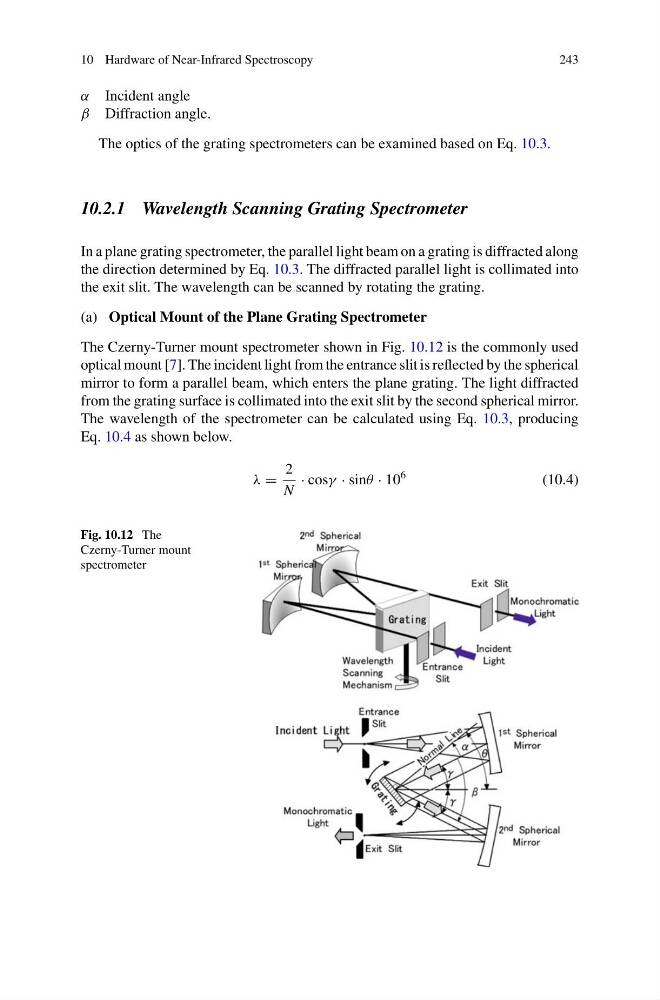
The Czerny-Turner mount spectrometer shown in Fig. 10.12 is the commonly used
optical mount [7]. The incident light from the entrance slit is reflected by the spherical
mirror to form a parallel beam, which enters the plane grating. The light diffracted
from the grating surface is collimated into the exit slit by the second spherical mirror.
The wavelength of the spectrometer can be calculated using Eq. 10.3, producing
Eq. 10.4 as shown below.
λ =
2
N
· cosγ · sinθ · 10
6
(10.4)
Fig. 10.12 The
Czerny-Turner mount
spectrometer
243
α Incident angle
β Diffraction angle.
The optics of the grating spectrometers can be examined based on Eq. 10.3.
10.2.1 Wavelength Scanning Grating Spectrometer
In a plane grating spectrometer, the parallel light beam on a grating is diffracted along
the direction determined by Eq. 10.3. The diffracted parallel light is collimated into
the exit slit. The wavelength can be scanned by rotating the grating.
(a) Optical Mount of the Plane Grating Spectrometer
The Czerny-Turner mount spectrometer shown in Fig. 10.12 is the commonly used
optical mount [7]. The incident light from the entrance slit is reflected by the spherical
mirror to form a parallel beam, which enters the plane grating. The light diffracted
from the grating surface is collimated into the exit slit by the second spherical mirror.
The wavelength of the spectrometer can be calculated using Eq. 10.3, producing
Eq. 10.4 as shown below.
λ =
2
N
· cosγ · sinθ · 10
6
(10.4)
Fig. 10.12 The
Czerny-Turner mount
spectrometer