

232
A. Ikehata
solute in a solution using a UV–VIS spectrometer, a cell with the solvent can be used
as a reference (blank sample). However, most solvents show strong absorption in the
NIR region and often overlap with the absorption of the target solute. Therefore, for
the NIR measurement of a clear solution, nothing or an empty cell should be placed
in the sample chamber as a reference.
9.2.2.4 References for Opaque Samples
It is not easy to choose a reference for an opaque sample, i.e., when DR is applicable. For NIR measurements, it is highly desirable to cancel the contribution of the
scattering component. To ensure this, the scattering coefficient of a reference should
be similar to that of the sample, but the reference should not show absorbance in
an objective wavelength region. For these reasons, polytetrafluorethylene (PTFE),
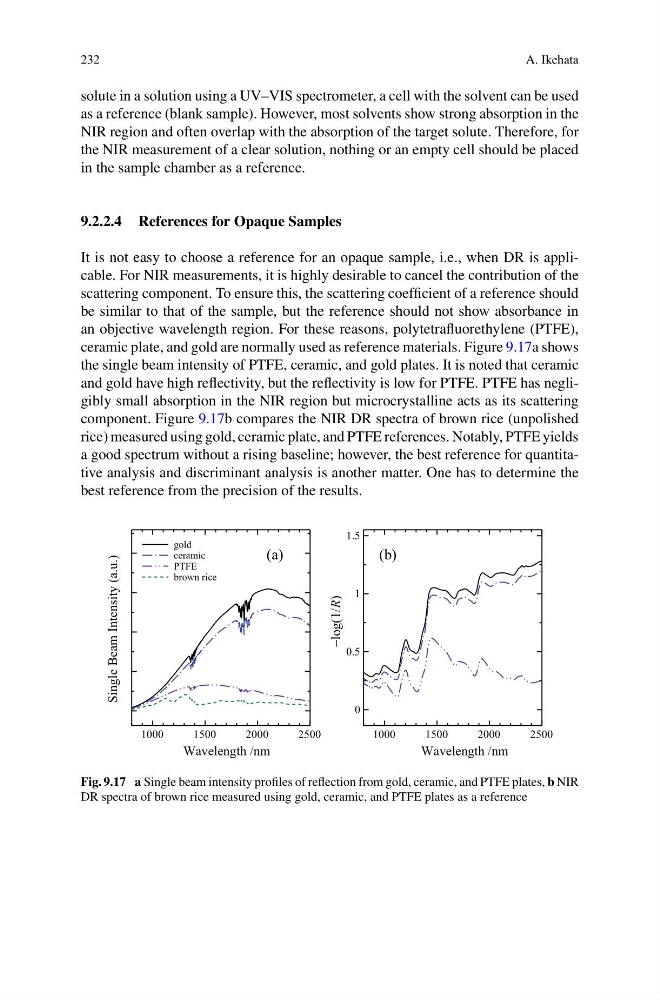
ceramic plate, and gold are normally used as reference materials. Figure 9.17a shows
the single beam intensity of PTFE, ceramic, and gold plates. It is noted that ceramic
and gold have high reflectivity, but the reflectivity is low for PTFE. PTFE has negligibly small absorption in the NIR region but microcrystalline acts as its scattering
component. Figure 9.17b compares the NIR DR spectra of brown rice (unpolished
rice) measured using gold, ceramic plate, and PTFE references. Notably, PTFE yields
a good spectrum without a rising baseline; however, the best reference for quantitative analysis and discriminant analysis is another matter. One has to determine the
best reference from the precision of the results.
Wavelength /nm
Wavelength /nm
Single Beam Intensity (a.u.)
−log(1/R)
0
0.5
1
1.5
gold
ceramic
PTFE
brown rice
1000
1500
2000
2500
1000
1500
2000
2500
(a)
(b)
Fig. 9.17 a Single beam intensity profiles of reflection from gold, ceramic, and PTFE plates, b NIR
DR spectra of brown rice measured using gold, ceramic, and PTFE plates as a reference
A. Ikehata
solute in a solution using a UV–VIS spectrometer, a cell with the solvent can be used
as a reference (blank sample). However, most solvents show strong absorption in the
NIR region and often overlap with the absorption of the target solute. Therefore, for
the NIR measurement of a clear solution, nothing or an empty cell should be placed
in the sample chamber as a reference.
9.2.2.4 References for Opaque Samples
It is not easy to choose a reference for an opaque sample, i.e., when DR is applicable. For NIR measurements, it is highly desirable to cancel the contribution of the
scattering component. To ensure this, the scattering coefficient of a reference should
be similar to that of the sample, but the reference should not show absorbance in
an objective wavelength region. For these reasons, polytetrafluorethylene (PTFE),
ceramic plate, and gold are normally used as reference materials. Figure 9.17a shows
the single beam intensity of PTFE, ceramic, and gold plates. It is noted that ceramic
and gold have high reflectivity, but the reflectivity is low for PTFE. PTFE has negligibly small absorption in the NIR region but microcrystalline acts as its scattering
component. Figure 9.17b compares the NIR DR spectra of brown rice (unpolished
rice) measured using gold, ceramic plate, and PTFE references. Notably, PTFE yields
a good spectrum without a rising baseline; however, the best reference for quantitative analysis and discriminant analysis is another matter. One has to determine the
best reference from the precision of the results.
Wavelength /nm
Wavelength /nm
Single Beam Intensity (a.u.)
−log(1/R)
0
0.5
1
1.5
gold
ceramic
PTFE
brown rice
1000
1500
2000
2500
1000
1500
2000
2500
(a)
(b)
Fig. 9.17 a Single beam intensity profiles of reflection from gold, ceramic, and PTFE plates, b NIR
DR spectra of brown rice measured using gold, ceramic, and PTFE plates as a reference