

9 NIR Optics and Measurement Methods
231
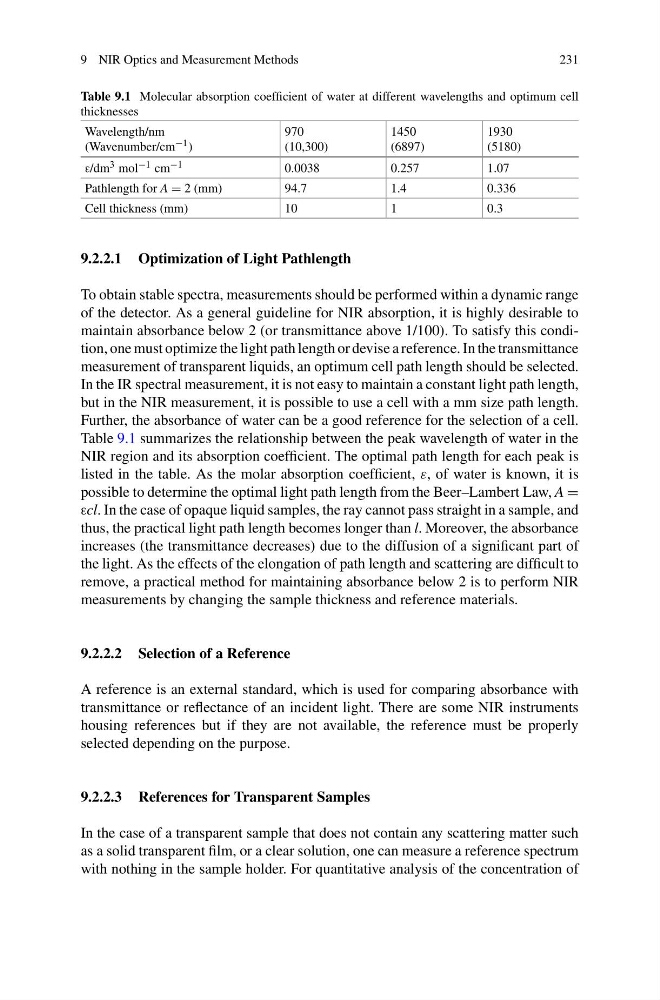
Table 9.1 Molecular absorption coefficient of water at different wavelengths and optimum cell
thicknesses
Wavelength/nm
(Wavenumber/cm −1 )
970
(10,300)
1450
(6897)
1930
(5180)
ε/dm 3 mol −1 cm −1
0.0038
0.257
1.07
Pathlength for A = 2 (mm)
94.7
1.4
0.336
Cell thickness (mm)
10
1
0.3
9.2.2.1 Optimization of Light Pathlength
To obtain stable spectra, measurements should be performed within a dynamic range
of the detector. As a general guideline for NIR absorption, it is highly desirable to
maintain absorbance below 2 (or transmittance above 1/100). To satisfy this condition, one must optimize the light path length or devise a reference. In the transmittance
measurement of transparent liquids, an optimum cell path length should be selected.
In the IR spectral measurement, it is not easy to maintain a constant light path length,
but in the NIR measurement, it is possible to use a cell with a mm size path length.
Further, the absorbance of water can be a good reference for the selection of a cell.
Table 9.1 summarizes the relationship between the peak wavelength of water in the
NIR region and its absorption coefficient. The optimal path length for each peak is
listed in the table. As the molar absorption coefficient, ε, of water is known, it is
possible to determine the optimal light path length from the Beer–Lambert Law, A =
εcl. In the case of opaque liquid samples, the ray cannot pass straight in a sample, and
thus, the practical light path length becomes longer than l. Moreover, the absorbance
increases (the transmittance decreases) due to the diffusion of a significant part of
the light. As the effects of the elongation of path length and scattering are difficult to
remove, a practical method for maintaining absorbance below 2 is to perform NIR
measurements by changing the sample thickness and reference materials.
9.2.2.2 Selection of a Reference
A reference is an external standard, which is used for comparing absorbance with
transmittance or reflectance of an incident light. There are some NIR instruments
housing references but if they are not available, the reference must be properly
selected depending on the purpose.
9.2.2.3 References for Transparent Samples
In the case of a transparent sample that does not contain any scattering matter such
as a solid transparent film, or a clear solution, one can measure a reference spectrum
with nothing in the sample holder. For quantitative analysis of the concentration of
231
Table 9.1 Molecular absorption coefficient of water at different wavelengths and optimum cell
thicknesses
Wavelength/nm
(Wavenumber/cm −1 )
970
(10,300)
1450
(6897)
1930
(5180)
ε/dm 3 mol −1 cm −1
0.0038
0.257
1.07
Pathlength for A = 2 (mm)
94.7
1.4
0.336
Cell thickness (mm)
10
1
0.3
9.2.2.1 Optimization of Light Pathlength
To obtain stable spectra, measurements should be performed within a dynamic range
of the detector. As a general guideline for NIR absorption, it is highly desirable to
maintain absorbance below 2 (or transmittance above 1/100). To satisfy this condition, one must optimize the light path length or devise a reference. In the transmittance
measurement of transparent liquids, an optimum cell path length should be selected.
In the IR spectral measurement, it is not easy to maintain a constant light path length,
but in the NIR measurement, it is possible to use a cell with a mm size path length.
Further, the absorbance of water can be a good reference for the selection of a cell.
Table 9.1 summarizes the relationship between the peak wavelength of water in the
NIR region and its absorption coefficient. The optimal path length for each peak is
listed in the table. As the molar absorption coefficient, ε, of water is known, it is
possible to determine the optimal light path length from the Beer–Lambert Law, A =
εcl. In the case of opaque liquid samples, the ray cannot pass straight in a sample, and
thus, the practical light path length becomes longer than l. Moreover, the absorbance
increases (the transmittance decreases) due to the diffusion of a significant part of
the light. As the effects of the elongation of path length and scattering are difficult to
remove, a practical method for maintaining absorbance below 2 is to perform NIR
measurements by changing the sample thickness and reference materials.
9.2.2.2 Selection of a Reference
A reference is an external standard, which is used for comparing absorbance with
transmittance or reflectance of an incident light. There are some NIR instruments
housing references but if they are not available, the reference must be properly
selected depending on the purpose.
9.2.2.3 References for Transparent Samples
In the case of a transparent sample that does not contain any scattering matter such
as a solid transparent film, or a clear solution, one can measure a reference spectrum
with nothing in the sample holder. For quantitative analysis of the concentration of