

2 Principles and Characteristics of NIR Spectroscopy
15
an acoustic optic tunable filter (AOTF) are also useful. Portable spectrometers and
hand-held spectrometers are prety popular in the NIR region. Many kinds of specialpurpose instruments are commercially available.
Spectral analysis gives yet another diversity of NIR spectroscopy. Compared
with other spectroscopy, chemometrics is quite often used for NIR spectral analysis.
Various kinds of chemometrics methods such as PCA (principal components analysis) and PLS (partial least squares) are employed extensively (Chap. 7). A variety
of spectral pretreatments are employed in NIR spectroscopy, since it treats various
kinds of bulk materials, which yield noise and baseline fluctuations (Sect. 4.1). Nowadays, even quantum chemical calculations are utilized in the spectral analysis in NIR
spectroscopy (Sect. 5.2).
2.1.5 Some Examples of NIR Spectra
To understand the characteristics of NIR spectroscopy it is important to study some
examples of NIR spectra.
(a) Water
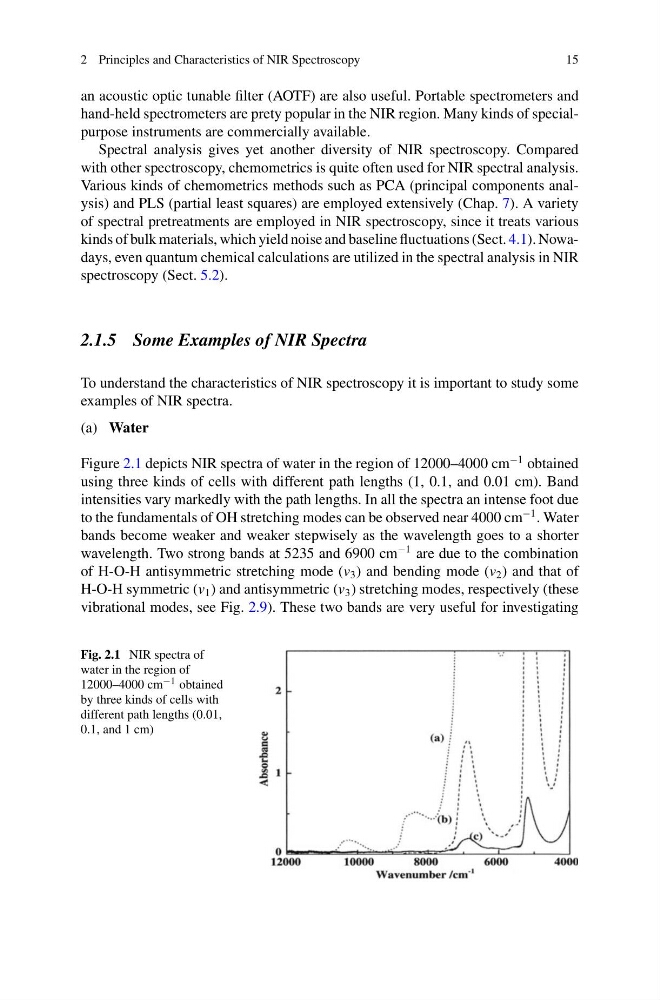
Figure 2.1 depicts NIR spectra of water in the region of 12000–4000 cm
−1 obtained
using three kinds of cells with different path lengths (1, 0.1, and 0.01 cm). Band
intensities vary markedly with the path lengths. In all the spectra an intense foot due
to the fundamentals of OH stretching modes can be observed near 4000 cm
−1 . Water
bands become weaker and weaker stepwisely as the wavelength goes to a shorter
wavelength. Two strong bands at 5235 and 6900 cm
−1 are due to the combination
of H-O-H antisymmetric stretching mode (v 3 ) and bending mode (v 2 ) and that of
H-O-H symmetric (v 1 ) and antisymmetric (v 3 ) stretching modes, respectively (these
vibrational modes, see Fig. 2.9). These two bands are very useful for investigating
Fig. 2.1 NIR spectra of
water in the region of
12000–4000 cm −1 obtained
by three kinds of cells with
different path lengths (0.01,
0.1, and 1 cm)
15
an acoustic optic tunable filter (AOTF) are also useful. Portable spectrometers and
hand-held spectrometers are prety popular in the NIR region. Many kinds of specialpurpose instruments are commercially available.
Spectral analysis gives yet another diversity of NIR spectroscopy. Compared
with other spectroscopy, chemometrics is quite often used for NIR spectral analysis.
Various kinds of chemometrics methods such as PCA (principal components analysis) and PLS (partial least squares) are employed extensively (Chap. 7). A variety
of spectral pretreatments are employed in NIR spectroscopy, since it treats various
kinds of bulk materials, which yield noise and baseline fluctuations (Sect. 4.1). Nowadays, even quantum chemical calculations are utilized in the spectral analysis in NIR
spectroscopy (Sect. 5.2).
2.1.5 Some Examples of NIR Spectra
To understand the characteristics of NIR spectroscopy it is important to study some
examples of NIR spectra.
(a) Water
Figure 2.1 depicts NIR spectra of water in the region of 12000–4000 cm
−1 obtained
using three kinds of cells with different path lengths (1, 0.1, and 0.01 cm). Band
intensities vary markedly with the path lengths. In all the spectra an intense foot due
to the fundamentals of OH stretching modes can be observed near 4000 cm
−1 . Water
bands become weaker and weaker stepwisely as the wavelength goes to a shorter
wavelength. Two strong bands at 5235 and 6900 cm
−1 are due to the combination
of H-O-H antisymmetric stretching mode (v 3 ) and bending mode (v 2 ) and that of
H-O-H symmetric (v 1 ) and antisymmetric (v 3 ) stretching modes, respectively (these
vibrational modes, see Fig. 2.9). These two bands are very useful for investigating
Fig. 2.1 NIR spectra of
water in the region of
12000–4000 cm −1 obtained
by three kinds of cells with
different path lengths (0.01,
0.1, and 1 cm)