

144
K. M. Sørensen et al.
The matrix E contains the spectral variation that could not be explained by the
model (e.g., noise and unsystematic structure/interferences).
Equation 7.12 can be solved using alternating least squares (ALS) [20] in which
both concentration profiles (C) and pure spectral profiles (S) are optimized simultaneously in an iterative manner. The value of f must be determined before starting the
algorithm, but very often the correct choice is not known for real systems. Several
procedures have been suggested to solve this issue. Most of them are based on the
principle that there are as many components as linearly independent elements (e.g.,
chemical constituents) in the X matrix (practical rank of the matrix). A very useful
method is to get the eigenvectors and eigenvalues of the X matrix by performing a
singular value decomposition (SVD) on the cross product X
T · X. The chemical rank
can be expressed as the number of eigenvalues higher than eigenvalues associated
with the noise level. Also, the shape of the eigenvector (or length m corresponding
to the spectral length) can be useful to estimate the correct number of absorbing
components. When the number of components f has been decided, the ALS goes as
follows.
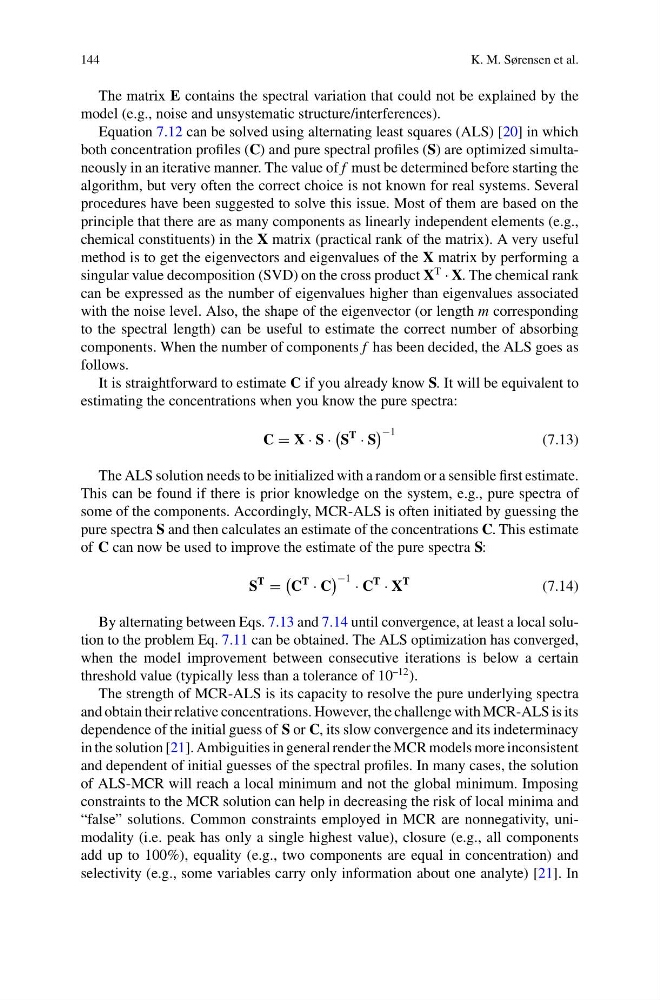
It is straightforward to estimate C if you already know S. It will be equivalent to
estimating the concentrations when you know the pure spectra:
C = X · S ·
S
T
· S
−1
(7.13)
The ALS solution needs to be initialized with a random or a sensible first estimate.
This can be found if there is prior knowledge on the system, e.g., pure spectra of
some of the components. Accordingly, MCR-ALS is often initiated by guessing the
pure spectra S and then calculates an estimate of the concentrations C. This estimate
of C can now be used to improve the estimate of the pure spectra S:
S
T
=
C
T
· C
−1 · C
T
· X
T
(7.14)
By alternating between Eqs. 7.13 and 7.14 until convergence, at least a local solution to the problem Eq. 7.11 can be obtained. The ALS optimization has converged,
when the model improvement between consecutive iterations is below a certain
threshold value (typically less than a tolerance of 10
–12 ).
The strength of MCR-ALS is its capacity to resolve the pure underlying spectra
and obtain their relative concentrations. However, the challenge with MCR-ALS is its
dependence of the initial guess of S or C, its slow convergence and its indeterminacy
in the solution [21]. Ambiguities in general render the MCR models more inconsistent
and dependent of initial guesses of the spectral profiles. In many cases, the solution
of ALS-MCR will reach a local minimum and not the global minimum. Imposing
constraints to the MCR solution can help in decreasing the risk of local minima and
“false” solutions. Common constraints employed in MCR are nonnegativity, unimodality (i.e. peak has only a single highest value), closure (e.g., all components
add up to 100%), equality (e.g., two components are equal in concentration) and
selectivity (e.g., some variables carry only information about one analyte) [21]. In
K. M. Sørensen et al.
The matrix E contains the spectral variation that could not be explained by the
model (e.g., noise and unsystematic structure/interferences).
Equation 7.12 can be solved using alternating least squares (ALS) [20] in which
both concentration profiles (C) and pure spectral profiles (S) are optimized simultaneously in an iterative manner. The value of f must be determined before starting the
algorithm, but very often the correct choice is not known for real systems. Several
procedures have been suggested to solve this issue. Most of them are based on the
principle that there are as many components as linearly independent elements (e.g.,
chemical constituents) in the X matrix (practical rank of the matrix). A very useful
method is to get the eigenvectors and eigenvalues of the X matrix by performing a
singular value decomposition (SVD) on the cross product X
T · X. The chemical rank
can be expressed as the number of eigenvalues higher than eigenvalues associated
with the noise level. Also, the shape of the eigenvector (or length m corresponding
to the spectral length) can be useful to estimate the correct number of absorbing
components. When the number of components f has been decided, the ALS goes as
follows.
It is straightforward to estimate C if you already know S. It will be equivalent to
estimating the concentrations when you know the pure spectra:
C = X · S ·
S
T
· S
−1
(7.13)
The ALS solution needs to be initialized with a random or a sensible first estimate.
This can be found if there is prior knowledge on the system, e.g., pure spectra of
some of the components. Accordingly, MCR-ALS is often initiated by guessing the
pure spectra S and then calculates an estimate of the concentrations C. This estimate
of C can now be used to improve the estimate of the pure spectra S:
S
T
=
C
T
· C
−1 · C
T
· X
T
(7.14)
By alternating between Eqs. 7.13 and 7.14 until convergence, at least a local solution to the problem Eq. 7.11 can be obtained. The ALS optimization has converged,
when the model improvement between consecutive iterations is below a certain
threshold value (typically less than a tolerance of 10
–12 ).
The strength of MCR-ALS is its capacity to resolve the pure underlying spectra
and obtain their relative concentrations. However, the challenge with MCR-ALS is its
dependence of the initial guess of S or C, its slow convergence and its indeterminacy
in the solution [21]. Ambiguities in general render the MCR models more inconsistent
and dependent of initial guesses of the spectral profiles. In many cases, the solution
of ALS-MCR will reach a local minimum and not the global minimum. Imposing
constraints to the MCR solution can help in decreasing the risk of local minima and
“false” solutions. Common constraints employed in MCR are nonnegativity, unimodality (i.e. peak has only a single highest value), closure (e.g., all components
add up to 100%), equality (e.g., two components are equal in concentration) and
selectivity (e.g., some variables carry only information about one analyte) [21]. In