

7 NIR Data Exploration and Regression by Chemometrics—A Primer
135
the light through the sample matrix and c is the concentration of the constituent of
interest. It is further assumed that the absorption from multiple analytes is additive,
which is a fundamental conjecture in applying chemometrics to spectral ensembles.
For a sample with several chemical species each defined by a concentration c s and a
molecular absorptivity ε λs :
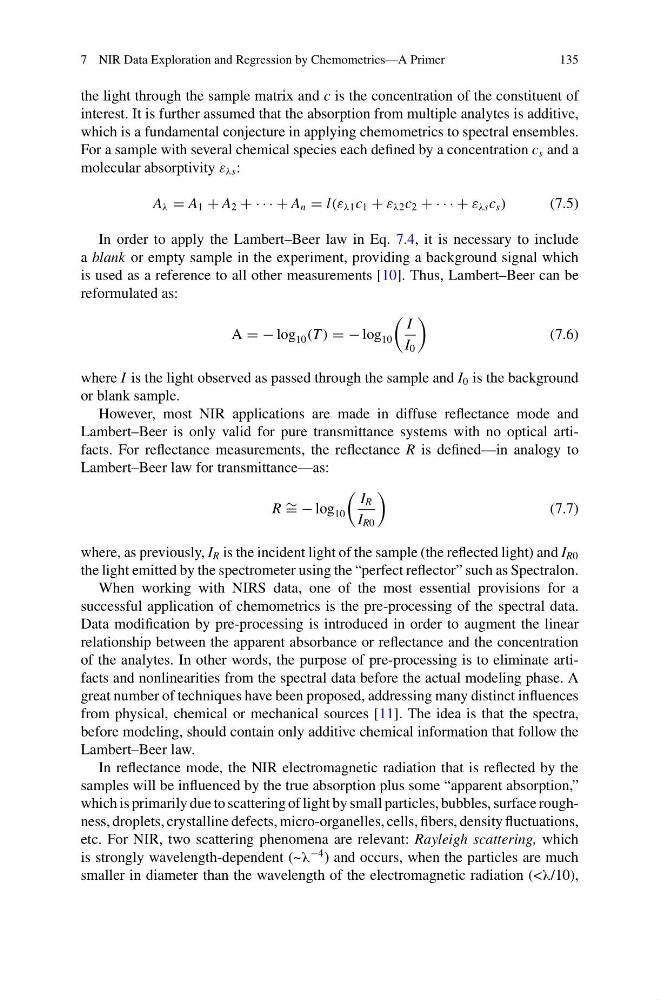
A λ = A 1 + A 2 + · · · + A n = l(ε λ1 c 1 + ε λ2 c 2 + · · · + ε λs c s )
(7.5)
In order to apply the Lambert–Beer law in Eq. 7.4, it is necessary to include
a blank or empty sample in the experiment, providing a background signal which
is used as a reference to all other measurements [10]. Thus, Lambert–Beer can be
reformulated as:
A = − log 10 (T ) = − log 10
I
I 0
(7.6)
where I is the light observed as passed through the sample and I 0 is the background
or blank sample.
However, most NIR applications are made in diffuse reflectance mode and
Lambert–Beer is only valid for pure transmittance systems with no optical artifacts. For reflectance measurements, the reflectance R is defined—in analogy to
Lambert–Beer law for transmittance—as:
R ∼ = − log 10
I R
I R0
(7.7)
where, as previously, I R is the incident light of the sample (the reflected light) and I R0
the light emitted by the spectrometer using the “perfect reflector” such as Spectralon.
When working with NIRS data, one of the most essential provisions for a
successful application of chemometrics is the pre-processing of the spectral data.
Data modification by pre-processing is introduced in order to augment the linear
relationship between the apparent absorbance or reflectance and the concentration
of the analytes. In other words, the purpose of pre-processing is to eliminate artifacts and nonlinearities from the spectral data before the actual modeling phase. A
great number of techniques have been proposed, addressing many distinct influences
from physical, chemical or mechanical sources [11]. The idea is that the spectra,
before modeling, should contain only additive chemical information that follow the
Lambert–Beer law.
In reflectance mode, the NIR electromagnetic radiation that is reflected by the
samples will be influenced by the true absorption plus some “apparent absorption,”
which is primarily due to scattering of light by small particles, bubbles, surface roughness, droplets, crystalline defects, micro-organelles, cells, fibers, density fluctuations,
etc. For NIR, two scattering phenomena are relevant: Rayleigh scattering, which
is strongly wavelength-dependent (~λ
−4 ) and occurs, when the particles are much
smaller in diameter than the wavelength of the electromagnetic radiation (<λ/10),
135
the light through the sample matrix and c is the concentration of the constituent of
interest. It is further assumed that the absorption from multiple analytes is additive,
which is a fundamental conjecture in applying chemometrics to spectral ensembles.
For a sample with several chemical species each defined by a concentration c s and a
molecular absorptivity ε λs :
A λ = A 1 + A 2 + · · · + A n = l(ε λ1 c 1 + ε λ2 c 2 + · · · + ε λs c s )
(7.5)
In order to apply the Lambert–Beer law in Eq. 7.4, it is necessary to include
a blank or empty sample in the experiment, providing a background signal which
is used as a reference to all other measurements [10]. Thus, Lambert–Beer can be
reformulated as:
A = − log 10 (T ) = − log 10
I
I 0
(7.6)
where I is the light observed as passed through the sample and I 0 is the background
or blank sample.
However, most NIR applications are made in diffuse reflectance mode and
Lambert–Beer is only valid for pure transmittance systems with no optical artifacts. For reflectance measurements, the reflectance R is defined—in analogy to
Lambert–Beer law for transmittance—as:
R ∼ = − log 10
I R
I R0
(7.7)
where, as previously, I R is the incident light of the sample (the reflected light) and I R0
the light emitted by the spectrometer using the “perfect reflector” such as Spectralon.
When working with NIRS data, one of the most essential provisions for a
successful application of chemometrics is the pre-processing of the spectral data.
Data modification by pre-processing is introduced in order to augment the linear
relationship between the apparent absorbance or reflectance and the concentration
of the analytes. In other words, the purpose of pre-processing is to eliminate artifacts and nonlinearities from the spectral data before the actual modeling phase. A
great number of techniques have been proposed, addressing many distinct influences
from physical, chemical or mechanical sources [11]. The idea is that the spectra,
before modeling, should contain only additive chemical information that follow the
Lambert–Beer law.
In reflectance mode, the NIR electromagnetic radiation that is reflected by the
samples will be influenced by the true absorption plus some “apparent absorption,”
which is primarily due to scattering of light by small particles, bubbles, surface roughness, droplets, crystalline defects, micro-organelles, cells, fibers, density fluctuations,
etc. For NIR, two scattering phenomena are relevant: Rayleigh scattering, which
is strongly wavelength-dependent (~λ
−4 ) and occurs, when the particles are much
smaller in diameter than the wavelength of the electromagnetic radiation (<λ/10),