

124
M. A. Czarnecki and S. Morita
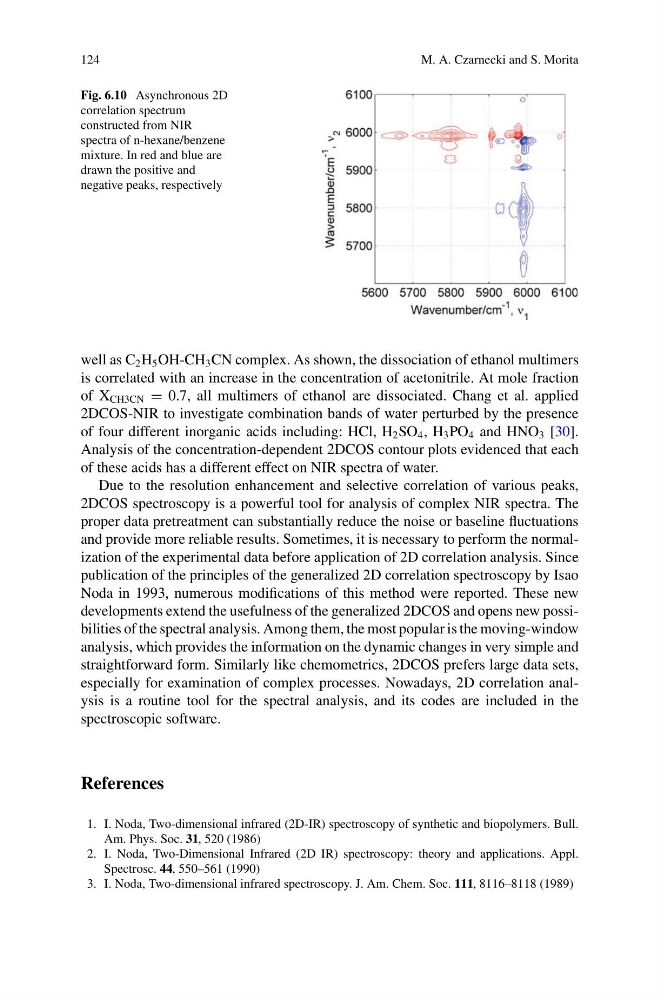
Fig. 6.10 Asynchronous 2D
correlation spectrum
constructed from NIR
spectra of n-hexane/benzene
mixture. In red and blue are
drawn the positive and
negative peaks, respectively
well as C 2 H 5 OH-CH 3 CN complex. As shown, the dissociation of ethanol multimers
is correlated with an increase in the concentration of acetonitrile. At mole fraction
of X CH3CN = 0.7, all multimers of ethanol are dissociated. Chang et al. applied
2DCOS-NIR to investigate combination bands of water perturbed by the presence
of four different inorganic acids including: HCl, H 2 SO 4 , H 3 PO 4 and HNO 3 [30].
Analysis of the concentration-dependent 2DCOS contour plots evidenced that each
of these acids has a different effect on NIR spectra of water.
Due to the resolution enhancement and selective correlation of various peaks,
2DCOS spectroscopy is a powerful tool for analysis of complex NIR spectra. The
proper data pretreatment can substantially reduce the noise or baseline fluctuations
and provide more reliable results. Sometimes, it is necessary to perform the normalization of the experimental data before application of 2D correlation analysis. Since
publication of the principles of the generalized 2D correlation spectroscopy by Isao
Noda in 1993, numerous modifications of this method were reported. These new
developments extend the usefulness of the generalized 2DCOS and opens new possibilities of the spectral analysis. Among them, the most popular is the moving-window
analysis, which provides the information on the dynamic changes in very simple and
straightforward form. Similarly like chemometrics, 2DCOS prefers large data sets,
especially for examination of complex processes. Nowadays, 2D correlation analysis is a routine tool for the spectral analysis, and its codes are included in the
spectroscopic software.
References
1. I. Noda, Two-dimensional infrared (2D-IR) spectroscopy of synthetic and biopolymers. Bull.
Am. Phys. Soc. 31, 520 (1986)
2. I. Noda, Two-Dimensional Infrared (2D IR) spectroscopy: theory and applications. Appl.
Spectrosc. 44, 550–561 (1990)
3. I. Noda, Two-dimensional infrared spectroscopy. J. Am. Chem. Soc. 111, 8116–8118 (1989)
M. A. Czarnecki and S. Morita
Fig. 6.10 Asynchronous 2D
correlation spectrum
constructed from NIR
spectra of n-hexane/benzene
mixture. In red and blue are
drawn the positive and
negative peaks, respectively
well as C 2 H 5 OH-CH 3 CN complex. As shown, the dissociation of ethanol multimers
is correlated with an increase in the concentration of acetonitrile. At mole fraction
of X CH3CN = 0.7, all multimers of ethanol are dissociated. Chang et al. applied
2DCOS-NIR to investigate combination bands of water perturbed by the presence
of four different inorganic acids including: HCl, H 2 SO 4 , H 3 PO 4 and HNO 3 [30].
Analysis of the concentration-dependent 2DCOS contour plots evidenced that each
of these acids has a different effect on NIR spectra of water.
Due to the resolution enhancement and selective correlation of various peaks,
2DCOS spectroscopy is a powerful tool for analysis of complex NIR spectra. The
proper data pretreatment can substantially reduce the noise or baseline fluctuations
and provide more reliable results. Sometimes, it is necessary to perform the normalization of the experimental data before application of 2D correlation analysis. Since
publication of the principles of the generalized 2D correlation spectroscopy by Isao
Noda in 1993, numerous modifications of this method were reported. These new
developments extend the usefulness of the generalized 2DCOS and opens new possibilities of the spectral analysis. Among them, the most popular is the moving-window
analysis, which provides the information on the dynamic changes in very simple and
straightforward form. Similarly like chemometrics, 2DCOS prefers large data sets,
especially for examination of complex processes. Nowadays, 2D correlation analysis is a routine tool for the spectral analysis, and its codes are included in the
spectroscopic software.
References
1. I. Noda, Two-dimensional infrared (2D-IR) spectroscopy of synthetic and biopolymers. Bull.
Am. Phys. Soc. 31, 520 (1986)
2. I. Noda, Two-Dimensional Infrared (2D IR) spectroscopy: theory and applications. Appl.
Spectrosc. 44, 550–561 (1990)
3. I. Noda, Two-dimensional infrared spectroscopy. J. Am. Chem. Soc. 111, 8116–8118 (1989)