

1 Introduction
5
of normal vibrational modes are expected to appear [1–7]. Therefore, NIR spectroscopy is electronic spectroscopy as well as vibrational spectroscopy. Ultraviolet
(UV)-visible (Vis) spectroscopy is electronic spectroscopy while infrared (IR) spectroscopy is vibrational spectroscopy, so that NIR spectroscopy is something special.
It lies in between electronic spectroscopy region and vibrational spectroscopy region.
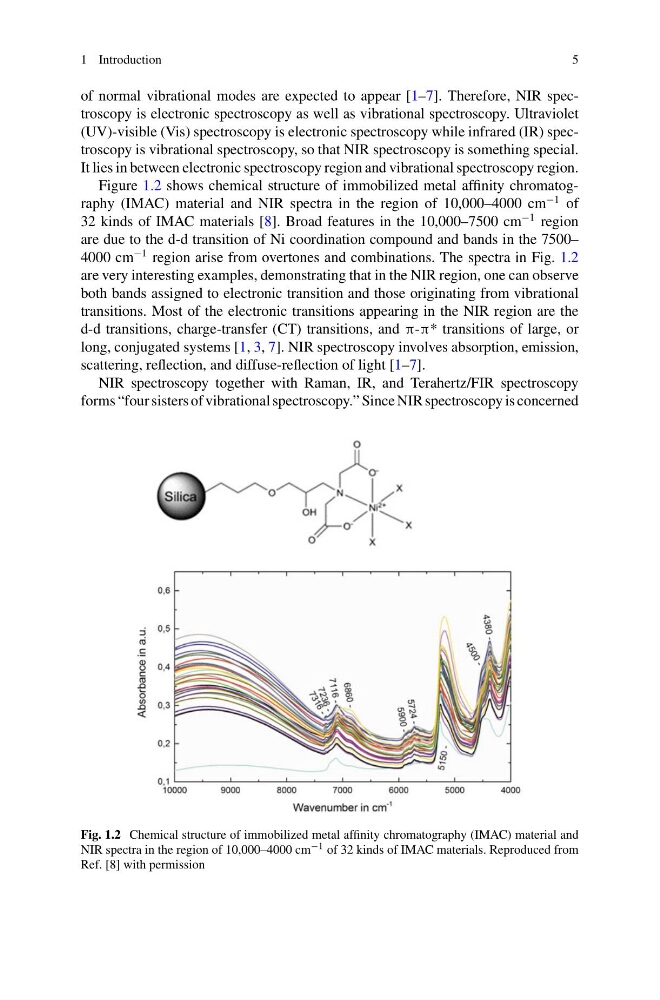
Figure 1.2 shows chemical structure of immobilized metal affinity chromatography (IMAC) material and NIR spectra in the region of 10,000–4000 cm
−1 of
32 kinds of IMAC materials [8]. Broad features in the 10,000–7500 cm
−1 region
are due to the d-d transition of Ni coordination compound and bands in the 7500–
4000 cm
−1 region arise from overtones and combinations. The spectra in Fig. 1.2
are very interesting examples, demonstrating that in the NIR region, one can observe
both bands assigned to electronic transition and those originating from vibrational
transitions. Most of the electronic transitions appearing in the NIR region are the
d-d transitions, charge-transfer (CT) transitions, and π-π* transitions of large, or
long, conjugated systems [1, 3, 7]. NIR spectroscopy involves absorption, emission,
scattering, reflection, and diffuse-reflection of light [1–7].
NIR spectroscopy together with Raman, IR, and Terahertz/FIR spectroscopy
forms “four sisters of vibrational spectroscopy.” Since NIR spectroscopy is concerned
Fig. 1.2 Chemical structure of immobilized metal affinity chromatography (IMAC) material and
NIR spectra in the region of 10,000–4000 cm −1 of 32 kinds of IMAC materials. Reproduced from
Ref. [8] with permission
5
of normal vibrational modes are expected to appear [1–7]. Therefore, NIR spectroscopy is electronic spectroscopy as well as vibrational spectroscopy. Ultraviolet
(UV)-visible (Vis) spectroscopy is electronic spectroscopy while infrared (IR) spectroscopy is vibrational spectroscopy, so that NIR spectroscopy is something special.
It lies in between electronic spectroscopy region and vibrational spectroscopy region.
Figure 1.2 shows chemical structure of immobilized metal affinity chromatography (IMAC) material and NIR spectra in the region of 10,000–4000 cm
−1 of
32 kinds of IMAC materials [8]. Broad features in the 10,000–7500 cm
−1 region
are due to the d-d transition of Ni coordination compound and bands in the 7500–
4000 cm
−1 region arise from overtones and combinations. The spectra in Fig. 1.2
are very interesting examples, demonstrating that in the NIR region, one can observe
both bands assigned to electronic transition and those originating from vibrational
transitions. Most of the electronic transitions appearing in the NIR region are the
d-d transitions, charge-transfer (CT) transitions, and π-π* transitions of large, or
long, conjugated systems [1, 3, 7]. NIR spectroscopy involves absorption, emission,
scattering, reflection, and diffuse-reflection of light [1–7].
NIR spectroscopy together with Raman, IR, and Terahertz/FIR spectroscopy
forms “four sisters of vibrational spectroscopy.” Since NIR spectroscopy is concerned
Fig. 1.2 Chemical structure of immobilized metal affinity chromatography (IMAC) material and
NIR spectra in the region of 10,000–4000 cm −1 of 32 kinds of IMAC materials. Reproduced from
Ref. [8] with permission