

4
Y. Ozaki and C. Huck
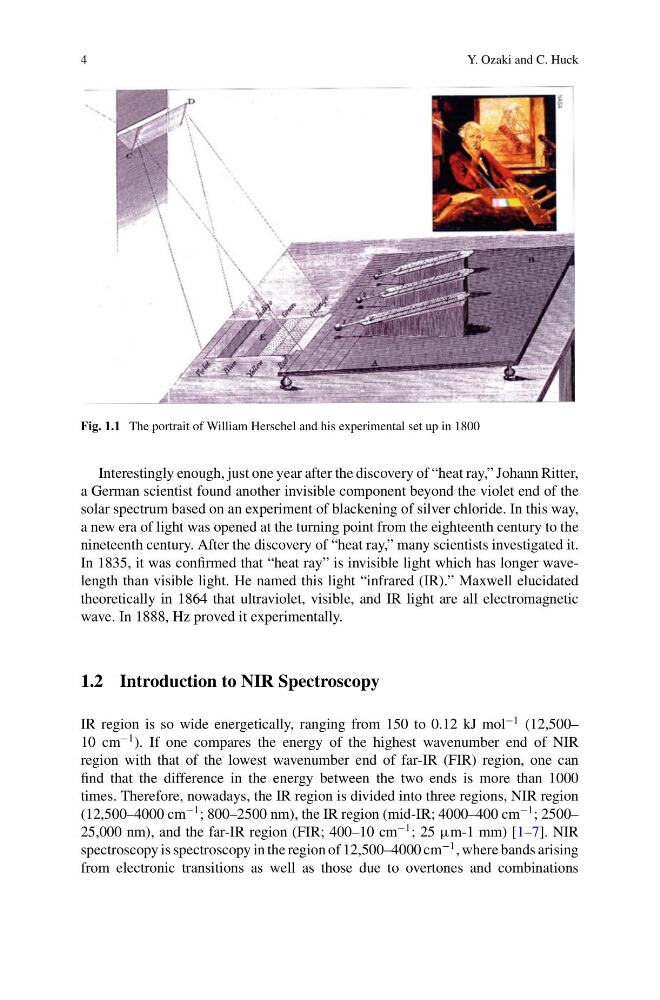
Fig. 1.1 The portrait of William Herschel and his experimental set up in 1800
Interestingly enough, just one year after the discovery of “heat ray,” Johann Ritter,
a German scientist found another invisible component beyond the violet end of the
solar spectrum based on an experiment of blackening of silver chloride. In this way,
a new era of light was opened at the turning point from the eighteenth century to the
nineteenth century. After the discovery of “heat ray,” many scientists investigated it.
In 1835, it was confirmed that “heat ray” is invisible light which has longer wavelength than visible light. He named this light “infrared (IR).” Maxwell elucidated
theoretically in 1864 that ultraviolet, visible, and IR light are all electromagnetic
wave. In 1888, Hz proved it experimentally.
1.2 Introduction to NIR Spectroscopy
IR region is so wide energetically, ranging from 150 to 0.12 kJ mol
−1 (12,500–
10 cm
−1 ). If one compares the energy of the highest wavenumber end of NIR
region with that of the lowest wavenumber end of far-IR (FIR) region, one can
find that the difference in the energy between the two ends is more than 1000
times. Therefore, nowadays, the IR region is divided into three regions, NIR region
(12,500–4000 cm
−1 ; 800–2500 nm), the IR region (mid-IR; 4000–400 cm
−1 ; 2500–
25,000 nm), and the far-IR region (FIR; 400–10 cm
−1 ; 25 μm-1 mm) [1–7]. NIR
spectroscopy is spectroscopy in the region of 12,500–4000 cm
−1 , where bands arising
from electronic transitions as well as those due to overtones and combinations
Y. Ozaki and C. Huck
Fig. 1.1 The portrait of William Herschel and his experimental set up in 1800
Interestingly enough, just one year after the discovery of “heat ray,” Johann Ritter,
a German scientist found another invisible component beyond the violet end of the
solar spectrum based on an experiment of blackening of silver chloride. In this way,
a new era of light was opened at the turning point from the eighteenth century to the
nineteenth century. After the discovery of “heat ray,” many scientists investigated it.
In 1835, it was confirmed that “heat ray” is invisible light which has longer wavelength than visible light. He named this light “infrared (IR).” Maxwell elucidated
theoretically in 1864 that ultraviolet, visible, and IR light are all electromagnetic
wave. In 1888, Hz proved it experimentally.
1.2 Introduction to NIR Spectroscopy
IR region is so wide energetically, ranging from 150 to 0.12 kJ mol
−1 (12,500–
10 cm
−1 ). If one compares the energy of the highest wavenumber end of NIR
region with that of the lowest wavenumber end of far-IR (FIR) region, one can
find that the difference in the energy between the two ends is more than 1000
times. Therefore, nowadays, the IR region is divided into three regions, NIR region
(12,500–4000 cm
−1 ; 800–2500 nm), the IR region (mid-IR; 4000–400 cm
−1 ; 2500–
25,000 nm), and the far-IR region (FIR; 400–10 cm
−1 ; 25 μm-1 mm) [1–7]. NIR
spectroscopy is spectroscopy in the region of 12,500–4000 cm
−1 , where bands arising
from electronic transitions as well as those due to overtones and combinations