

108
K. B. Be´ c et al.
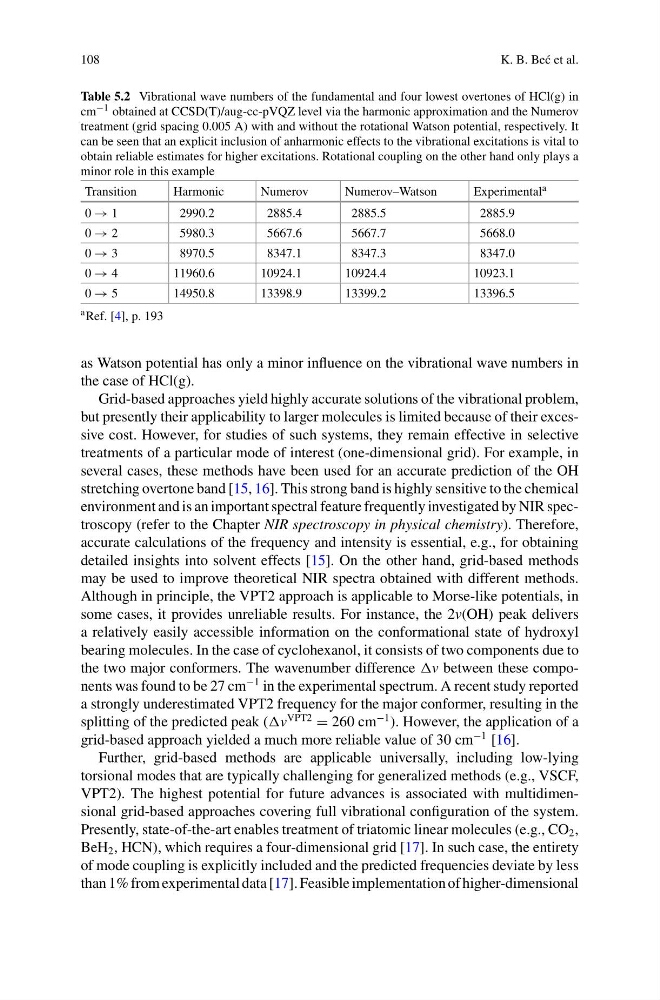
Table 5.2 Vibrational wave numbers of the fundamental and four lowest overtones of HCl(g) in
cm −1 obtained at CCSD(T)/aug-cc-pVQZ level via the harmonic approximation and the Numerov
treatment (grid spacing 0.005 A) with and without the rotational Watson potential, respectively. It
can be seen that an explicit inclusion of anharmonic effects to the vibrational excitations is vital to
obtain reliable estimates for higher excitations. Rotational coupling on the other hand only plays a
minor role in this example
Transition
Harmonic
Numerov
Numerov–Watson
Experimental a
0 → 1
2990.2
2885.4
2885.5
2885.9
0 → 2
5980.3
5667.6
5667.7
5668.0
0 → 3
8970.5
8347.1
8347.3
8347.0
0 → 4
11960.6
10924.1
10924.4
10923.1
0 → 5
14950.8
13398.9
13399.2
13396.5
a Ref. [4], p. 193
as Watson potential has only a minor influence on the vibrational wave numbers in
the case of HCl(g).
Grid-based approaches yield highly accurate solutions of the vibrational problem,
but presently their applicability to larger molecules is limited because of their excessive cost. However, for studies of such systems, they remain effective in selective
treatments of a particular mode of interest (one-dimensional grid). For example, in
several cases, these methods have been used for an accurate prediction of the OH
stretching overtone band [15, 16]. This strong band is highly sensitive to the chemical
environment and is an important spectral feature frequently investigated by NIR spectroscopy (refer to the Chapter NIR spectroscopy in physical chemistry). Therefore,
accurate calculations of the frequency and intensity is essential, e.g., for obtaining
detailed insights into solvent effects [15]. On the other hand, grid-based methods
may be used to improve theoretical NIR spectra obtained with different methods.
Although in principle, the VPT2 approach is applicable to Morse-like potentials, in
some cases, it provides unreliable results. For instance, the 2v(OH) peak delivers
a relatively easily accessible information on the conformational state of hydroxyl
bearing molecules. In the case of cyclohexanol, it consists of two components due to
the two major conformers. The wavenumber difference v between these components was found to be 27 cm
−1 in the experimental spectrum. A recent study reported
a strongly underestimated VPT2 frequency for the major conformer, resulting in the
splitting of the predicted peak (v
VPT2
= 260 cm
−1 ). However, the application of a
grid-based approach yielded a much more reliable value of 30 cm
−1 [16].
Further, grid-based methods are applicable universally, including low-lying
torsional modes that are typically challenging for generalized methods (e.g., VSCF,
VPT2). The highest potential for future advances is associated with multidimensional grid-based approaches covering full vibrational configuration of the system.
Presently, state-of-the-art enables treatment of triatomic linear molecules (e.g., CO 2 ,
BeH 2 , HCN), which requires a four-dimensional grid [17]. In such case, the entirety
of mode coupling is explicitly included and the predicted frequencies deviate by less
than 1% from experimental data [17]. Feasible implementation of higher-dimensional
K. B. Be´ c et al.
Table 5.2 Vibrational wave numbers of the fundamental and four lowest overtones of HCl(g) in
cm −1 obtained at CCSD(T)/aug-cc-pVQZ level via the harmonic approximation and the Numerov
treatment (grid spacing 0.005 A) with and without the rotational Watson potential, respectively. It
can be seen that an explicit inclusion of anharmonic effects to the vibrational excitations is vital to
obtain reliable estimates for higher excitations. Rotational coupling on the other hand only plays a
minor role in this example
Transition
Harmonic
Numerov
Numerov–Watson
Experimental a
0 → 1
2990.2
2885.4
2885.5
2885.9
0 → 2
5980.3
5667.6
5667.7
5668.0
0 → 3
8970.5
8347.1
8347.3
8347.0
0 → 4
11960.6
10924.1
10924.4
10923.1
0 → 5
14950.8
13398.9
13399.2
13396.5
a Ref. [4], p. 193
as Watson potential has only a minor influence on the vibrational wave numbers in
the case of HCl(g).
Grid-based approaches yield highly accurate solutions of the vibrational problem,
but presently their applicability to larger molecules is limited because of their excessive cost. However, for studies of such systems, they remain effective in selective
treatments of a particular mode of interest (one-dimensional grid). For example, in
several cases, these methods have been used for an accurate prediction of the OH
stretching overtone band [15, 16]. This strong band is highly sensitive to the chemical
environment and is an important spectral feature frequently investigated by NIR spectroscopy (refer to the Chapter NIR spectroscopy in physical chemistry). Therefore,
accurate calculations of the frequency and intensity is essential, e.g., for obtaining
detailed insights into solvent effects [15]. On the other hand, grid-based methods
may be used to improve theoretical NIR spectra obtained with different methods.
Although in principle, the VPT2 approach is applicable to Morse-like potentials, in
some cases, it provides unreliable results. For instance, the 2v(OH) peak delivers
a relatively easily accessible information on the conformational state of hydroxyl
bearing molecules. In the case of cyclohexanol, it consists of two components due to
the two major conformers. The wavenumber difference v between these components was found to be 27 cm
−1 in the experimental spectrum. A recent study reported
a strongly underestimated VPT2 frequency for the major conformer, resulting in the
splitting of the predicted peak (v
VPT2
= 260 cm
−1 ). However, the application of a
grid-based approach yielded a much more reliable value of 30 cm
−1 [16].
Further, grid-based methods are applicable universally, including low-lying
torsional modes that are typically challenging for generalized methods (e.g., VSCF,
VPT2). The highest potential for future advances is associated with multidimensional grid-based approaches covering full vibrational configuration of the system.
Presently, state-of-the-art enables treatment of triatomic linear molecules (e.g., CO 2 ,
BeH 2 , HCN), which requires a four-dimensional grid [17]. In such case, the entirety
of mode coupling is explicitly included and the predicted frequencies deviate by less
than 1% from experimental data [17]. Feasible implementation of higher-dimensional