

5 Introduction to Quantum Vibrational Spectroscopy
107
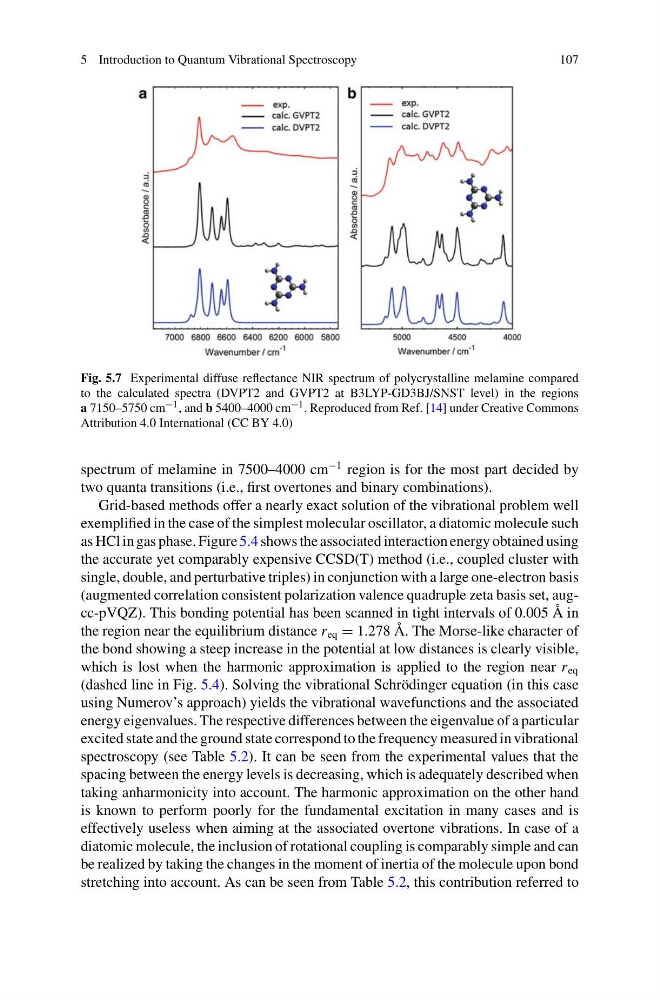
Fig. 5.7 Experimental diffuse reflectance NIR spectrum of polycrystalline melamine compared
to the calculated spectra (DVPT2 and GVPT2 at B3LYP-GD3BJ/SNST level) in the regions
a 7150–5750 cm −1 , and b 5400–4000 cm −1 . Reproduced from Ref. [14] under Creative Commons
Attribution 4.0 International (CC BY 4.0)
spectrum of melamine in 7500–4000 cm
−1 region is for the most part decided by
two quanta transitions (i.e., first overtones and binary combinations).
Grid-based methods offer a nearly exact solution of the vibrational problem well
exemplified in the case of the simplest molecular oscillator, a diatomic molecule such
as HCl in gas phase. Figure 5.4 shows the associated interaction energy obtained using
the accurate yet comparably expensive CCSD(T) method (i.e., coupled cluster with
single, double, and perturbative triples) in conjunction with a large one-electron basis
(augmented correlation consistent polarization valence quadruple zeta basis set, augcc-pVQZ). This bonding potential has been scanned in tight intervals of 0.005 Å in
the region near the equilibrium distance r eq = 1.278 Å. The Morse-like character of
the bond showing a steep increase in the potential at low distances is clearly visible,
which is lost when the harmonic approximation is applied to the region near r eq
(dashed line in Fig. 5.4). Solving the vibrational Schrödinger equation (in this case
using Numerov’s approach) yields the vibrational wavefunctions and the associated
energy eigenvalues. The respective differences between the eigenvalue of a particular
excited state and the ground state correspond to the frequency measured in vibrational
spectroscopy (see Table 5.2). It can be seen from the experimental values that the
spacing between the energy levels is decreasing, which is adequately described when
taking anharmonicity into account. The harmonic approximation on the other hand
is known to perform poorly for the fundamental excitation in many cases and is
effectively useless when aiming at the associated overtone vibrations. In case of a
diatomic molecule, the inclusion of rotational coupling is comparably simple and can
be realized by taking the changes in the moment of inertia of the molecule upon bond
stretching into account. As can be seen from Table 5.2, this contribution referred to
107
Fig. 5.7 Experimental diffuse reflectance NIR spectrum of polycrystalline melamine compared
to the calculated spectra (DVPT2 and GVPT2 at B3LYP-GD3BJ/SNST level) in the regions
a 7150–5750 cm −1 , and b 5400–4000 cm −1 . Reproduced from Ref. [14] under Creative Commons
Attribution 4.0 International (CC BY 4.0)
spectrum of melamine in 7500–4000 cm
−1 region is for the most part decided by
two quanta transitions (i.e., first overtones and binary combinations).
Grid-based methods offer a nearly exact solution of the vibrational problem well
exemplified in the case of the simplest molecular oscillator, a diatomic molecule such
as HCl in gas phase. Figure 5.4 shows the associated interaction energy obtained using
the accurate yet comparably expensive CCSD(T) method (i.e., coupled cluster with
single, double, and perturbative triples) in conjunction with a large one-electron basis
(augmented correlation consistent polarization valence quadruple zeta basis set, augcc-pVQZ). This bonding potential has been scanned in tight intervals of 0.005 Å in
the region near the equilibrium distance r eq = 1.278 Å. The Morse-like character of
the bond showing a steep increase in the potential at low distances is clearly visible,
which is lost when the harmonic approximation is applied to the region near r eq
(dashed line in Fig. 5.4). Solving the vibrational Schrödinger equation (in this case
using Numerov’s approach) yields the vibrational wavefunctions and the associated
energy eigenvalues. The respective differences between the eigenvalue of a particular
excited state and the ground state correspond to the frequency measured in vibrational
spectroscopy (see Table 5.2). It can be seen from the experimental values that the
spacing between the energy levels is decreasing, which is adequately described when
taking anharmonicity into account. The harmonic approximation on the other hand
is known to perform poorly for the fundamental excitation in many cases and is
effectively useless when aiming at the associated overtone vibrations. In case of a
diatomic molecule, the inclusion of rotational coupling is comparably simple and can
be realized by taking the changes in the moment of inertia of the molecule upon bond
stretching into account. As can be seen from Table 5.2, this contribution referred to