

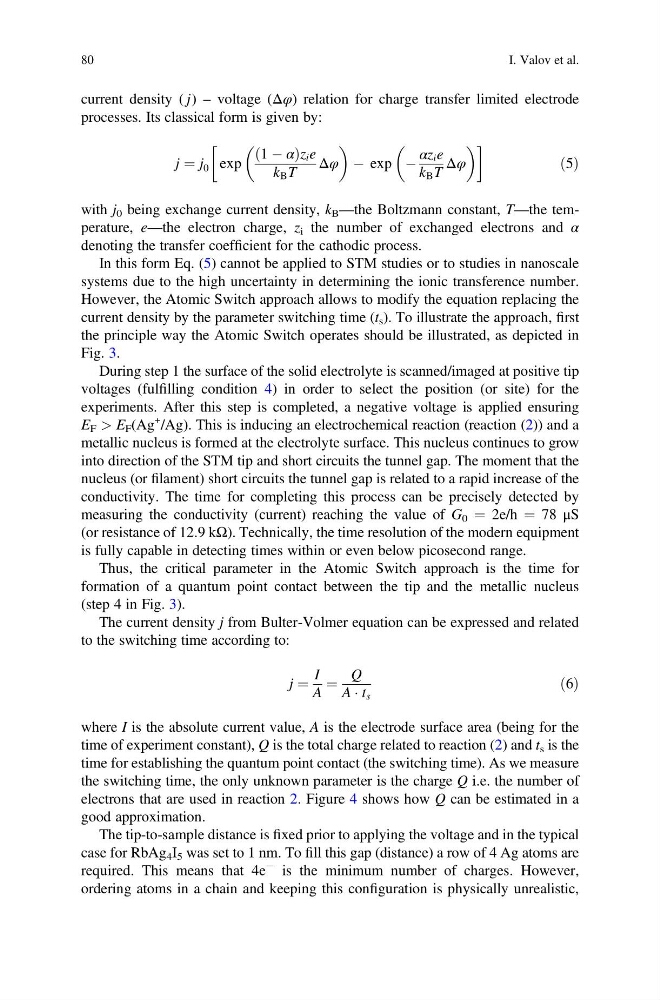
current density ( j) – voltage (Δφ) relation for charge transfer limited electrode
processes. Its classical form is given by:
j ¼ j 0 exp
1 À α
ð
Þz i e
k B T
Δφ
À exp À
αz i e
k B T
Δφ
ð5Þ
with j 0 being exchange current density, k B —the Boltzmann constant, T—the temperature, e—the electron charge, z i the number of exchanged electrons and α
denoting the transfer coefficient for the cathodic process.
In this form Eq. (5) cannot be applied to STM studies or to studies in nanoscale
systems due to the high uncertainty in determining the ionic transference number.
However, the Atomic Switch approach allows to modify the equation replacing the
current density by the parameter switching time (t s ). To illustrate the approach, first
the principle way the Atomic Switch operates should be illustrated, as depicted in
Fig. 3.
During step 1 the surface of the solid electrolyte is scanned/imaged at positive tip
voltages (fulfilling condition 4) in order to select the position (or site) for the
experiments. After this step is completed, a negative voltage is applied ensuring
E F > E F (Ag
+ /Ag). This is inducing an electrochemical reaction (reaction (2)) and a
metallic nucleus is formed at the electrolyte surface. This nucleus continues to grow
into direction of the STM tip and short circuits the tunnel gap. The moment that the
nucleus (or filament) short circuits the tunnel gap is related to a rapid increase of the
conductivity. The time for completing this process can be precisely detected by
measuring the conductivity (current) reaching the value of G 0 ¼ 2e/h ¼ 78 μS
(or resistance of 12.9 kΩ). Technically, the time resolution of the modern equipment
is fully capable in detecting times within or even below picosecond range.
Thus, the critical parameter in the Atomic Switch approach is the time for
formation of a quantum point contact between the tip and the metallic nucleus
(step 4 in Fig. 3).
The current density j from Bulter-Volmer equation can be expressed and related
to the switching time according to:
j ¼
I
A
¼
Q
A Á t s
ð6Þ
where I is the absolute current value, A is the electrode surface area (being for the
time of experiment constant), Q is the total charge related to reaction (2) and t s is the
time for establishing the quantum point contact (the switching time). As we measure
the switching time, the only unknown parameter is the charge Q i.e. the number of
electrons that are used in reaction 2. Figure 4 shows how Q can be estimated in a
good approximation.
The tip-to-sample distance is fixed prior to applying the voltage and in the typical
case for RbAg 4 I 5 was set to 1 nm. To fill this gap (distance) a row of 4 Ag atoms are
required. This means that 4e
À is the minimum number of charges. However,
ordering atoms in a chain and keeping this configuration is physically unrealistic,
80
I. Valov et al.
processes. Its classical form is given by:
j ¼ j 0 exp
1 À α
ð
Þz i e
k B T
Δφ
À exp À
αz i e
k B T
Δφ
ð5Þ
with j 0 being exchange current density, k B —the Boltzmann constant, T—the temperature, e—the electron charge, z i the number of exchanged electrons and α
denoting the transfer coefficient for the cathodic process.
In this form Eq. (5) cannot be applied to STM studies or to studies in nanoscale
systems due to the high uncertainty in determining the ionic transference number.
However, the Atomic Switch approach allows to modify the equation replacing the
current density by the parameter switching time (t s ). To illustrate the approach, first
the principle way the Atomic Switch operates should be illustrated, as depicted in
Fig. 3.
During step 1 the surface of the solid electrolyte is scanned/imaged at positive tip
voltages (fulfilling condition 4) in order to select the position (or site) for the
experiments. After this step is completed, a negative voltage is applied ensuring
E F > E F (Ag
+ /Ag). This is inducing an electrochemical reaction (reaction (2)) and a
metallic nucleus is formed at the electrolyte surface. This nucleus continues to grow
into direction of the STM tip and short circuits the tunnel gap. The moment that the
nucleus (or filament) short circuits the tunnel gap is related to a rapid increase of the
conductivity. The time for completing this process can be precisely detected by
measuring the conductivity (current) reaching the value of G 0 ¼ 2e/h ¼ 78 μS
(or resistance of 12.9 kΩ). Technically, the time resolution of the modern equipment
is fully capable in detecting times within or even below picosecond range.
Thus, the critical parameter in the Atomic Switch approach is the time for
formation of a quantum point contact between the tip and the metallic nucleus
(step 4 in Fig. 3).
The current density j from Bulter-Volmer equation can be expressed and related
to the switching time according to:
j ¼
I
A
¼
Q
A Á t s
ð6Þ
where I is the absolute current value, A is the electrode surface area (being for the
time of experiment constant), Q is the total charge related to reaction (2) and t s is the
time for establishing the quantum point contact (the switching time). As we measure
the switching time, the only unknown parameter is the charge Q i.e. the number of
electrons that are used in reaction 2. Figure 4 shows how Q can be estimated in a
good approximation.
The tip-to-sample distance is fixed prior to applying the voltage and in the typical
case for RbAg 4 I 5 was set to 1 nm. To fill this gap (distance) a row of 4 Ag atoms are
required. This means that 4e
À is the minimum number of charges. However,
ordering atoms in a chain and keeping this configuration is physically unrealistic,
80
I. Valov et al.