

and dose not represents statistical fluctuations. Though actual ion hits to the cell are
relatively limited, estimated SEU cross sections were much smaller than the actual
cell area regardless of the cell state, in the cases where voltage was not applied to
each cell in irradiations to ROM.
4.2 FPGA
No SEU was also observed up to 68.9 MeV/(mg/cm
2 ) on the FPGAs as validated by
the LSI tester after irradiation to ensure that the configured circuit had not changed.
About 1376 particles were expected to hit somewhere in the atom switches on the
FPGA, assuming that the cell area (conductive bridge area) of the atom switch was
atom switch is 1.5 Â 10
–11 cm
2 .
Apparent SEL signatures were also observed, however. Once SEL was observed,
the reset-check-restart sequence was done similar to that for ROMs. In Fig. 13, the
estimated upper limit of SEU cross sections was also much smaller than actual cell
area (showed in the red plot), even if the power supply voltage was applied to each
CAS during irradiation to the FPGA. Conversely, single event transient (SET) pulses
caused by ions hitting the CMOS circuit (which is not hardened against radiation)
were observed. The SET cross-section was about 10
5 times larger than the atom
switch itself, and was dependent on LET (data not shown). Even though the atom
switch would be fine, SET could cause the logic status to fail. Radiation hardening
by design (RHBD) technique is necessary for CMOS logics, so that the CAS FPGA
will work in space applications.
100
80
60
40
30
90
70
50
20
300
400
500
600
Read time [ns]
]
V
m
[
e
g
a
t
l
o
v
d
e
i
l
p
p
A
100
80
60
40
30
90
70
50
20
Pre-irradiation
Post-irradiation
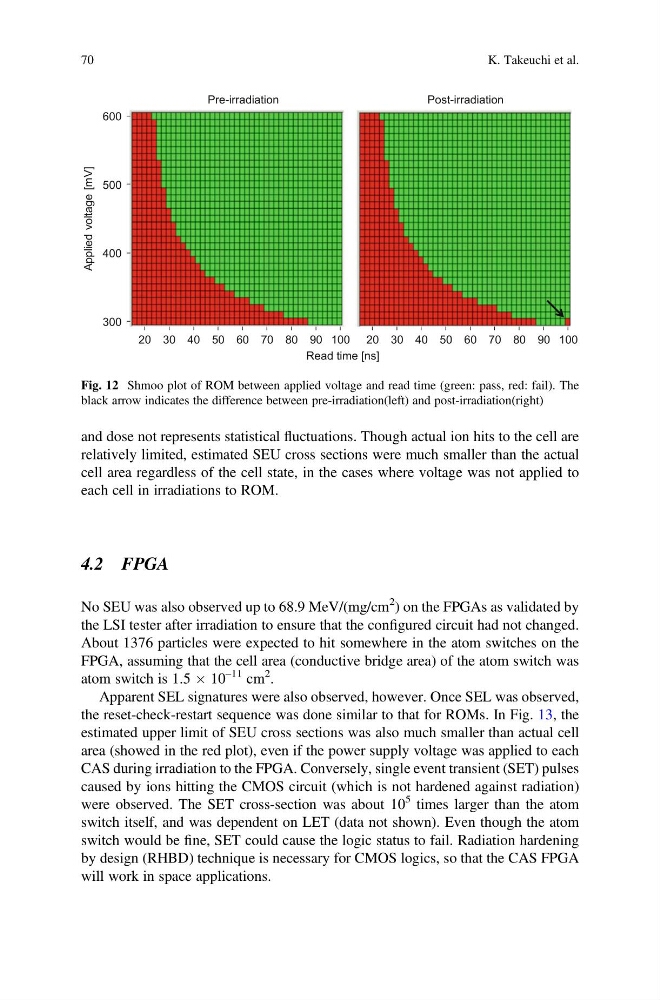
Fig. 12 Shmoo plot of ROM between applied voltage and read time (green: pass, red: fail). The
black arrow indicates the difference between pre-irradiation(left) and post-irradiation(right)
70
K. Takeuchi et al.
relatively limited, estimated SEU cross sections were much smaller than the actual
cell area regardless of the cell state, in the cases where voltage was not applied to
each cell in irradiations to ROM.
4.2 FPGA
No SEU was also observed up to 68.9 MeV/(mg/cm
2 ) on the FPGAs as validated by
the LSI tester after irradiation to ensure that the configured circuit had not changed.
About 1376 particles were expected to hit somewhere in the atom switches on the
FPGA, assuming that the cell area (conductive bridge area) of the atom switch was
atom switch is 1.5 Â 10
–11 cm
2 .
Apparent SEL signatures were also observed, however. Once SEL was observed,
the reset-check-restart sequence was done similar to that for ROMs. In Fig. 13, the
estimated upper limit of SEU cross sections was also much smaller than actual cell
area (showed in the red plot), even if the power supply voltage was applied to each
CAS during irradiation to the FPGA. Conversely, single event transient (SET) pulses
caused by ions hitting the CMOS circuit (which is not hardened against radiation)
were observed. The SET cross-section was about 10
5 times larger than the atom
switch itself, and was dependent on LET (data not shown). Even though the atom
switch would be fine, SET could cause the logic status to fail. Radiation hardening
by design (RHBD) technique is necessary for CMOS logics, so that the CAS FPGA
will work in space applications.
100
80
60
40
30
90
70
50
20
300
400
500
600
Read time [ns]
]
V
m
[
e
g
a
t
l
o
v
d
e
i
l
p
p
A
100
80
60
40
30
90
70
50
20
Pre-irradiation
Post-irradiation
Fig. 12 Shmoo plot of ROM between applied voltage and read time (green: pass, red: fail). The
black arrow indicates the difference between pre-irradiation(left) and post-irradiation(right)
70
K. Takeuchi et al.