

temperature changes ranging from –30 to +60
C or higher when launched with a
rocket. Regarding the temperature difference, thanks to the progress of recent
spacecraft system development and design technology, onboard equipment can be
operated within a controlled environment to keep the temperature inside the satellite.
The inside of a satellite can be kept within an appropriate and fixed temperature
range. However, considering the entire lifecycle including launch, transportation,
etc., the temperature range for the guaranteed operation of onboard equipment still
reaches 70–90
C. As for a radiation environment, once going out of the atmosphere,
it is exposed to a high level of radiation peculiar to the outer space. Soft errors often
found in semiconductor devices must be taken into account during the operation of
the space system.
The influence of cosmic radiation on semiconductor devices is summarized as
follows [12]. The source of space radiation environment is high energy particles
existing in outer space, such as gamma rays contained in the vicinity of the planet
and solar wind, and heavy particles contained in galactic cosmic rays, etc. High level
gamma ray mainly leads to degradation of device characteristics such as shift of gate
threshold voltage level and increase of leakage current depending on total dose rate.
As for heavy particles, it is necessary to consider the influence of protons, neutrons,
α (alpha) particles, heavy ion particles, etc. Among them, the radiation carried by
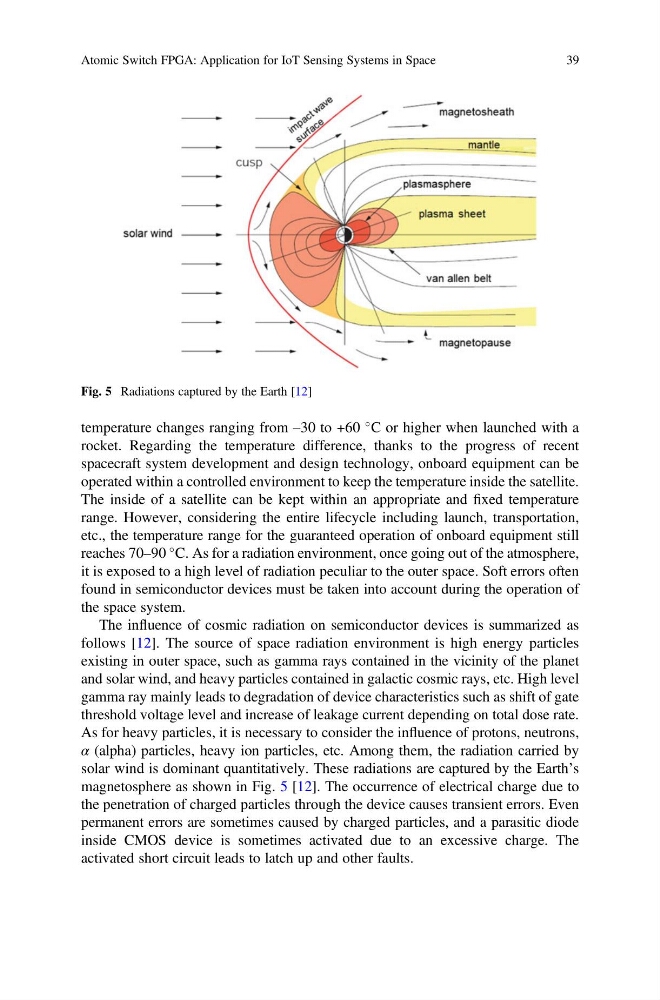
solar wind is dominant quantitatively. These radiations are captured by the Earth’s
magnetosphere as shown in Fig. 5 [12]. The occurrence of electrical charge due to
the penetration of charged particles through the device causes transient errors. Even
permanent errors are sometimes caused by charged particles, and a parasitic diode
inside CMOS device is sometimes activated due to an excessive charge. The
activated short circuit leads to latch up and other faults.
Fig. 5 Radiations captured by the Earth [12]
Atomic Switch FPGA: Application for IoT Sensing Systems in Space
39
C or higher when launched with a
rocket. Regarding the temperature difference, thanks to the progress of recent
spacecraft system development and design technology, onboard equipment can be
operated within a controlled environment to keep the temperature inside the satellite.
The inside of a satellite can be kept within an appropriate and fixed temperature
range. However, considering the entire lifecycle including launch, transportation,
etc., the temperature range for the guaranteed operation of onboard equipment still
reaches 70–90
C. As for a radiation environment, once going out of the atmosphere,
it is exposed to a high level of radiation peculiar to the outer space. Soft errors often
found in semiconductor devices must be taken into account during the operation of
the space system.
The influence of cosmic radiation on semiconductor devices is summarized as
follows [12]. The source of space radiation environment is high energy particles
existing in outer space, such as gamma rays contained in the vicinity of the planet
and solar wind, and heavy particles contained in galactic cosmic rays, etc. High level
gamma ray mainly leads to degradation of device characteristics such as shift of gate
threshold voltage level and increase of leakage current depending on total dose rate.
As for heavy particles, it is necessary to consider the influence of protons, neutrons,
α (alpha) particles, heavy ion particles, etc. Among them, the radiation carried by
solar wind is dominant quantitatively. These radiations are captured by the Earth’s
magnetosphere as shown in Fig. 5 [12]. The occurrence of electrical charge due to
the penetration of charged particles through the device causes transient errors. Even
permanent errors are sometimes caused by charged particles, and a parasitic diode
inside CMOS device is sometimes activated due to an excessive charge. The
activated short circuit leads to latch up and other faults.
Fig. 5 Radiations captured by the Earth [12]
Atomic Switch FPGA: Application for IoT Sensing Systems in Space
39