

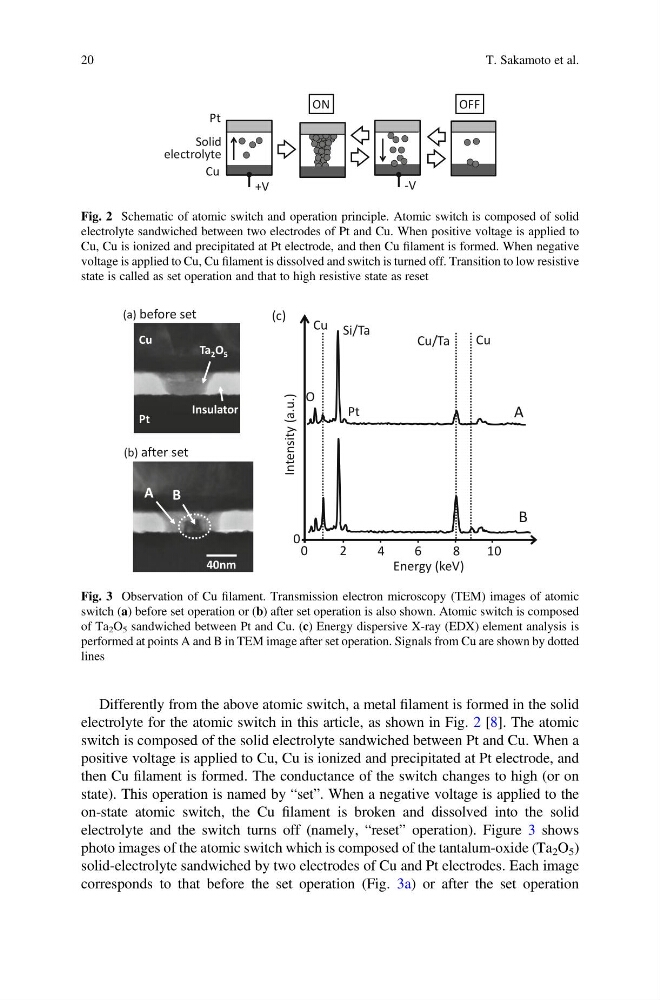
Differently from the above atomic switch, a metal filament is formed in the solid
electrolyte for the atomic switch in this article, as shown in Fig. 2 [8]. The atomic
switch is composed of the solid electrolyte sandwiched between Pt and Cu. When a
positive voltage is applied to Cu, Cu is ionized and precipitated at Pt electrode, and
then Cu filament is formed. The conductance of the switch changes to high (or on
state). This operation is named by “set”. When a negative voltage is applied to the
on-state atomic switch, the Cu filament is broken and dissolved into the solid
electrolyte and the switch turns off (namely, “reset” operation). Figure 3 shows
photo images of the atomic switch which is composed of the tantalum-oxide (Ta 2 O 5 )
solid-electrolyte sandwiched by two electrodes of Cu and Pt electrodes. Each image
corresponds to that before the set operation (Fig. 3a) or after the set operation
ON
Pt
Cu
+V
Solid
electrolyte
OFF
-V
Fig. 2 Schematic of atomic switch and operation principle. Atomic switch is composed of solid
electrolyte sandwiched between two electrodes of Pt and Cu. When positive voltage is applied to
Cu, Cu is ionized and precipitated at Pt electrode, and then Cu filament is formed. When negative
voltage is applied to Cu, Cu filament is dissolved and switch is turned off. Transition to low resistive
state is called as set operation and that to high resistive state as reset
Pt
Cu
Ta 2 O 5
B
Insulator
A
40nm
(a) before set
(b) after set
0
0
Si/Ta
Cu
O
Pt
Cu/Ta
Cu
10
2
4
6
8
Energy (keV)
Intensity (a.u.)
(c)
A
B
Fig. 3 Observation of Cu filament. Transmission electron microscopy (TEM) images of atomic
switch (a) before set operation or (b) after set operation is also shown. Atomic switch is composed
of Ta 2 O 5 sandwiched between Pt and Cu. (c) Energy dispersive X-ray (EDX) element analysis is
performed at points A and B in TEM image after set operation. Signals from Cu are shown by dotted
lines
20
T. Sakamoto et al.
electrolyte for the atomic switch in this article, as shown in Fig. 2 [8]. The atomic
switch is composed of the solid electrolyte sandwiched between Pt and Cu. When a
positive voltage is applied to Cu, Cu is ionized and precipitated at Pt electrode, and
then Cu filament is formed. The conductance of the switch changes to high (or on
state). This operation is named by “set”. When a negative voltage is applied to the
on-state atomic switch, the Cu filament is broken and dissolved into the solid
electrolyte and the switch turns off (namely, “reset” operation). Figure 3 shows
photo images of the atomic switch which is composed of the tantalum-oxide (Ta 2 O 5 )
solid-electrolyte sandwiched by two electrodes of Cu and Pt electrodes. Each image
corresponds to that before the set operation (Fig. 3a) or after the set operation
ON
Pt
Cu
+V
Solid
electrolyte
OFF
-V
Fig. 2 Schematic of atomic switch and operation principle. Atomic switch is composed of solid
electrolyte sandwiched between two electrodes of Pt and Cu. When positive voltage is applied to
Cu, Cu is ionized and precipitated at Pt electrode, and then Cu filament is formed. When negative
voltage is applied to Cu, Cu filament is dissolved and switch is turned off. Transition to low resistive
state is called as set operation and that to high resistive state as reset
Pt
Cu
Ta 2 O 5
B
Insulator
A
40nm
(a) before set
(b) after set
0
0
Si/Ta
Cu
O
Pt
Cu/Ta
Cu
10
2
4
6
8
Energy (keV)
Intensity (a.u.)
(c)
A
B
Fig. 3 Observation of Cu filament. Transmission electron microscopy (TEM) images of atomic
switch (a) before set operation or (b) after set operation is also shown. Atomic switch is composed
of Ta 2 O 5 sandwiched between Pt and Cu. (c) Energy dispersive X-ray (EDX) element analysis is
performed at points A and B in TEM image after set operation. Signals from Cu are shown by dotted
lines
20
T. Sakamoto et al.