

bits were converted to negative and positive DC voltage pulses, respectively. Next, a
linear readout layer was applied to an array of voltage outputs from the device to
reconstruct target output signals for the given task. ASNs produced nearly perfect
results at low voltages for AND, OR, and NAND with more than 95% confidence.
XOR, which requires non-linearity to solve, was able to be partially solved at high
voltages with more than 95% confidence owed to stable, non-temporal, non-linear
behaviors in the device under optimized operational conditions. As opposed to
previous works which have investigated temporal computation in ASNs, this work
was the first to demonstrate semi-predictable, non-temporal, non-linear behavior
within the device. These results demonstrate that the device connectivity is complete
enough to perform complex computations. With a more comprehensive view of
ASN behavior, these devices will be capable of performing functions currently
implemented in CMOS while occupying less area and processing more inputs
simultaneously (Fig. 17).
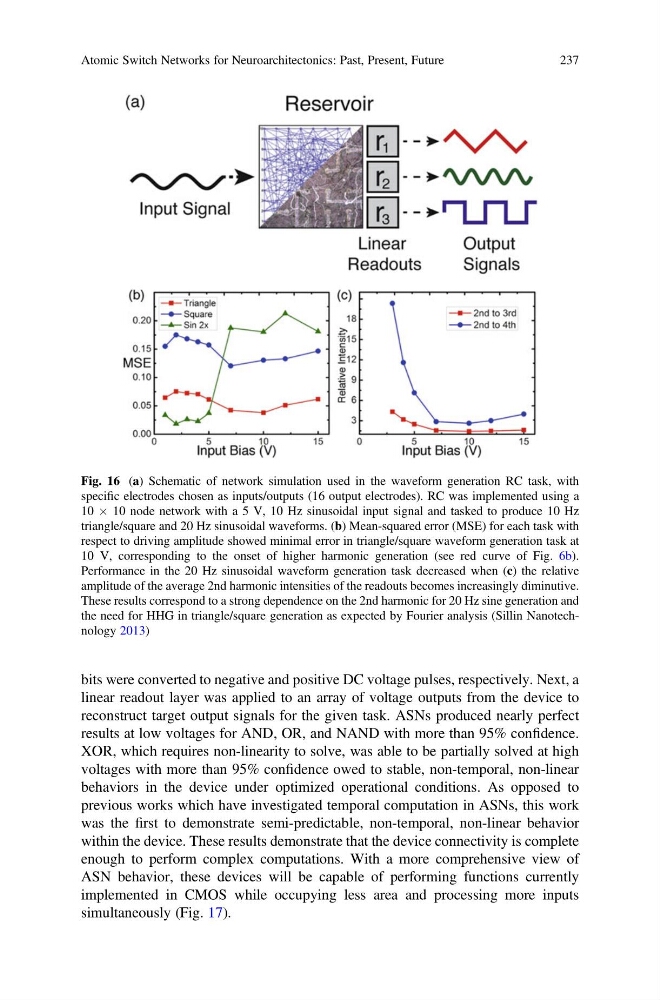
Fig. 16 (a) Schematic of network simulation used in the waveform generation RC task, with
specific electrodes chosen as inputs/outputs (16 output electrodes). RC was implemented using a
10 Â 10 node network with a 5 V, 10 Hz sinusoidal input signal and tasked to produce 10 Hz
triangle/square and 20 Hz sinusoidal waveforms. (b) Mean-squared error (MSE) for each task with
respect to driving amplitude showed minimal error in triangle/square waveform generation task at
10 V, corresponding to the onset of higher harmonic generation (see red curve of Fig. 6b).
Performance in the 20 Hz sinusoidal waveform generation task decreased when (c) the relative
amplitude of the average 2nd harmonic intensities of the readouts becomes increasingly diminutive.
These results correspond to a strong dependence on the 2nd harmonic for 20 Hz sine generation and
the need for HHG in triangle/square generation as expected by Fourier analysis (Sillin Nanotechnology 2013)
Atomic Switch Networks for Neuroarchitectonics: Past, Present, Future
237
linear readout layer was applied to an array of voltage outputs from the device to
reconstruct target output signals for the given task. ASNs produced nearly perfect
results at low voltages for AND, OR, and NAND with more than 95% confidence.
XOR, which requires non-linearity to solve, was able to be partially solved at high
voltages with more than 95% confidence owed to stable, non-temporal, non-linear
behaviors in the device under optimized operational conditions. As opposed to
previous works which have investigated temporal computation in ASNs, this work
was the first to demonstrate semi-predictable, non-temporal, non-linear behavior
within the device. These results demonstrate that the device connectivity is complete
enough to perform complex computations. With a more comprehensive view of
ASN behavior, these devices will be capable of performing functions currently
implemented in CMOS while occupying less area and processing more inputs
simultaneously (Fig. 17).
Fig. 16 (a) Schematic of network simulation used in the waveform generation RC task, with
specific electrodes chosen as inputs/outputs (16 output electrodes). RC was implemented using a
10 Â 10 node network with a 5 V, 10 Hz sinusoidal input signal and tasked to produce 10 Hz
triangle/square and 20 Hz sinusoidal waveforms. (b) Mean-squared error (MSE) for each task with
respect to driving amplitude showed minimal error in triangle/square waveform generation task at
10 V, corresponding to the onset of higher harmonic generation (see red curve of Fig. 6b).
Performance in the 20 Hz sinusoidal waveform generation task decreased when (c) the relative
amplitude of the average 2nd harmonic intensities of the readouts becomes increasingly diminutive.
These results correspond to a strong dependence on the 2nd harmonic for 20 Hz sine generation and
the need for HHG in triangle/square generation as expected by Fourier analysis (Sillin Nanotechnology 2013)
Atomic Switch Networks for Neuroarchitectonics: Past, Present, Future
237