

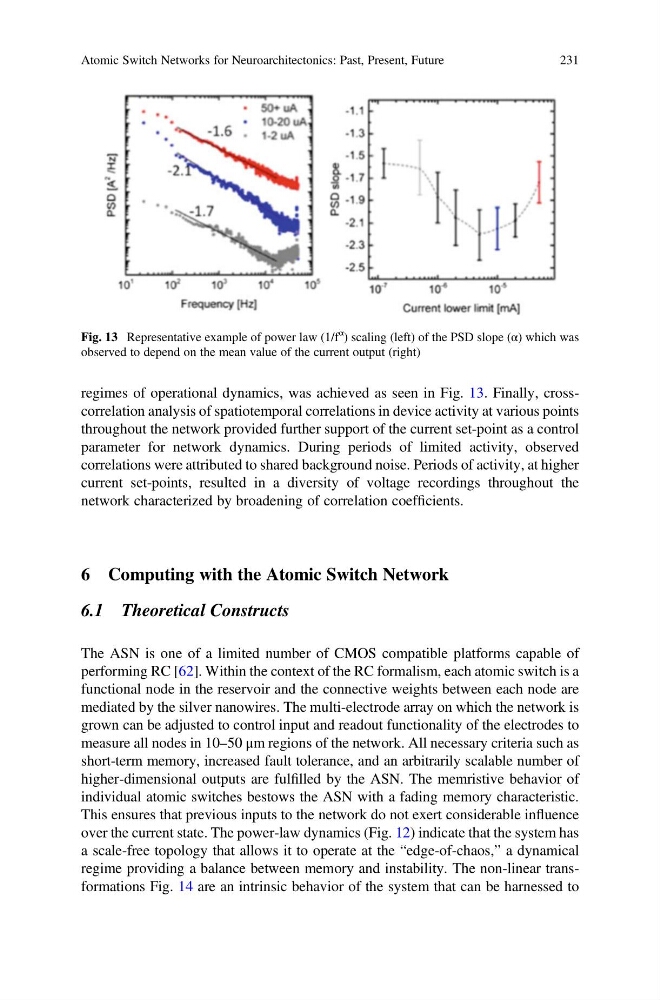
regimes of operational dynamics, was achieved as seen in Fig. 13. Finally, crosscorrelation analysis of spatiotemporal correlations in device activity at various points
throughout the network provided further support of the current set-point as a control
parameter for network dynamics. During periods of limited activity, observed
correlations were attributed to shared background noise. Periods of activity, at higher
current set-points, resulted in a diversity of voltage recordings throughout the
network characterized by broadening of correlation coefficients.
6 Computing with the Atomic Switch Network
6.1 Theoretical Constructs
The ASN is one of a limited number of CMOS compatible platforms capable of
performing RC [62]. Within the context of the RC formalism, each atomic switch is a
functional node in the reservoir and the connective weights between each node are
mediated by the silver nanowires. The multi-electrode array on which the network is
grown can be adjusted to control input and readout functionality of the electrodes to
measure all nodes in 10–50 μm regions of the network. All necessary criteria such as
short-term memory, increased fault tolerance, and an arbitrarily scalable number of
higher-dimensional outputs are fulfilled by the ASN. The memristive behavior of
individual atomic switches bestows the ASN with a fading memory characteristic.
This ensures that previous inputs to the network do not exert considerable influence
over the current state. The power-law dynamics (Fig. 12) indicate that the system has
a scale-free topology that allows it to operate at the “edge-of-chaos,” a dynamical
regime providing a balance between memory and instability. The non-linear transformations Fig. 14 are an intrinsic behavior of the system that can be harnessed to
Fig. 13 Representative example of power law (1/f
α
) scaling (left) of the PSD slope (α) which was
observed to depend on the mean value of the current output (right)
Atomic Switch Networks for Neuroarchitectonics: Past, Present, Future
231
throughout the network provided further support of the current set-point as a control
parameter for network dynamics. During periods of limited activity, observed
correlations were attributed to shared background noise. Periods of activity, at higher
current set-points, resulted in a diversity of voltage recordings throughout the
network characterized by broadening of correlation coefficients.
6 Computing with the Atomic Switch Network
6.1 Theoretical Constructs
The ASN is one of a limited number of CMOS compatible platforms capable of
performing RC [62]. Within the context of the RC formalism, each atomic switch is a
functional node in the reservoir and the connective weights between each node are
mediated by the silver nanowires. The multi-electrode array on which the network is
grown can be adjusted to control input and readout functionality of the electrodes to
measure all nodes in 10–50 μm regions of the network. All necessary criteria such as
short-term memory, increased fault tolerance, and an arbitrarily scalable number of
higher-dimensional outputs are fulfilled by the ASN. The memristive behavior of
individual atomic switches bestows the ASN with a fading memory characteristic.
This ensures that previous inputs to the network do not exert considerable influence
over the current state. The power-law dynamics (Fig. 12) indicate that the system has
a scale-free topology that allows it to operate at the “edge-of-chaos,” a dynamical
regime providing a balance between memory and instability. The non-linear transformations Fig. 14 are an intrinsic behavior of the system that can be harnessed to
Fig. 13 Representative example of power law (1/f
α
) scaling (left) of the PSD slope (α) which was
observed to depend on the mean value of the current output (right)
Atomic Switch Networks for Neuroarchitectonics: Past, Present, Future
231