

diverging temporal correlation length. Observation of both increased and decreased
conductivity during stimulation, similar to fluctuations under DC stimulation
described above, were again attributed to recurrent network dynamics.
Finally, opportunities for teaching and learning through utilizing metastable
critical states were initiated through close collaboration with our theoretical team.
This process required: the development of an analytical model for the complex
behavior observed in such devices, the design and implementation of teaching
algorithms, and exploration of means to interact with the network.
5.8 Altered Critical Power-Law Dynamics
ASN devices have also demonstrated altered power spectral density, or PSD, slopes.
As seen in Figs. 1 and 2, the mean current of a given state showed a marked
dependence on both the length of the state and the probability (P(D)) of its occurrence where longer state durations and increased activity, characterized by 1/f alpha
power-law scaling of PSD, were observed for intermediate mean current values. In
an effort to control these properties, a current-controlled feedback loop was
implemented in a similar fashion to that shown in Fig. 3. Real-time maintenance
of a defined current set-point between two arbitrarily defined electrodes was readily
achieved through application of an applied bias voltage (Fig. 14). While persistent
fluctuations in ASN conductance are known to exhibit non-trivial spatiotemporal
correlations characterized by power-law scaling of PSD [44, 46], procedures to
control such correlations have yet to be reported. Utilization of the current-control
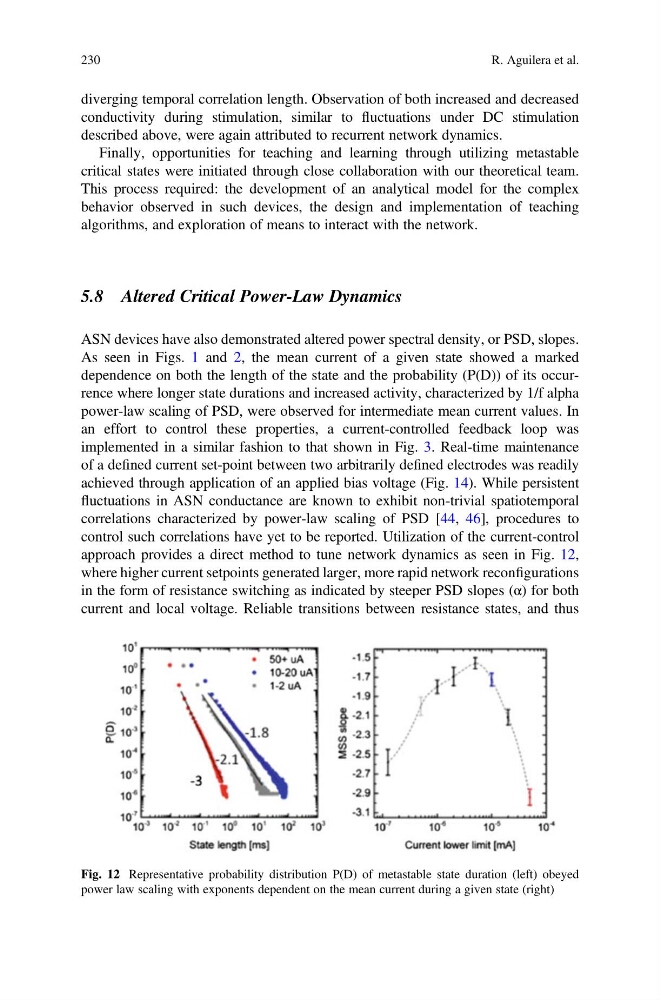
approach provides a direct method to tune network dynamics as seen in Fig. 12,
where higher current setpoints generated larger, more rapid network reconfigurations
in the form of resistance switching as indicated by steeper PSD slopes (α) for both
current and local voltage. Reliable transitions between resistance states, and thus
Fig. 12 Representative probability distribution P(D) of metastable state duration (left) obeyed
power law scaling with exponents dependent on the mean current during a given state (right)
230
R. Aguilera et al.
conductivity during stimulation, similar to fluctuations under DC stimulation
described above, were again attributed to recurrent network dynamics.
Finally, opportunities for teaching and learning through utilizing metastable
critical states were initiated through close collaboration with our theoretical team.
This process required: the development of an analytical model for the complex
behavior observed in such devices, the design and implementation of teaching
algorithms, and exploration of means to interact with the network.
5.8 Altered Critical Power-Law Dynamics
ASN devices have also demonstrated altered power spectral density, or PSD, slopes.
As seen in Figs. 1 and 2, the mean current of a given state showed a marked
dependence on both the length of the state and the probability (P(D)) of its occurrence where longer state durations and increased activity, characterized by 1/f alpha
power-law scaling of PSD, were observed for intermediate mean current values. In
an effort to control these properties, a current-controlled feedback loop was
implemented in a similar fashion to that shown in Fig. 3. Real-time maintenance
of a defined current set-point between two arbitrarily defined electrodes was readily
achieved through application of an applied bias voltage (Fig. 14). While persistent
fluctuations in ASN conductance are known to exhibit non-trivial spatiotemporal
correlations characterized by power-law scaling of PSD [44, 46], procedures to
control such correlations have yet to be reported. Utilization of the current-control
approach provides a direct method to tune network dynamics as seen in Fig. 12,
where higher current setpoints generated larger, more rapid network reconfigurations
in the form of resistance switching as indicated by steeper PSD slopes (α) for both
current and local voltage. Reliable transitions between resistance states, and thus
Fig. 12 Representative probability distribution P(D) of metastable state duration (left) obeyed
power law scaling with exponents dependent on the mean current during a given state (right)
230
R. Aguilera et al.