

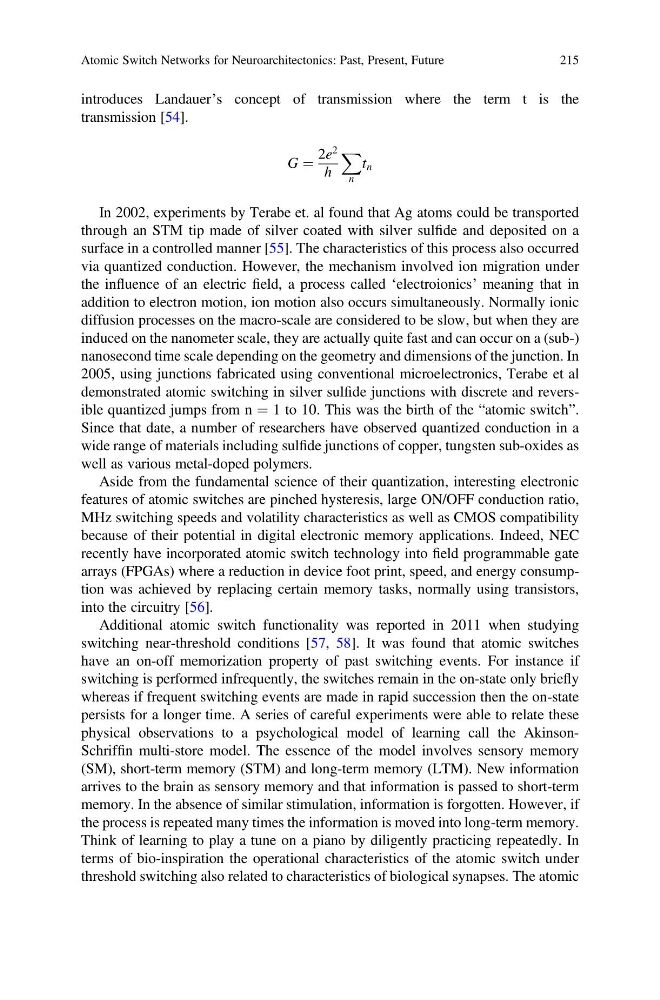
introduces Landauer’s concept of transmission where the term t is the
transmission [54].
G ¼
2e
2
h
X
n
t n
In 2002, experiments by Terabe et. al found that Ag atoms could be transported
through an STM tip made of silver coated with silver sulfide and deposited on a
surface in a controlled manner [55]. The characteristics of this process also occurred
via quantized conduction. However, the mechanism involved ion migration under
the influence of an electric field, a process called ‘electroionics’ meaning that in
addition to electron motion, ion motion also occurs simultaneously. Normally ionic
diffusion processes on the macro-scale are considered to be slow, but when they are
induced on the nanometer scale, they are actually quite fast and can occur on a (sub-)
nanosecond time scale depending on the geometry and dimensions of the junction. In
2005, using junctions fabricated using conventional microelectronics, Terabe et al
demonstrated atomic switching in silver sulfide junctions with discrete and reversible quantized jumps from n ¼ 1 to 10. This was the birth of the “atomic switch”.
Since that date, a number of researchers have observed quantized conduction in a
wide range of materials including sulfide junctions of copper, tungsten sub-oxides as
well as various metal-doped polymers.
Aside from the fundamental science of their quantization, interesting electronic
features of atomic switches are pinched hysteresis, large ON/OFF conduction ratio,
MHz switching speeds and volatility characteristics as well as CMOS compatibility
because of their potential in digital electronic memory applications. Indeed, NEC
recently have incorporated atomic switch technology into field programmable gate
arrays (FPGAs) where a reduction in device foot print, speed, and energy consumption was achieved by replacing certain memory tasks, normally using transistors,
into the circuitry [56].
Additional atomic switch functionality was reported in 2011 when studying
switching near-threshold conditions [57, 58]. It was found that atomic switches
have an on-off memorization property of past switching events. For instance if
switching is performed infrequently, the switches remain in the on-state only briefly
whereas if frequent switching events are made in rapid succession then the on-state
persists for a longer time. A series of careful experiments were able to relate these
physical observations to a psychological model of learning call the AkinsonSchriffin multi-store model. The essence of the model involves sensory memory
(SM), short-term memory (STM) and long-term memory (LTM). New information
arrives to the brain as sensory memory and that information is passed to short-term
memory. In the absence of similar stimulation, information is forgotten. However, if
the process is repeated many times the information is moved into long-term memory.
Think of learning to play a tune on a piano by diligently practicing repeatedly. In
terms of bio-inspiration the operational characteristics of the atomic switch under
threshold switching also related to characteristics of biological synapses. The atomic
Atomic Switch Networks for Neuroarchitectonics: Past, Present, Future
215
transmission [54].
G ¼
2e
2
h
X
n
t n
In 2002, experiments by Terabe et. al found that Ag atoms could be transported
through an STM tip made of silver coated with silver sulfide and deposited on a
surface in a controlled manner [55]. The characteristics of this process also occurred
via quantized conduction. However, the mechanism involved ion migration under
the influence of an electric field, a process called ‘electroionics’ meaning that in
addition to electron motion, ion motion also occurs simultaneously. Normally ionic
diffusion processes on the macro-scale are considered to be slow, but when they are
induced on the nanometer scale, they are actually quite fast and can occur on a (sub-)
nanosecond time scale depending on the geometry and dimensions of the junction. In
2005, using junctions fabricated using conventional microelectronics, Terabe et al
demonstrated atomic switching in silver sulfide junctions with discrete and reversible quantized jumps from n ¼ 1 to 10. This was the birth of the “atomic switch”.
Since that date, a number of researchers have observed quantized conduction in a
wide range of materials including sulfide junctions of copper, tungsten sub-oxides as
well as various metal-doped polymers.
Aside from the fundamental science of their quantization, interesting electronic
features of atomic switches are pinched hysteresis, large ON/OFF conduction ratio,
MHz switching speeds and volatility characteristics as well as CMOS compatibility
because of their potential in digital electronic memory applications. Indeed, NEC
recently have incorporated atomic switch technology into field programmable gate
arrays (FPGAs) where a reduction in device foot print, speed, and energy consumption was achieved by replacing certain memory tasks, normally using transistors,
into the circuitry [56].
Additional atomic switch functionality was reported in 2011 when studying
switching near-threshold conditions [57, 58]. It was found that atomic switches
have an on-off memorization property of past switching events. For instance if
switching is performed infrequently, the switches remain in the on-state only briefly
whereas if frequent switching events are made in rapid succession then the on-state
persists for a longer time. A series of careful experiments were able to relate these
physical observations to a psychological model of learning call the AkinsonSchriffin multi-store model. The essence of the model involves sensory memory
(SM), short-term memory (STM) and long-term memory (LTM). New information
arrives to the brain as sensory memory and that information is passed to short-term
memory. In the absence of similar stimulation, information is forgotten. However, if
the process is repeated many times the information is moved into long-term memory.
Think of learning to play a tune on a piano by diligently practicing repeatedly. In
terms of bio-inspiration the operational characteristics of the atomic switch under
threshold switching also related to characteristics of biological synapses. The atomic
Atomic Switch Networks for Neuroarchitectonics: Past, Present, Future
215