

3 Gapless (Junction)-Type Atomic Switch
Gapless-type atomic switches operated by controlling the migration of metal ions
and the solid electrochemical reaction from the nanoscale to the atomic scale in the
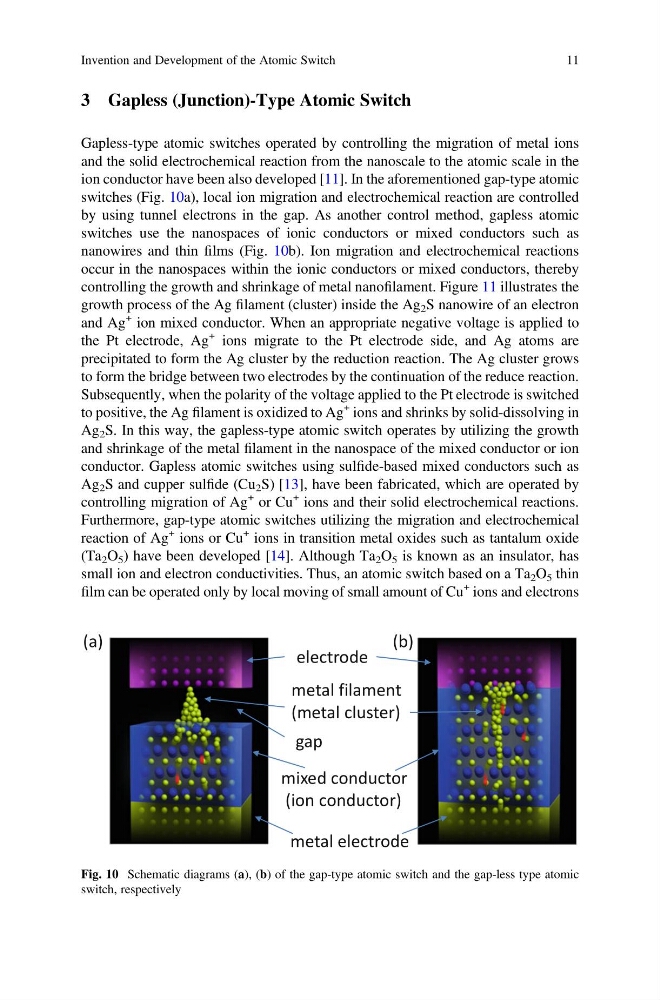
ion conductor have been also developed [11]. In the aforementioned gap-type atomic
switches (Fig. 10a), local ion migration and electrochemical reaction are controlled
by using tunnel electrons in the gap. As another control method, gapless atomic
switches use the nanospaces of ionic conductors or mixed conductors such as
nanowires and thin films (Fig. 10b). Ion migration and electrochemical reactions
occur in the nanospaces within the ionic conductors or mixed conductors, thereby
controlling the growth and shrinkage of metal nanofilament. Figure 11 illustrates the
growth process of the Ag filament (cluster) inside the Ag 2 S nanowire of an electron
and Ag
+ ion mixed conductor. When an appropriate negative voltage is applied to
the Pt electrode, Ag
+ ions migrate to the Pt electrode side, and Ag atoms are
precipitated to form the Ag cluster by the reduction reaction. The Ag cluster grows
to form the bridge between two electrodes by the continuation of the reduce reaction.
Subsequently, when the polarity of the voltage applied to the Pt electrode is switched
to positive, the Ag filament is oxidized to Ag
+ ions and shrinks by solid-dissolving in
Ag 2 S. In this way, the gapless-type atomic switch operates by utilizing the growth
and shrinkage of the metal filament in the nanospace of the mixed conductor or ion
conductor. Gapless atomic switches using sulfide-based mixed conductors such as
Ag 2 S and cupper sulfide (Cu 2 S) [13], have been fabricated, which are operated by
controlling migration of Ag
+ or Cu
+ ions and their solid electrochemical reactions.
Furthermore, gap-type atomic switches utilizing the migration and electrochemical
reaction of Ag
+ ions or Cu
+ ions in transition metal oxides such as tantalum oxide
(Ta 2 O 5 ) have been developed [14]. Although Ta 2 O 5 is known as an insulator, has
small ion and electron conductivities. Thus, an atomic switch based on a Ta 2 O 5 thin
film can be operated only by local moving of small amount of Cu
+ ions and electrons
(a)
(b)
metal filament
(metal cluster)
electrode
metal electrode
mixed conductor
(ion conductor)
gap
Fig. 10 Schematic diagrams (a), (b) of the gap-type atomic switch and the gap-less type atomic
switch, respectively
Invention and Development of the Atomic Switch
11
Gapless-type atomic switches operated by controlling the migration of metal ions
and the solid electrochemical reaction from the nanoscale to the atomic scale in the
ion conductor have been also developed [11]. In the aforementioned gap-type atomic
switches (Fig. 10a), local ion migration and electrochemical reaction are controlled
by using tunnel electrons in the gap. As another control method, gapless atomic
switches use the nanospaces of ionic conductors or mixed conductors such as
nanowires and thin films (Fig. 10b). Ion migration and electrochemical reactions
occur in the nanospaces within the ionic conductors or mixed conductors, thereby
controlling the growth and shrinkage of metal nanofilament. Figure 11 illustrates the
growth process of the Ag filament (cluster) inside the Ag 2 S nanowire of an electron
and Ag
+ ion mixed conductor. When an appropriate negative voltage is applied to
the Pt electrode, Ag
+ ions migrate to the Pt electrode side, and Ag atoms are
precipitated to form the Ag cluster by the reduction reaction. The Ag cluster grows
to form the bridge between two electrodes by the continuation of the reduce reaction.
Subsequently, when the polarity of the voltage applied to the Pt electrode is switched
to positive, the Ag filament is oxidized to Ag
+ ions and shrinks by solid-dissolving in
Ag 2 S. In this way, the gapless-type atomic switch operates by utilizing the growth
and shrinkage of the metal filament in the nanospace of the mixed conductor or ion
conductor. Gapless atomic switches using sulfide-based mixed conductors such as
Ag 2 S and cupper sulfide (Cu 2 S) [13], have been fabricated, which are operated by
controlling migration of Ag
+ or Cu
+ ions and their solid electrochemical reactions.
Furthermore, gap-type atomic switches utilizing the migration and electrochemical
reaction of Ag
+ ions or Cu
+ ions in transition metal oxides such as tantalum oxide
(Ta 2 O 5 ) have been developed [14]. Although Ta 2 O 5 is known as an insulator, has
small ion and electron conductivities. Thus, an atomic switch based on a Ta 2 O 5 thin
film can be operated only by local moving of small amount of Cu
+ ions and electrons
(a)
(b)
metal filament
(metal cluster)
electrode
metal electrode
mixed conductor
(ion conductor)
gap
Fig. 10 Schematic diagrams (a), (b) of the gap-type atomic switch and the gap-less type atomic
switch, respectively
Invention and Development of the Atomic Switch
11