

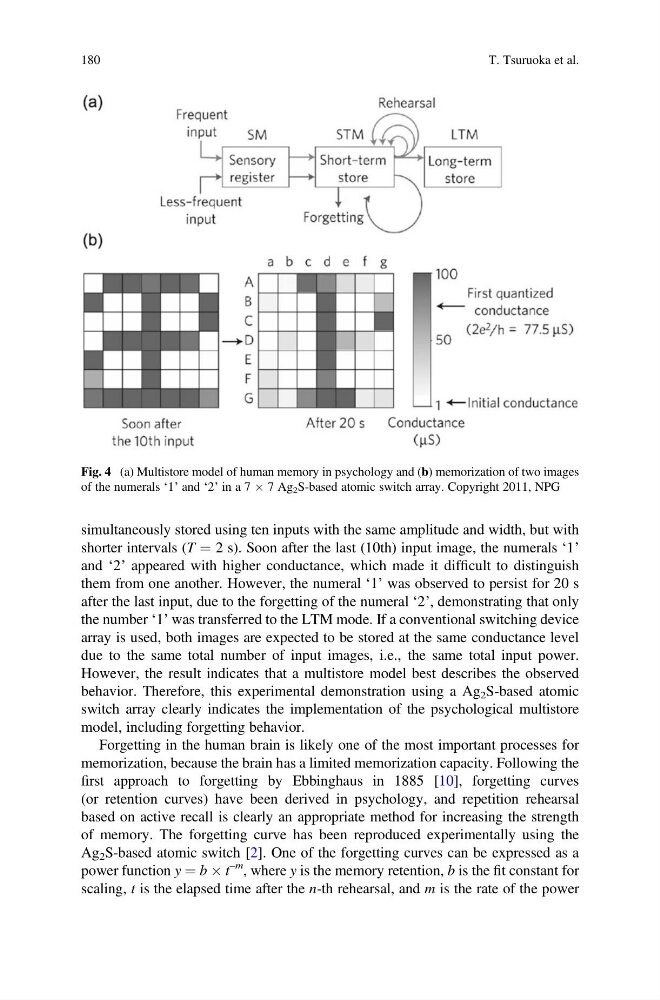
simultaneously stored using ten inputs with the same amplitude and width, but with
shorter intervals (T ¼ 2 s). Soon after the last (10th) input image, the numerals ‘1’
and ‘2’ appeared with higher conductance, which made it difficult to distinguish
them from one another. However, the numeral ‘1’ was observed to persist for 20 s
after the last input, due to the forgetting of the numeral ‘2’, demonstrating that only
the number ‘1’ was transferred to the LTM mode. If a conventional switching device
array is used, both images are expected to be stored at the same conductance level
due to the same total number of input images, i.e., the same total input power.
However, the result indicates that a multistore model best describes the observed
behavior. Therefore, this experimental demonstration using a Ag 2 S-based atomic
switch array clearly indicates the implementation of the psychological multistore
model, including forgetting behavior.
Forgetting in the human brain is likely one of the most important processes for
memorization, because the brain has a limited memorization capacity. Following the
first approach to forgetting by Ebbinghaus in 1885 [10], forgetting curves
(or retention curves) have been derived in psychology, and repetition rehearsal
based on active recall is clearly an appropriate method for increasing the strength
of memory. The forgetting curve has been reproduced experimentally using the
Ag 2 S-based atomic switch [2]. One of the forgetting curves can be expressed as a
power function y ¼ b  t
–m
, where y is the memory retention, b is the fit constant for
scaling, t is the elapsed time after the n-th rehearsal, and m is the rate of the power
Fig. 4 (a) Multistore model of human memory in psychology and (b) memorization of two images
of the numerals ‘1’ and ‘2’ in a 7 Â 7 Ag 2 S-based atomic switch array. Copyright 2011, NPG
180
T. Tsuruoka et al.
shorter intervals (T ¼ 2 s). Soon after the last (10th) input image, the numerals ‘1’
and ‘2’ appeared with higher conductance, which made it difficult to distinguish
them from one another. However, the numeral ‘1’ was observed to persist for 20 s
after the last input, due to the forgetting of the numeral ‘2’, demonstrating that only
the number ‘1’ was transferred to the LTM mode. If a conventional switching device
array is used, both images are expected to be stored at the same conductance level
due to the same total number of input images, i.e., the same total input power.
However, the result indicates that a multistore model best describes the observed
behavior. Therefore, this experimental demonstration using a Ag 2 S-based atomic
switch array clearly indicates the implementation of the psychological multistore
model, including forgetting behavior.
Forgetting in the human brain is likely one of the most important processes for
memorization, because the brain has a limited memorization capacity. Following the
first approach to forgetting by Ebbinghaus in 1885 [10], forgetting curves
(or retention curves) have been derived in psychology, and repetition rehearsal
based on active recall is clearly an appropriate method for increasing the strength
of memory. The forgetting curve has been reproduced experimentally using the
Ag 2 S-based atomic switch [2]. One of the forgetting curves can be expressed as a
power function y ¼ b  t
–m
, where y is the memory retention, b is the fit constant for
scaling, t is the elapsed time after the n-th rehearsal, and m is the rate of the power
Fig. 4 (a) Multistore model of human memory in psychology and (b) memorization of two images
of the numerals ‘1’ and ‘2’ in a 7 Â 7 Ag 2 S-based atomic switch array. Copyright 2011, NPG
180
T. Tsuruoka et al.