

neural circuits via synaptic plasticity. Although several models of human memory
have been proposed, the multistore model developed by Atkinson and Shiffrin in
1968 is one of the most popular psychological memorization models [9]. Figure 4a
shows the three types of memory in this model: sensory memory (SM), short-term
memory (STM), and long-term memory (LTM). New information from the external
environment is stored in the sensory register as an SM for a very short period of time,
and then selected information is transferred from a temporary STM in short-term
store to a permanent LTM in long-term store. Note that Atkinson and Shiffrin
assumed that STM can change to LTM through a rehearsal process, and that frequent
rehearsals increase the probability of changing from STM to LTM.
We were successful in introducing the concept of the psychological multistore
model into neuromorphic engineering [2]. Ag 2 S-based atomic switches were used to
conduct image memorization to demonstrate psychological behavior. In this demonstration, two images of the numerals ‘1’ and ‘2’ were stored in a 7 Â 7 Ag 2 S-based
atomic switch array (Fig. 4b). In this array, the change in conductance at each pixel
corresponded to the result for a single atomic switch, where a dark color indicates a
high conductance value. Here, an image of the numeral ‘2’ was stored using ten
inputs with longer intervals (T ¼ 20 s), and an image of the numeral ‘1’ was
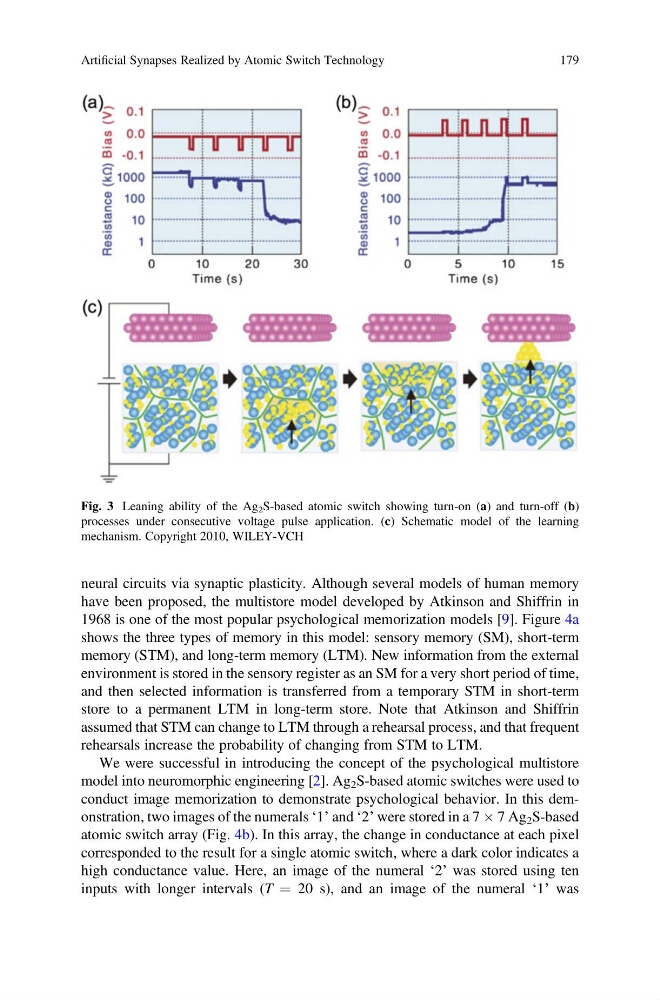
Fig. 3 Leaning ability of the Ag 2 S-based atomic switch showing turn-on (a) and turn-off (b)
processes under consecutive voltage pulse application. (c) Schematic model of the learning
mechanism. Copyright 2010, WILEY-VCH
Artificial Synapses Realized by Atomic Switch Technology
179
have been proposed, the multistore model developed by Atkinson and Shiffrin in
1968 is one of the most popular psychological memorization models [9]. Figure 4a
shows the three types of memory in this model: sensory memory (SM), short-term
memory (STM), and long-term memory (LTM). New information from the external
environment is stored in the sensory register as an SM for a very short period of time,
and then selected information is transferred from a temporary STM in short-term
store to a permanent LTM in long-term store. Note that Atkinson and Shiffrin
assumed that STM can change to LTM through a rehearsal process, and that frequent
rehearsals increase the probability of changing from STM to LTM.
We were successful in introducing the concept of the psychological multistore
model into neuromorphic engineering [2]. Ag 2 S-based atomic switches were used to
conduct image memorization to demonstrate psychological behavior. In this demonstration, two images of the numerals ‘1’ and ‘2’ were stored in a 7 Â 7 Ag 2 S-based
atomic switch array (Fig. 4b). In this array, the change in conductance at each pixel
corresponded to the result for a single atomic switch, where a dark color indicates a
high conductance value. Here, an image of the numeral ‘2’ was stored using ten
inputs with longer intervals (T ¼ 20 s), and an image of the numeral ‘1’ was
Fig. 3 Leaning ability of the Ag 2 S-based atomic switch showing turn-on (a) and turn-off (b)
processes under consecutive voltage pulse application. (c) Schematic model of the learning
mechanism. Copyright 2010, WILEY-VCH
Artificial Synapses Realized by Atomic Switch Technology
179