

2 Gap-Type Atomic Switch Synaptic Behavior
From the earliest stages of the research into the atomic switch, it has shown learning
abilities in which the conductance increases gradually under repeated bias sweeping
[6]. Subsequently, we found synaptic behavior by applying consecutive voltage
pulses [7]. In this section, we describe synaptic behaviors of gap-type atomic
switches using sulfides. Utilizing the mixed conductor properties of sulfide materials, we demonstrated not only STP/LTP behaviors but also sensitivity to the
environmental conditions. Note that most of Sect. 2.2 is reproduced with permission
from Ref. [3]. Copyright 2012 John Wiley & Sons.
2.1 Ag 2 S-Based Switch
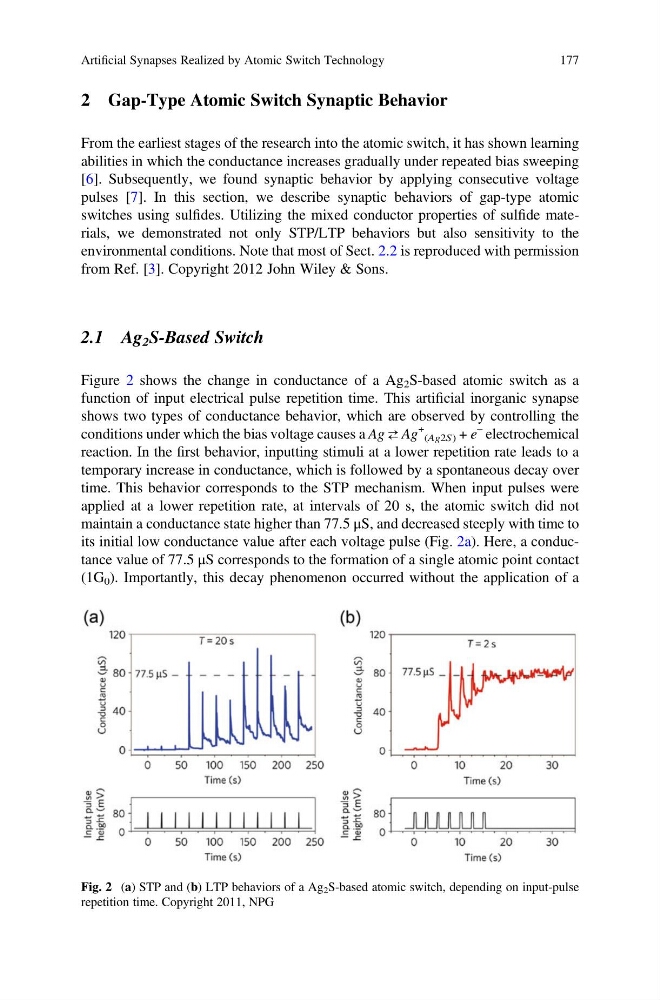
Figure 2 shows the change in conductance of a Ag 2 S-based atomic switch as a
function of input electrical pulse repetition time. This artificial inorganic synapse
shows two types of conductance behavior, which are observed by controlling the
conditions under which the bias voltage causes a Ag ⇄ Ag
+
(Ag2S) + e
– electrochemical
reaction. In the first behavior, inputting stimuli at a lower repetition rate leads to a
temporary increase in conductance, which is followed by a spontaneous decay over
time. This behavior corresponds to the STP mechanism. When input pulses were
applied at a lower repetition rate, at intervals of 20 s, the atomic switch did not
maintain a conductance state higher than 77.5 μS, and decreased steeply with time to
its initial low conductance value after each voltage pulse (Fig. 2a). Here, a conductance value of 77.5 μS corresponds to the formation of a single atomic point contact
(1G 0 ). Importantly, this decay phenomenon occurred without the application of a
Fig. 2 (a) STP and (b) LTP behaviors of a Ag 2 S-based atomic switch, depending on input-pulse
repetition time. Copyright 2011, NPG
Artificial Synapses Realized by Atomic Switch Technology
177
From the earliest stages of the research into the atomic switch, it has shown learning
abilities in which the conductance increases gradually under repeated bias sweeping
[6]. Subsequently, we found synaptic behavior by applying consecutive voltage
pulses [7]. In this section, we describe synaptic behaviors of gap-type atomic
switches using sulfides. Utilizing the mixed conductor properties of sulfide materials, we demonstrated not only STP/LTP behaviors but also sensitivity to the
environmental conditions. Note that most of Sect. 2.2 is reproduced with permission
from Ref. [3]. Copyright 2012 John Wiley & Sons.
2.1 Ag 2 S-Based Switch
Figure 2 shows the change in conductance of a Ag 2 S-based atomic switch as a
function of input electrical pulse repetition time. This artificial inorganic synapse
shows two types of conductance behavior, which are observed by controlling the
conditions under which the bias voltage causes a Ag ⇄ Ag
+
(Ag2S) + e
– electrochemical
reaction. In the first behavior, inputting stimuli at a lower repetition rate leads to a
temporary increase in conductance, which is followed by a spontaneous decay over
time. This behavior corresponds to the STP mechanism. When input pulses were
applied at a lower repetition rate, at intervals of 20 s, the atomic switch did not
maintain a conductance state higher than 77.5 μS, and decreased steeply with time to
its initial low conductance value after each voltage pulse (Fig. 2a). Here, a conductance value of 77.5 μS corresponds to the formation of a single atomic point contact
(1G 0 ). Importantly, this decay phenomenon occurred without the application of a
Fig. 2 (a) STP and (b) LTP behaviors of a Ag 2 S-based atomic switch, depending on input-pulse
repetition time. Copyright 2011, NPG
Artificial Synapses Realized by Atomic Switch Technology
177