

1 Introduction
Memory in the human brain is believed to occur via two types of synaptic plasticity:
short-term plasticity (STP) and long-term potentiation (LTP). Synaptic plasticity
refers to changes that occur in the organization of the brain as a result of information
input and human experience. Providing stimuli over longer intervals forms STP
through the temporal enhancement of synaptic weight (or synaptic connections),
which then quickly decays to its initial state. By contrast, frequent stimulation
permanently changes the synaptic weight required to achieve LTP; shorter repetition
intervals enable more efficient LTP formation using fewer stimuli. These synaptic
behaviors are achieved in a biological system by the action potential from a neuron.
Endeavors continue toward identifying appropriate materials and architectures that
will bring electronics closer to the complexity of the human brain. Even slight
variations in operation based on materials can be rewarding when they are put
together to design brain-type elements. It is noteworthy that, in the human brain,
various metal ions (Fe, Zn, Cu) are known to influence the process of neural signal
transmission, yet each of them has a different role; for instance, the flow of metal
ions in the brain has a recognized role in learning and memory [1].
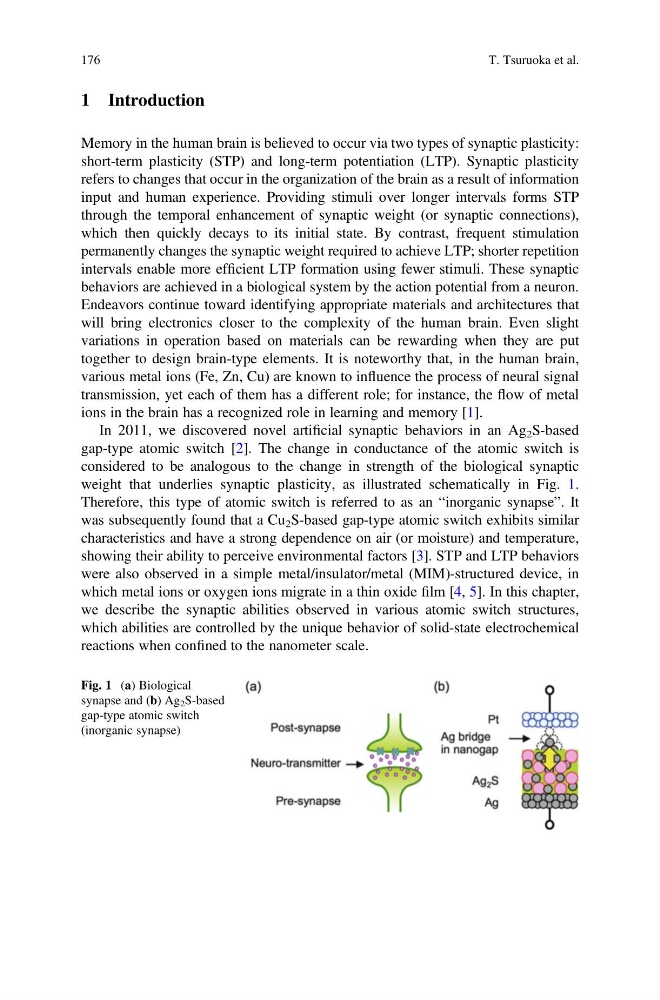
In 2011, we discovered novel artificial synaptic behaviors in an Ag 2 S-based
gap-type atomic switch [2]. The change in conductance of the atomic switch is
considered to be analogous to the change in strength of the biological synaptic
weight that underlies synaptic plasticity, as illustrated schematically in Fig. 1.
Therefore, this type of atomic switch is referred to as an “inorganic synapse”. It
was subsequently found that a Cu 2 S-based gap-type atomic switch exhibits similar
characteristics and have a strong dependence on air (or moisture) and temperature,
showing their ability to perceive environmental factors [3]. STP and LTP behaviors
were also observed in a simple metal/insulator/metal (MIM)-structured device, in
which metal ions or oxygen ions migrate in a thin oxide film [4, 5]. In this chapter,
we describe the synaptic abilities observed in various atomic switch structures,
which abilities are controlled by the unique behavior of solid-state electrochemical
reactions when confined to the nanometer scale.
Fig. 1 (a) Biological
synapse and (b) Ag 2 S-based
gap-type atomic switch
(inorganic synapse)
176
T. Tsuruoka et al.
Memory in the human brain is believed to occur via two types of synaptic plasticity:
short-term plasticity (STP) and long-term potentiation (LTP). Synaptic plasticity
refers to changes that occur in the organization of the brain as a result of information
input and human experience. Providing stimuli over longer intervals forms STP
through the temporal enhancement of synaptic weight (or synaptic connections),
which then quickly decays to its initial state. By contrast, frequent stimulation
permanently changes the synaptic weight required to achieve LTP; shorter repetition
intervals enable more efficient LTP formation using fewer stimuli. These synaptic
behaviors are achieved in a biological system by the action potential from a neuron.
Endeavors continue toward identifying appropriate materials and architectures that
will bring electronics closer to the complexity of the human brain. Even slight
variations in operation based on materials can be rewarding when they are put
together to design brain-type elements. It is noteworthy that, in the human brain,
various metal ions (Fe, Zn, Cu) are known to influence the process of neural signal
transmission, yet each of them has a different role; for instance, the flow of metal
ions in the brain has a recognized role in learning and memory [1].
In 2011, we discovered novel artificial synaptic behaviors in an Ag 2 S-based
gap-type atomic switch [2]. The change in conductance of the atomic switch is
considered to be analogous to the change in strength of the biological synaptic
weight that underlies synaptic plasticity, as illustrated schematically in Fig. 1.
Therefore, this type of atomic switch is referred to as an “inorganic synapse”. It
was subsequently found that a Cu 2 S-based gap-type atomic switch exhibits similar
characteristics and have a strong dependence on air (or moisture) and temperature,
showing their ability to perceive environmental factors [3]. STP and LTP behaviors
were also observed in a simple metal/insulator/metal (MIM)-structured device, in
which metal ions or oxygen ions migrate in a thin oxide film [4, 5]. In this chapter,
we describe the synaptic abilities observed in various atomic switch structures,
which abilities are controlled by the unique behavior of solid-state electrochemical
reactions when confined to the nanometer scale.
Fig. 1 (a) Biological
synapse and (b) Ag 2 S-based
gap-type atomic switch
(inorganic synapse)
176
T. Tsuruoka et al.