

magnitude in the negative bias range with increasing salt concentration. However,
most of them appear in the positive bias range at 5 wt%, suggesting a transition to
volatile switching behavior. For higher than 6 wt%, the device retains the pristine off
state and no longer shows any resistive switching behavior.
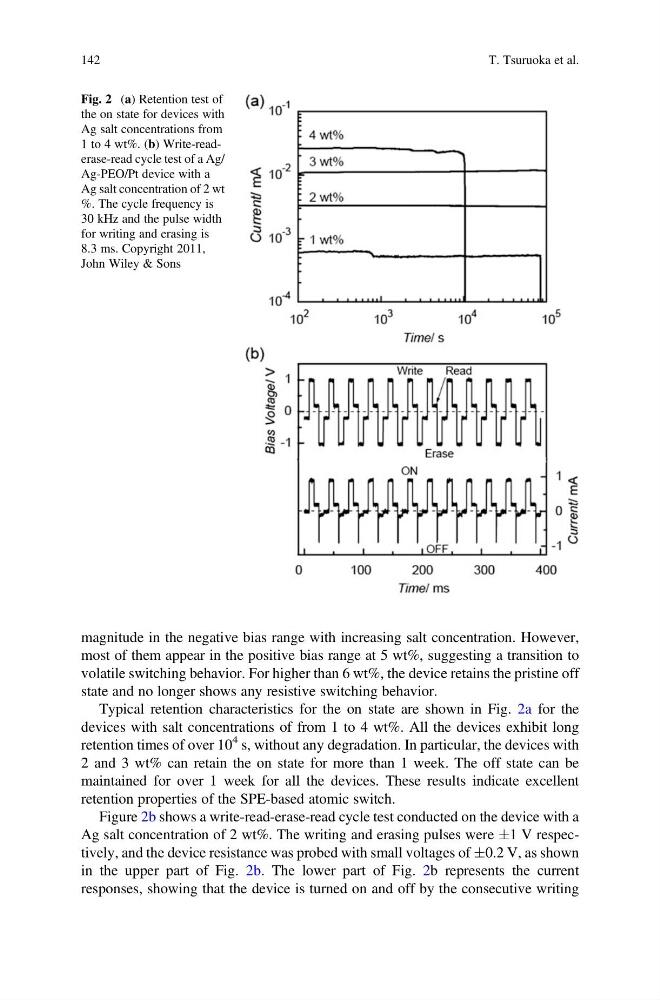
Typical retention characteristics for the on state are shown in Fig. 2a for the
devices with salt concentrations of from 1 to 4 wt%. All the devices exhibit long
retention times of over 10
4 s, without any degradation. In particular, the devices with
2 and 3 wt% can retain the on state for more than 1 week. The off state can be
maintained for over 1 week for all the devices. These results indicate excellent
retention properties of the SPE-based atomic switch.
Figure 2b shows a write-read-erase-read cycle test conducted on the device with a
Ag salt concentration of 2 wt%. The writing and erasing pulses were Æ1 V respectively, and the device resistance was probed with small voltages of Æ0.2 V, as shown
in the upper part of Fig. 2b. The lower part of Fig. 2b represents the current
responses, showing that the device is turned on and off by the consecutive writing
Fig. 2 (a) Retention test of
the on state for devices with
Ag salt concentrations from
1 to 4 wt%. (b) Write-readerase-read cycle test of a Ag/
Ag-PEO/Pt device with a
Ag salt concentration of 2 wt
%. The cycle frequency is
30 kHz and the pulse width
for writing and erasing is
8.3 ms. Copyright 2011,
John Wiley & Sons
142
T. Tsuruoka et al.
most of them appear in the positive bias range at 5 wt%, suggesting a transition to
volatile switching behavior. For higher than 6 wt%, the device retains the pristine off
state and no longer shows any resistive switching behavior.
Typical retention characteristics for the on state are shown in Fig. 2a for the
devices with salt concentrations of from 1 to 4 wt%. All the devices exhibit long
retention times of over 10
4 s, without any degradation. In particular, the devices with
2 and 3 wt% can retain the on state for more than 1 week. The off state can be
maintained for over 1 week for all the devices. These results indicate excellent
retention properties of the SPE-based atomic switch.
Figure 2b shows a write-read-erase-read cycle test conducted on the device with a
Ag salt concentration of 2 wt%. The writing and erasing pulses were Æ1 V respectively, and the device resistance was probed with small voltages of Æ0.2 V, as shown
in the upper part of Fig. 2b. The lower part of Fig. 2b represents the current
responses, showing that the device is turned on and off by the consecutive writing
Fig. 2 (a) Retention test of
the on state for devices with
Ag salt concentrations from
1 to 4 wt%. (b) Write-readerase-read cycle test of a Ag/
Ag-PEO/Pt device with a
Ag salt concentration of 2 wt
%. The cycle frequency is
30 kHz and the pulse width
for writing and erasing is
8.3 ms. Copyright 2011,
John Wiley & Sons
142
T. Tsuruoka et al.