

Ag-included PEO (AG-PEO) film ranged from 1 to 8 wt%. Thicknesses of SPE films
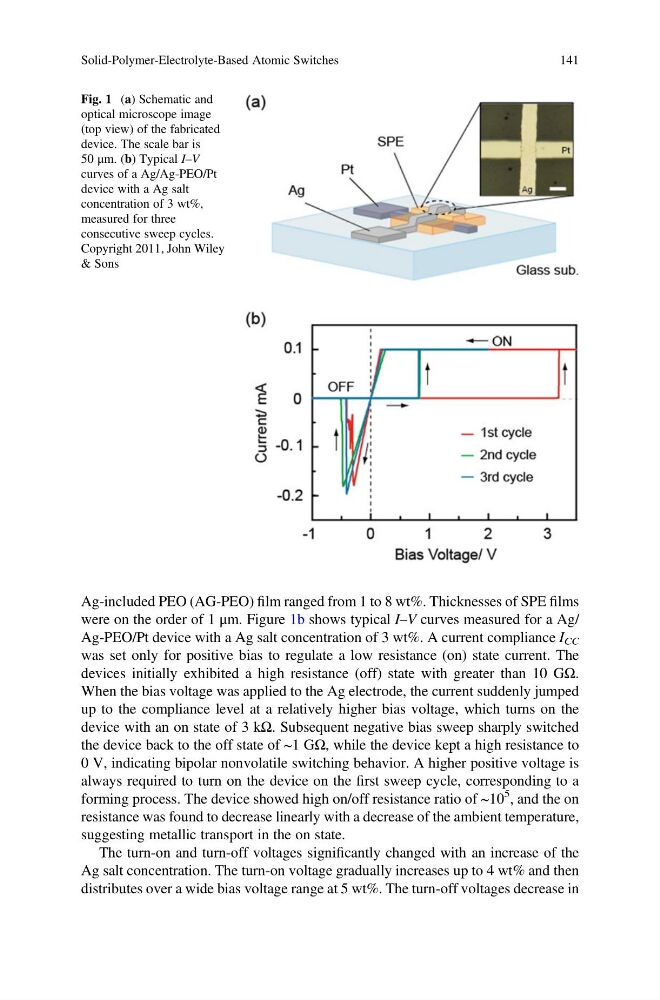
were on the order of 1 μm. Figure 1b shows typical I–V curves measured for a Ag/
Ag-PEO/Pt device with a Ag salt concentration of 3 wt%. A current compliance I CC
was set only for positive bias to regulate a low resistance (on) state current. The
devices initially exhibited a high resistance (off) state with greater than 10 GΩ.
When the bias voltage was applied to the Ag electrode, the current suddenly jumped
up to the compliance level at a relatively higher bias voltage, which turns on the
device with an on state of 3 kΩ. Subsequent negative bias sweep sharply switched
the device back to the off state of ~1 GΩ, while the device kept a high resistance to
0 V, indicating bipolar nonvolatile switching behavior. A higher positive voltage is
always required to turn on the device on the first sweep cycle, corresponding to a
forming process. The device showed high on/off resistance ratio of ~10
5 , and the on
resistance was found to decrease linearly with a decrease of the ambient temperature,
suggesting metallic transport in the on state.
The turn-on and turn-off voltages significantly changed with an increase of the
Ag salt concentration. The turn-on voltage gradually increases up to 4 wt% and then
distributes over a wide bias voltage range at 5 wt%. The turn-off voltages decrease in
Fig. 1 (a) Schematic and
optical microscope image
(top view) of the fabricated
device. The scale bar is
50 μm. (b) Typical I–V
curves of a Ag/Ag-PEO/Pt
device with a Ag salt
concentration of 3 wt%,
measured for three
consecutive sweep cycles.
Copyright 2011, John Wiley
& Sons
Solid-Polymer-Electrolyte-Based Atomic Switches
141
were on the order of 1 μm. Figure 1b shows typical I–V curves measured for a Ag/
Ag-PEO/Pt device with a Ag salt concentration of 3 wt%. A current compliance I CC
was set only for positive bias to regulate a low resistance (on) state current. The
devices initially exhibited a high resistance (off) state with greater than 10 GΩ.
When the bias voltage was applied to the Ag electrode, the current suddenly jumped
up to the compliance level at a relatively higher bias voltage, which turns on the
device with an on state of 3 kΩ. Subsequent negative bias sweep sharply switched
the device back to the off state of ~1 GΩ, while the device kept a high resistance to
0 V, indicating bipolar nonvolatile switching behavior. A higher positive voltage is
always required to turn on the device on the first sweep cycle, corresponding to a
forming process. The device showed high on/off resistance ratio of ~10
5 , and the on
resistance was found to decrease linearly with a decrease of the ambient temperature,
suggesting metallic transport in the on state.
The turn-on and turn-off voltages significantly changed with an increase of the
Ag salt concentration. The turn-on voltage gradually increases up to 4 wt% and then
distributes over a wide bias voltage range at 5 wt%. The turn-off voltages decrease in
Fig. 1 (a) Schematic and
optical microscope image
(top view) of the fabricated
device. The scale bar is
50 μm. (b) Typical I–V
curves of a Ag/Ag-PEO/Pt
device with a Ag salt
concentration of 3 wt%,
measured for three
consecutive sweep cycles.
Copyright 2011, John Wiley
& Sons
Solid-Polymer-Electrolyte-Based Atomic Switches
141