

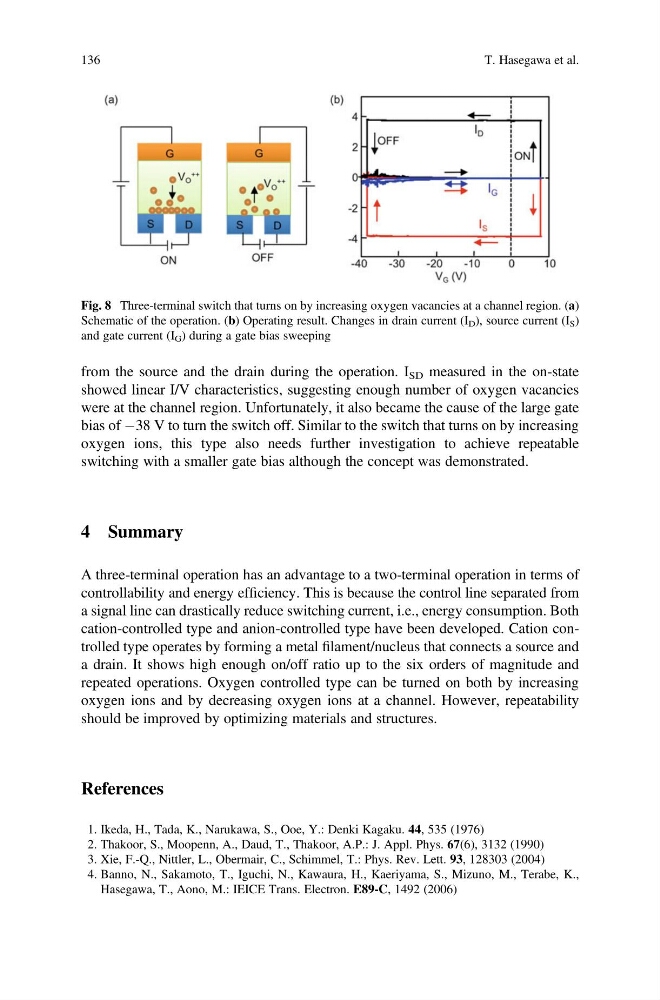
from the source and the drain during the operation. I SD measured in the on-state
showed linear I/V characteristics, suggesting enough number of oxygen vacancies
were at the channel region. Unfortunately, it also became the cause of the large gate
bias of À38 V to turn the switch off. Similar to the switch that turns on by increasing
oxygen ions, this type also needs further investigation to achieve repeatable
switching with a smaller gate bias although the concept was demonstrated.
4 Summary
A three-terminal operation has an advantage to a two-terminal operation in terms of
controllability and energy efficiency. This is because the control line separated from
a signal line can drastically reduce switching current, i.e., energy consumption. Both
cation-controlled type and anion-controlled type have been developed. Cation controlled type operates by forming a metal filament/nucleus that connects a source and
a drain. It shows high enough on/off ratio up to the six orders of magnitude and
repeated operations. Oxygen controlled type can be turned on both by increasing
oxygen ions and by decreasing oxygen ions at a channel. However, repeatability
should be improved by optimizing materials and structures.
References
1. Ikeda, H., Tada, K., Narukawa, S., Ooe, Y.: Denki Kagaku. 44, 535 (1976)
2. Thakoor, S., Moopenn, A., Daud, T., Thakoor, A.P.: J. Appl. Phys. 67(6), 3132 (1990)
3. Xie, F.-Q., Nittler, L., Obermair, C., Schimmel, T.: Phys. Rev. Lett. 93, 128303 (2004)
4. Banno, N., Sakamoto, T., Iguchi, N., Kawaura, H., Kaeriyama, S., Mizuno, M., Terabe, K.,
Hasegawa, T., Aono, M.: IEICE Trans. Electron. E89-C, 1492 (2006)
Fig. 8 Three-terminal switch that turns on by increasing oxygen vacancies at a channel region. (a)
Schematic of the operation. (b) Operating result. Changes in drain current (I D ), source current (I S )
and gate current (I G ) during a gate bias sweeping
136
T. Hasegawa et al.
showed linear I/V characteristics, suggesting enough number of oxygen vacancies
were at the channel region. Unfortunately, it also became the cause of the large gate
bias of À38 V to turn the switch off. Similar to the switch that turns on by increasing
oxygen ions, this type also needs further investigation to achieve repeatable
switching with a smaller gate bias although the concept was demonstrated.
4 Summary
A three-terminal operation has an advantage to a two-terminal operation in terms of
controllability and energy efficiency. This is because the control line separated from
a signal line can drastically reduce switching current, i.e., energy consumption. Both
cation-controlled type and anion-controlled type have been developed. Cation controlled type operates by forming a metal filament/nucleus that connects a source and
a drain. It shows high enough on/off ratio up to the six orders of magnitude and
repeated operations. Oxygen controlled type can be turned on both by increasing
oxygen ions and by decreasing oxygen ions at a channel. However, repeatability
should be improved by optimizing materials and structures.
References
1. Ikeda, H., Tada, K., Narukawa, S., Ooe, Y.: Denki Kagaku. 44, 535 (1976)
2. Thakoor, S., Moopenn, A., Daud, T., Thakoor, A.P.: J. Appl. Phys. 67(6), 3132 (1990)
3. Xie, F.-Q., Nittler, L., Obermair, C., Schimmel, T.: Phys. Rev. Lett. 93, 128303 (2004)
4. Banno, N., Sakamoto, T., Iguchi, N., Kawaura, H., Kaeriyama, S., Mizuno, M., Terabe, K.,
Hasegawa, T., Aono, M.: IEICE Trans. Electron. E89-C, 1492 (2006)
Fig. 8 Three-terminal switch that turns on by increasing oxygen vacancies at a channel region. (a)
Schematic of the operation. (b) Operating result. Changes in drain current (I D ), source current (I S )
and gate current (I G ) during a gate bias sweeping
136
T. Hasegawa et al.