

stoichiometric value often gives a severe damage in a TaOx layer. Namely, a hard
breakdown occurs. Exploring of metal oxide that is not damaged by the increase in
oxygen ions is needed.
Three-terminal operation is also achievable by decreasing oxygen ion concentration at a channel region [11], which is the method to make a conductive channel used
in the conventional two-terminal metal oxide resistive switches [12]. Its operating
concept is shown in Fig. 8a, where an oxygen vacancy V O
++ are drawn instead of an
oxygen ion. The application of a positive gate bias brings oxygen vacancies towards
a source and a drain. When a gap between a source and a drain is sufficiently narrow,
oxygen vacancies also migrate to the channel region, making the channel conductive. Application of a negative gate bias brings oxygen vacancies back from the
channel region, returning the channel insulative. Figure 8b shows an example of
operating results of the oxygen ion-controlled three-terminal switch. Gate bias
sweeping in the positive polarity steeply increased source current (I S ) and drain
current (I D ) at 8 V. The large currents of a source (I S ) and a drain (I D ) were kept until
a negative gate bias of À38 V was applied. The gate current (I G ) remained at a value
much smaller than I S and I D , indicating the gate electrode was electrically isolated
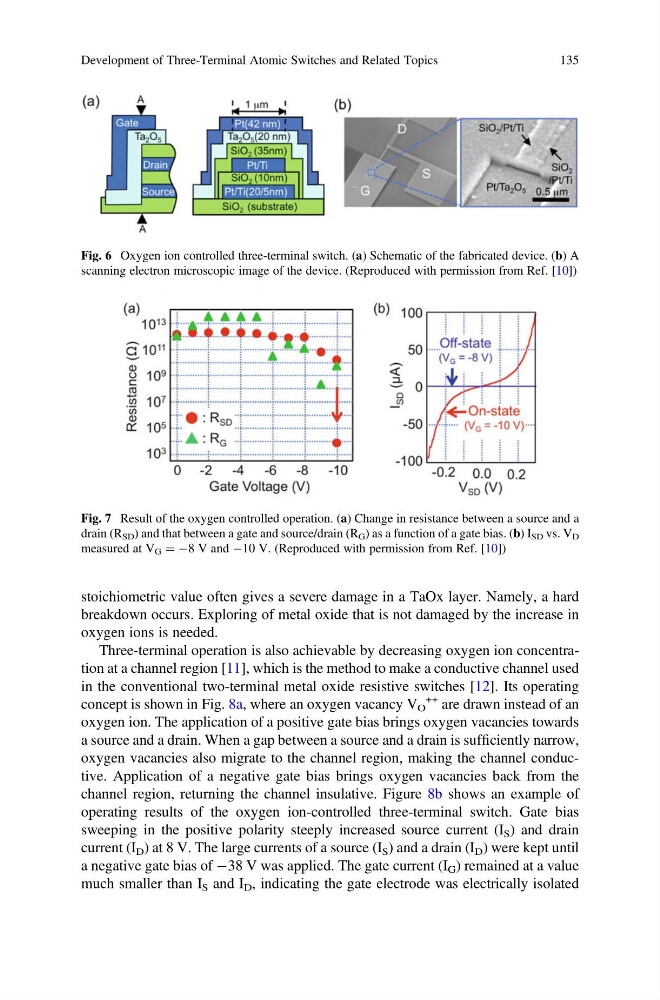
Fig. 6 Oxygen ion controlled three-terminal switch. (a) Schematic of the fabricated device. (b) A
scanning electron microscopic image of the device. (Reproduced with permission from Ref. [10])
Fig. 7 Result of the oxygen controlled operation. (a) Change in resistance between a source and a
drain (R SD ) and that between a gate and source/drain (R G ) as a function of a gate bias. (b) I SD vs. V D
measured at V G ¼ À8 V and À10 V. (Reproduced with permission from Ref. [10])
Development of Three-Terminal Atomic Switches and Related Topics
135
breakdown occurs. Exploring of metal oxide that is not damaged by the increase in
oxygen ions is needed.
Three-terminal operation is also achievable by decreasing oxygen ion concentration at a channel region [11], which is the method to make a conductive channel used
in the conventional two-terminal metal oxide resistive switches [12]. Its operating
concept is shown in Fig. 8a, where an oxygen vacancy V O
++ are drawn instead of an
oxygen ion. The application of a positive gate bias brings oxygen vacancies towards
a source and a drain. When a gap between a source and a drain is sufficiently narrow,
oxygen vacancies also migrate to the channel region, making the channel conductive. Application of a negative gate bias brings oxygen vacancies back from the
channel region, returning the channel insulative. Figure 8b shows an example of
operating results of the oxygen ion-controlled three-terminal switch. Gate bias
sweeping in the positive polarity steeply increased source current (I S ) and drain
current (I D ) at 8 V. The large currents of a source (I S ) and a drain (I D ) were kept until
a negative gate bias of À38 V was applied. The gate current (I G ) remained at a value
much smaller than I S and I D , indicating the gate electrode was electrically isolated
Fig. 6 Oxygen ion controlled three-terminal switch. (a) Schematic of the fabricated device. (b) A
scanning electron microscopic image of the device. (Reproduced with permission from Ref. [10])
Fig. 7 Result of the oxygen controlled operation. (a) Change in resistance between a source and a
drain (R SD ) and that between a gate and source/drain (R G ) as a function of a gate bias. (b) I SD vs. V D
measured at V G ¼ À8 V and À10 V. (Reproduced with permission from Ref. [10])
Development of Three-Terminal Atomic Switches and Related Topics
135