

activation process, traveling time of metal cations can be expressed using Arrhenius
equation as follows
t %
X
j
A j ∙ exp
E x j
À Á À eΔV x j
À Á
kT
,
where E(x j ) and ΔV(x j ) are a diffusion barrier at a position of x j without bias
application and a potential drop at x j due to a bias application. From the equation,
it is understood that metal cation’s drift occurs even with an application of smaller
bias although the traveling time exponentially becomes longer. As a result, there is
no threshold bias for the switching although switching time changes over several
orders of magnitude depending on an applied bias. Therefore, SET bias depends on
the speed of bias sweeping. This isn’t a matter when atomic switches are used such
as a memory device and a programmable switch. Only when used as logic devices, it
becomes a matter that is the reason why we developed another type of the threeterminal atomic switches.
In order to develop a three-terminal atomic switch that has a clear threshold bias
for SET and RESET, we employed Ta 2 O 5 , which is an insulator in terms of electrical
conductivity, as the ionic transferring material. This is because the rate limiting
process of Ta 2 O 5 -based gapless atomic switches is nucleation of metal atoms in a
Ta 2 O 5 layer at the counter electrode side. Since the nucleation occurs when a
concentration of metal cations reaches a certain value, i.e., super-saturation value,
nucleation controlled three-terminal atomic switch should have a clear
threshold bias.
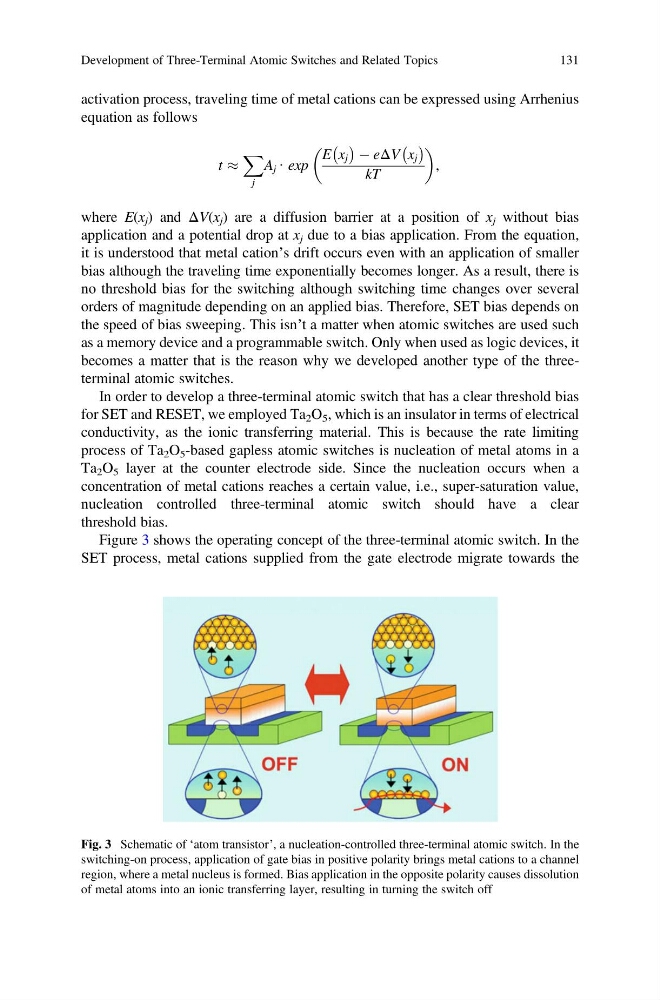
Figure 3 shows the operating concept of the three-terminal atomic switch. In the
SET process, metal cations supplied from the gate electrode migrate towards the
Fig. 3 Schematic of ‘atom transistor’, a nucleation-controlled three-terminal atomic switch. In the
switching-on process, application of gate bias in positive polarity brings metal cations to a channel
region, where a metal nucleus is formed. Bias application in the opposite polarity causes dissolution
of metal atoms into an ionic transferring layer, resulting in turning the switch off
Development of Three-Terminal Atomic Switches and Related Topics
131
equation as follows
t %
X
j
A j ∙ exp
E x j
À Á À eΔV x j
À Á
kT
,
where E(x j ) and ΔV(x j ) are a diffusion barrier at a position of x j without bias
application and a potential drop at x j due to a bias application. From the equation,
it is understood that metal cation’s drift occurs even with an application of smaller
bias although the traveling time exponentially becomes longer. As a result, there is
no threshold bias for the switching although switching time changes over several
orders of magnitude depending on an applied bias. Therefore, SET bias depends on
the speed of bias sweeping. This isn’t a matter when atomic switches are used such
as a memory device and a programmable switch. Only when used as logic devices, it
becomes a matter that is the reason why we developed another type of the threeterminal atomic switches.
In order to develop a three-terminal atomic switch that has a clear threshold bias
for SET and RESET, we employed Ta 2 O 5 , which is an insulator in terms of electrical
conductivity, as the ionic transferring material. This is because the rate limiting
process of Ta 2 O 5 -based gapless atomic switches is nucleation of metal atoms in a
Ta 2 O 5 layer at the counter electrode side. Since the nucleation occurs when a
concentration of metal cations reaches a certain value, i.e., super-saturation value,
nucleation controlled three-terminal atomic switch should have a clear
threshold bias.
Figure 3 shows the operating concept of the three-terminal atomic switch. In the
SET process, metal cations supplied from the gate electrode migrate towards the
Fig. 3 Schematic of ‘atom transistor’, a nucleation-controlled three-terminal atomic switch. In the
switching-on process, application of gate bias in positive polarity brings metal cations to a channel
region, where a metal nucleus is formed. Bias application in the opposite polarity causes dissolution
of metal atoms into an ionic transferring layer, resulting in turning the switch off
Development of Three-Terminal Atomic Switches and Related Topics
131