

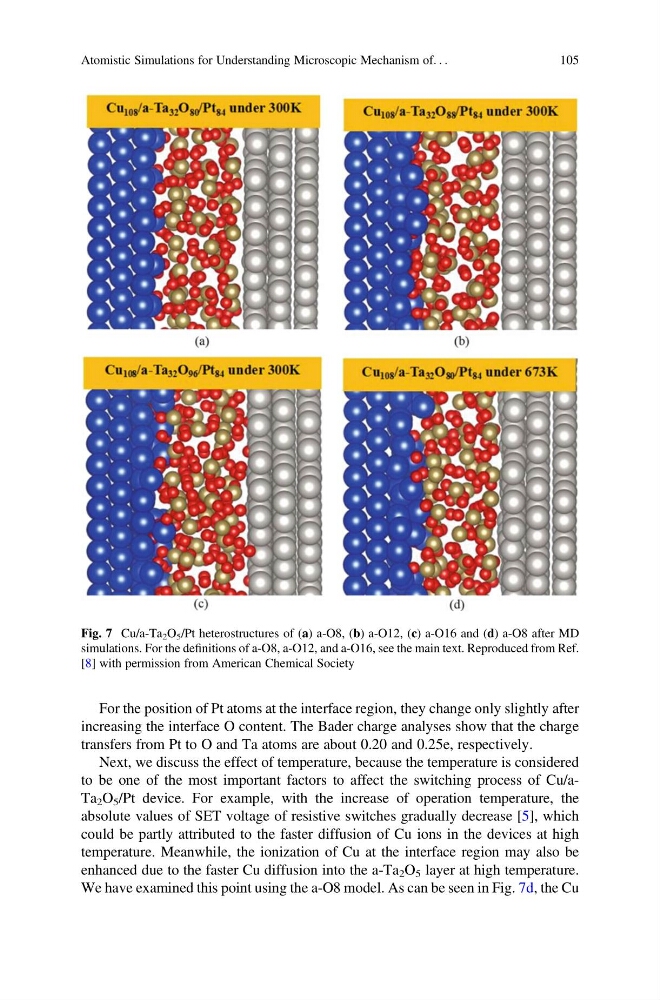
For the position of Pt atoms at the interface region, they change only slightly after
increasing the interface O content. The Bader charge analyses show that the charge
transfers from Pt to O and Ta atoms are about 0.20 and 0.25e, respectively.
Next, we discuss the effect of temperature, because the temperature is considered
to be one of the most important factors to affect the switching process of Cu/aTa 2 O 5 /Pt device. For example, with the increase of operation temperature, the
absolute values of SET voltage of resistive switches gradually decrease [5], which
could be partly attributed to the faster diffusion of Cu ions in the devices at high
temperature. Meanwhile, the ionization of Cu at the interface region may also be
enhanced due to the faster Cu diffusion into the a-Ta 2 O 5 layer at high temperature.
We have examined this point using the a-O8 model. As can be seen in Fig. 7d, the Cu
Fig. 7 Cu/a-Ta 2 O 5 /Pt heterostructures of (a) a-O8, (b) a-O12, (c) a-O16 and (d) a-O8 after MD
simulations. For the definitions of a-O8, a-O12, and a-O16, see the main text. Reproduced from Ref.
[8] with permission from American Chemical Society
Atomistic Simulations for Understanding Microscopic Mechanism of. . .
105
increasing the interface O content. The Bader charge analyses show that the charge
transfers from Pt to O and Ta atoms are about 0.20 and 0.25e, respectively.
Next, we discuss the effect of temperature, because the temperature is considered
to be one of the most important factors to affect the switching process of Cu/aTa 2 O 5 /Pt device. For example, with the increase of operation temperature, the
absolute values of SET voltage of resistive switches gradually decrease [5], which
could be partly attributed to the faster diffusion of Cu ions in the devices at high
temperature. Meanwhile, the ionization of Cu at the interface region may also be
enhanced due to the faster Cu diffusion into the a-Ta 2 O 5 layer at high temperature.
We have examined this point using the a-O8 model. As can be seen in Fig. 7d, the Cu
Fig. 7 Cu/a-Ta 2 O 5 /Pt heterostructures of (a) a-O8, (b) a-O12, (c) a-O16 and (d) a-O8 after MD
simulations. For the definitions of a-O8, a-O12, and a-O16, see the main text. Reproduced from Ref.
[8] with permission from American Chemical Society
Atomistic Simulations for Understanding Microscopic Mechanism of. . .
105