

that MD simulations may be insufficient to confirm their stability due to the short
time scale compared with that in the practical use. Thus, we also examined their
thermodynamic stability, by evaluating the insertion (formation) energies of both
structures [6]. The calculated values of insertion (formation) energies are À0.45
(0.48) and À0.29 (0.54) eV, respectively, which suggests that (1) such thin Cu
filaments could be stable in a-Ta 2 O 5 , while (2) the Cu atoms in thin filaments are less
stable than that in the bulk system. It should be noted that the Cu nanowire structures
have been widely observed in experiments [23], even though they are less stable than
the Cu bulk system. Thus, we can expect that both of the structures (Fig. 3a,b) can
exist in a-Ta 2 O 5 for sufficiently long periods.
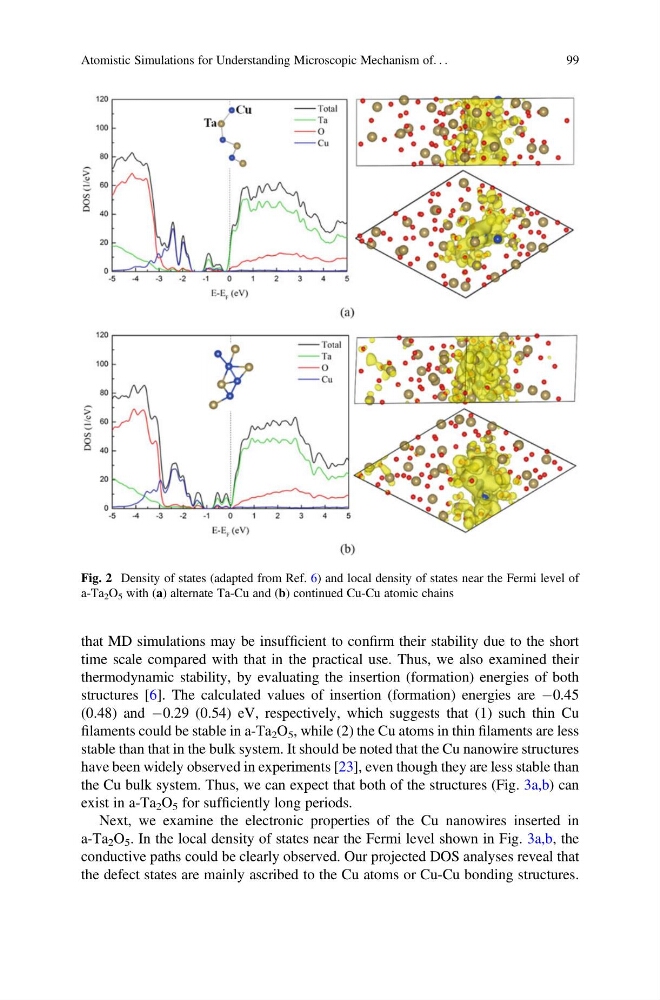
Next, we examine the electronic properties of the Cu nanowires inserted in
a-Ta 2 O 5 . In the local density of states near the Fermi level shown in Fig. 3a,b, the
conductive paths could be clearly observed. Our projected DOS analyses reveal that
the defect states are mainly ascribed to the Cu atoms or Cu-Cu bonding structures.
Fig. 2 Density of states (adapted from Ref. 6) and local density of states near the Fermi level of
a-Ta 2 O 5 with (a) alternate Ta-Cu and (b) continued Cu-Cu atomic chains
Atomistic Simulations for Understanding Microscopic Mechanism of. . .
99
time scale compared with that in the practical use. Thus, we also examined their
thermodynamic stability, by evaluating the insertion (formation) energies of both
structures [6]. The calculated values of insertion (formation) energies are À0.45
(0.48) and À0.29 (0.54) eV, respectively, which suggests that (1) such thin Cu
filaments could be stable in a-Ta 2 O 5 , while (2) the Cu atoms in thin filaments are less
stable than that in the bulk system. It should be noted that the Cu nanowire structures
have been widely observed in experiments [23], even though they are less stable than
the Cu bulk system. Thus, we can expect that both of the structures (Fig. 3a,b) can
exist in a-Ta 2 O 5 for sufficiently long periods.
Next, we examine the electronic properties of the Cu nanowires inserted in
a-Ta 2 O 5 . In the local density of states near the Fermi level shown in Fig. 3a,b, the
conductive paths could be clearly observed. Our projected DOS analyses reveal that
the defect states are mainly ascribed to the Cu atoms or Cu-Cu bonding structures.
Fig. 2 Density of states (adapted from Ref. 6) and local density of states near the Fermi level of
a-Ta 2 O 5 with (a) alternate Ta-Cu and (b) continued Cu-Cu atomic chains
Atomistic Simulations for Understanding Microscopic Mechanism of. . .
99