

Ordering Transitions in Short-Chain Alcohols
93
R O
H
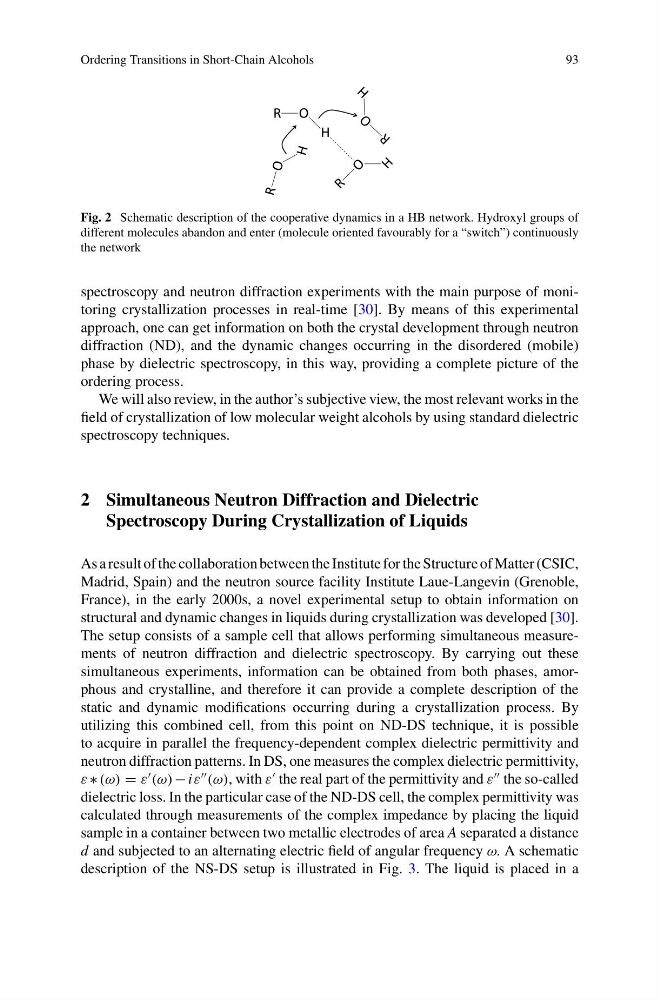
Fig. 2 Schematic description of the cooperative dynamics in a HB network. Hydroxyl groups of
different molecules abandon and enter (molecule oriented favourably for a “switch”) continuously
the network
spectroscopy and neutron diffraction experiments with the main purpose of monitoring crystallization processes in real-time [30]. By means of this experimental
approach, one can get information on both the crystal development through neutron
diffraction (ND), and the dynamic changes occurring in the disordered (mobile)
phase by dielectric spectroscopy, in this way, providing a complete picture of the
ordering process.
We will also review, in the author’s subjective view, the most relevant works in the
field of crystallization of low molecular weight alcohols by using standard dielectric
spectroscopy techniques.
2 Simultaneous Neutron Diffraction and Dielectric
Spectroscopy During Crystallization of Liquids
As a result of the collaboration between the Institute for the Structure of Matter (CSIC,
Madrid, Spain) and the neutron source facility Institute Laue-Langevin (Grenoble,
France), in the early 2000s, a novel experimental setup to obtain information on
structural and dynamic changes in liquids during crystallization was developed [30].
The setup consists of a sample cell that allows performing simultaneous measurements of neutron diffraction and dielectric spectroscopy. By carrying out these
simultaneous experiments, information can be obtained from both phases, amorphous and crystalline, and therefore it can provide a complete description of the
static and dynamic modifications occurring during a crystallization process. By
utilizing this combined cell, from this point on ND-DS technique, it is possible
to acquire in parallel the frequency-dependent complex dielectric permittivity and
neutron diffraction patterns. In DS, one measures the complex dielectric permittivity,
ε ∗ (ω) = ε
(ω) − iε
(ω), with ε
the real part of the permittivity and ε
the so-called
dielectric loss. In the particular case of the ND-DS cell, the complex permittivity was
calculated through measurements of the complex impedance by placing the liquid
sample in a container between two metallic electrodes of area A separated a distance
d and subjected to an alternating electric field of angular frequency ω. A schematic
description of the NS-DS setup is illustrated in Fig. 3. The liquid is placed in a
93
R O
H
Fig. 2 Schematic description of the cooperative dynamics in a HB network. Hydroxyl groups of
different molecules abandon and enter (molecule oriented favourably for a “switch”) continuously
the network
spectroscopy and neutron diffraction experiments with the main purpose of monitoring crystallization processes in real-time [30]. By means of this experimental
approach, one can get information on both the crystal development through neutron
diffraction (ND), and the dynamic changes occurring in the disordered (mobile)
phase by dielectric spectroscopy, in this way, providing a complete picture of the
ordering process.
We will also review, in the author’s subjective view, the most relevant works in the
field of crystallization of low molecular weight alcohols by using standard dielectric
spectroscopy techniques.
2 Simultaneous Neutron Diffraction and Dielectric
Spectroscopy During Crystallization of Liquids
As a result of the collaboration between the Institute for the Structure of Matter (CSIC,
Madrid, Spain) and the neutron source facility Institute Laue-Langevin (Grenoble,
France), in the early 2000s, a novel experimental setup to obtain information on
structural and dynamic changes in liquids during crystallization was developed [30].
The setup consists of a sample cell that allows performing simultaneous measurements of neutron diffraction and dielectric spectroscopy. By carrying out these
simultaneous experiments, information can be obtained from both phases, amorphous and crystalline, and therefore it can provide a complete description of the
static and dynamic modifications occurring during a crystallization process. By
utilizing this combined cell, from this point on ND-DS technique, it is possible
to acquire in parallel the frequency-dependent complex dielectric permittivity and
neutron diffraction patterns. In DS, one measures the complex dielectric permittivity,
ε ∗ (ω) = ε
(ω) − iε
(ω), with ε
the real part of the permittivity and ε
the so-called
dielectric loss. In the particular case of the ND-DS cell, the complex permittivity was
calculated through measurements of the complex impedance by placing the liquid
sample in a container between two metallic electrodes of area A separated a distance
d and subjected to an alternating electric field of angular frequency ω. A schematic
description of the NS-DS setup is illustrated in Fig. 3. The liquid is placed in a