

94
A. Sanz
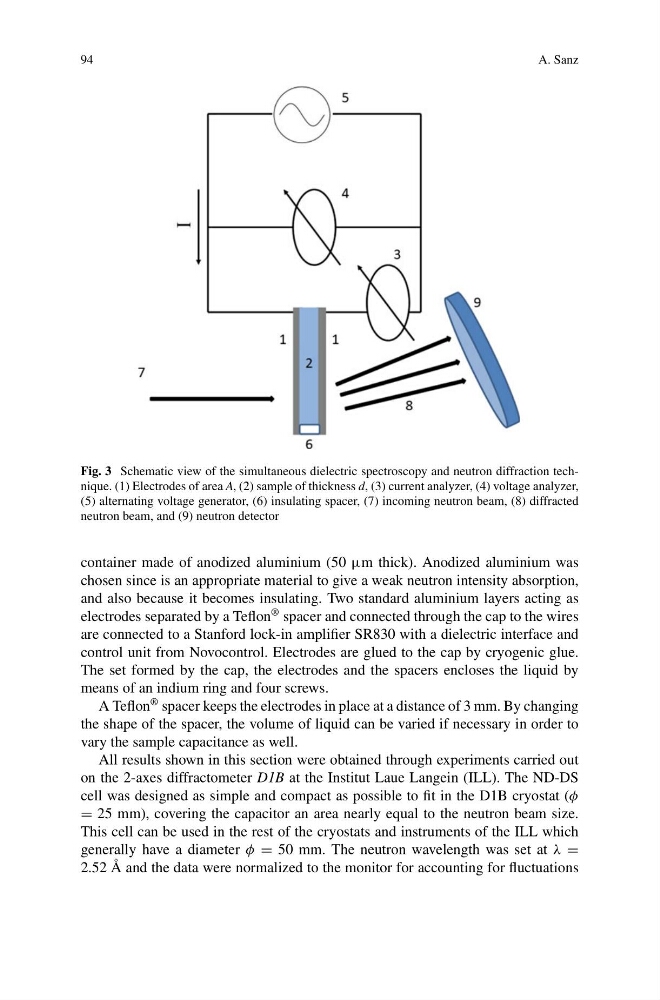
Fig. 3 Schematic view of the simultaneous dielectric spectroscopy and neutron diffraction technique. (1) Electrodes of area A, (2) sample of thickness d, (3) current analyzer, (4) voltage analyzer,
(5) alternating voltage generator, (6) insulating spacer, (7) incoming neutron beam, (8) diffracted
neutron beam, and (9) neutron detector
container made of anodized aluminium (50 μm thick). Anodized aluminium was
chosen since is an appropriate material to give a weak neutron intensity absorption,
and also because it becomes insulating. Two standard aluminium layers acting as
electrodes separated by a Teflon
® spacer and connected through the cap to the wires
are connected to a Stanford lock-in amplifier SR830 with a dielectric interface and
control unit from Novocontrol. Electrodes are glued to the cap by cryogenic glue.
The set formed by the cap, the electrodes and the spacers encloses the liquid by
means of an indium ring and four screws.
A Teflon
® spacer keeps the electrodes in place at a distance of 3 mm. By changing
the shape of the spacer, the volume of liquid can be varied if necessary in order to
vary the sample capacitance as well.
All results shown in this section were obtained through experiments carried out
on the 2-axes diffractometer D1B at the Institut Laue Langein (ILL). The ND-DS
cell was designed as simple and compact as possible to fit in the D1B cryostat (φ
= 25 mm), covering the capacitor an area nearly equal to the neutron beam size.
This cell can be used in the rest of the cryostats and instruments of the ILL which
generally have a diameter φ = 50 mm. The neutron wavelength was set at λ =
2.52 Å and the data were normalized to the monitor for accounting for fluctuations
A. Sanz
Fig. 3 Schematic view of the simultaneous dielectric spectroscopy and neutron diffraction technique. (1) Electrodes of area A, (2) sample of thickness d, (3) current analyzer, (4) voltage analyzer,
(5) alternating voltage generator, (6) insulating spacer, (7) incoming neutron beam, (8) diffracted
neutron beam, and (9) neutron detector
container made of anodized aluminium (50 μm thick). Anodized aluminium was
chosen since is an appropriate material to give a weak neutron intensity absorption,
and also because it becomes insulating. Two standard aluminium layers acting as
electrodes separated by a Teflon
® spacer and connected through the cap to the wires
are connected to a Stanford lock-in amplifier SR830 with a dielectric interface and
control unit from Novocontrol. Electrodes are glued to the cap by cryogenic glue.
The set formed by the cap, the electrodes and the spacers encloses the liquid by
means of an indium ring and four screws.
A Teflon
® spacer keeps the electrodes in place at a distance of 3 mm. By changing
the shape of the spacer, the volume of liquid can be varied if necessary in order to
vary the sample capacitance as well.
All results shown in this section were obtained through experiments carried out
on the 2-axes diffractometer D1B at the Institut Laue Langein (ILL). The ND-DS
cell was designed as simple and compact as possible to fit in the D1B cryostat (φ
= 25 mm), covering the capacitor an area nearly equal to the neutron beam size.
This cell can be used in the rest of the cryostats and instruments of the ILL which
generally have a diameter φ = 50 mm. The neutron wavelength was set at λ =
2.52 Å and the data were normalized to the monitor for accounting for fluctuations