

64
J. Knapik-Kowalczuk et al.
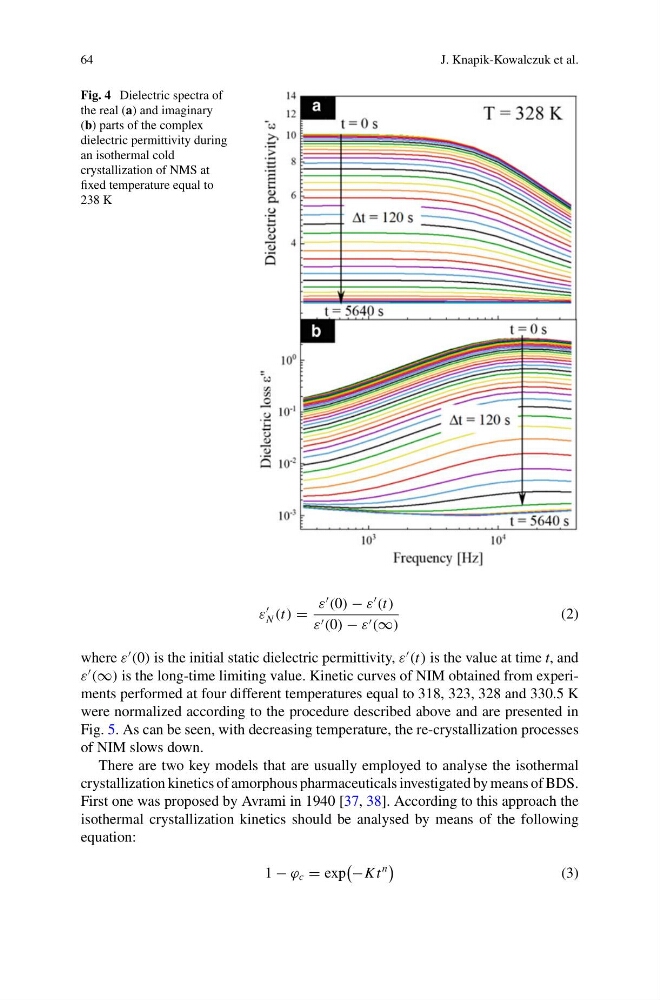
Fig. 4 Dielectric spectra of
the real (a) and imaginary
(b) parts of the complex
dielectric permittivity during
an isothermal cold
crystallization of NMS at
fixed temperature equal to
238 K
ε
N (t) =
ε
(0) − ε
(t)
ε (0) − ε (∞)
(2)
where ε
(0) is the initial static dielectric permittivity, ε
(t) is the value at time t, and
ε
(∞) is the long-time limiting value. Kinetic curves of NIM obtained from experiments performed at four different temperatures equal to 318, 323, 328 and 330.5 K
were normalized according to the procedure described above and are presented in
Fig. 5. As can be seen, with decreasing temperature, the re-crystallization processes
of NIM slows down.
There are two key models that are usually employed to analyse the isothermal
crystallization kinetics of amorphous pharmaceuticals investigated by means of BDS.
First one was proposed by Avrami in 1940 [37, 38]. According to this approach the
isothermal crystallization kinetics should be analysed by means of the following
equation:
1 − ϕ c = exp
−K t
n
(3)
J. Knapik-Kowalczuk et al.
Fig. 4 Dielectric spectra of
the real (a) and imaginary
(b) parts of the complex
dielectric permittivity during
an isothermal cold
crystallization of NMS at
fixed temperature equal to
238 K
ε
N (t) =
ε
(0) − ε
(t)
ε (0) − ε (∞)
(2)
where ε
(0) is the initial static dielectric permittivity, ε
(t) is the value at time t, and
ε
(∞) is the long-time limiting value. Kinetic curves of NIM obtained from experiments performed at four different temperatures equal to 318, 323, 328 and 330.5 K
were normalized according to the procedure described above and are presented in
Fig. 5. As can be seen, with decreasing temperature, the re-crystallization processes
of NIM slows down.
There are two key models that are usually employed to analyse the isothermal
crystallization kinetics of amorphous pharmaceuticals investigated by means of BDS.
First one was proposed by Avrami in 1940 [37, 38]. According to this approach the
isothermal crystallization kinetics should be analysed by means of the following
equation:
1 − ϕ c = exp
−K t
n
(3)