

High-Pressure Crystallization of Glass-Forming Liquids …
45
0
30
60
90 120 150 180 210 240
8.5
9.0
9.5
10.0
10.5
0
40 80 120 160 200 240
19.5
20.0
20.5
21.0
Δμ [kJ/mol]
p [MPa]
σ [mJ/m
2
]
p [MPa]
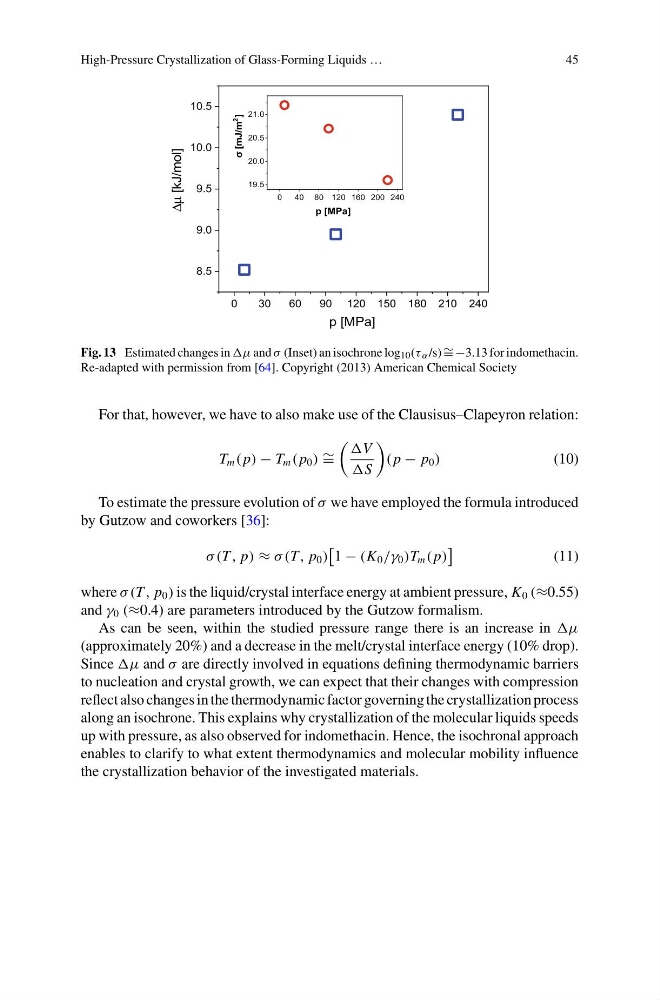
Fig. 13 Estimated changes in μ and σ (Inset) an isochrone log 10 (τ α /s) ∼ = −3.13 for indomethacin.
Re-adapted with permission from [64]. Copyright (2013) American Chemical Society
For that, however, we have to also make use of the Clausisus–Clapeyron relation:
T m ( p) − T m ( p 0 ) ∼ =
S
( p − p 0 )
(10)
To estimate the pressure evolution of σ we have employed the formula introduced
by Gutzow and coworkers [36]:
σ (T, p) ≈ σ (T, p 0 )
1 − (K 0 /γ 0 )T m ( p)
(11)
where σ (T, p 0 ) is the liquid/crystal interface energy at ambient pressure, K 0 (≈0.55)
and γ 0 (≈0.4) are parameters introduced by the Gutzow formalism.
As can be seen, within the studied pressure range there is an increase in μ
(approximately 20%) and a decrease in the melt/crystal interface energy (10% drop).
Since μ and σ are directly involved in equations defining thermodynamic barriers
to nucleation and crystal growth, we can expect that their changes with compression
reflect also changes in the thermodynamic factor governing the crystallization process
along an isochrone. This explains why crystallization of the molecular liquids speeds
up with pressure, as also observed for indomethacin. Hence, the isochronal approach
enables to clarify to what extent thermodynamics and molecular mobility influence
the crystallization behavior of the investigated materials.
45
0
30
60
90 120 150 180 210 240
8.5
9.0
9.5
10.0
10.5
0
40 80 120 160 200 240
19.5
20.0
20.5
21.0
Δμ [kJ/mol]
p [MPa]
σ [mJ/m
2
]
p [MPa]
Fig. 13 Estimated changes in μ and σ (Inset) an isochrone log 10 (τ α /s) ∼ = −3.13 for indomethacin.
Re-adapted with permission from [64]. Copyright (2013) American Chemical Society
For that, however, we have to also make use of the Clausisus–Clapeyron relation:
T m ( p) − T m ( p 0 ) ∼ =
S
( p − p 0 )
(10)
To estimate the pressure evolution of σ we have employed the formula introduced
by Gutzow and coworkers [36]:
σ (T, p) ≈ σ (T, p 0 )
1 − (K 0 /γ 0 )T m ( p)
(11)
where σ (T, p 0 ) is the liquid/crystal interface energy at ambient pressure, K 0 (≈0.55)
and γ 0 (≈0.4) are parameters introduced by the Gutzow formalism.
As can be seen, within the studied pressure range there is an increase in μ
(approximately 20%) and a decrease in the melt/crystal interface energy (10% drop).
Since μ and σ are directly involved in equations defining thermodynamic barriers
to nucleation and crystal growth, we can expect that their changes with compression
reflect also changes in the thermodynamic factor governing the crystallization process
along an isochrone. This explains why crystallization of the molecular liquids speeds
up with pressure, as also observed for indomethacin. Hence, the isochronal approach
enables to clarify to what extent thermodynamics and molecular mobility influence
the crystallization behavior of the investigated materials.