

High-Pressure Crystallization of Glass-Forming Liquids …
43
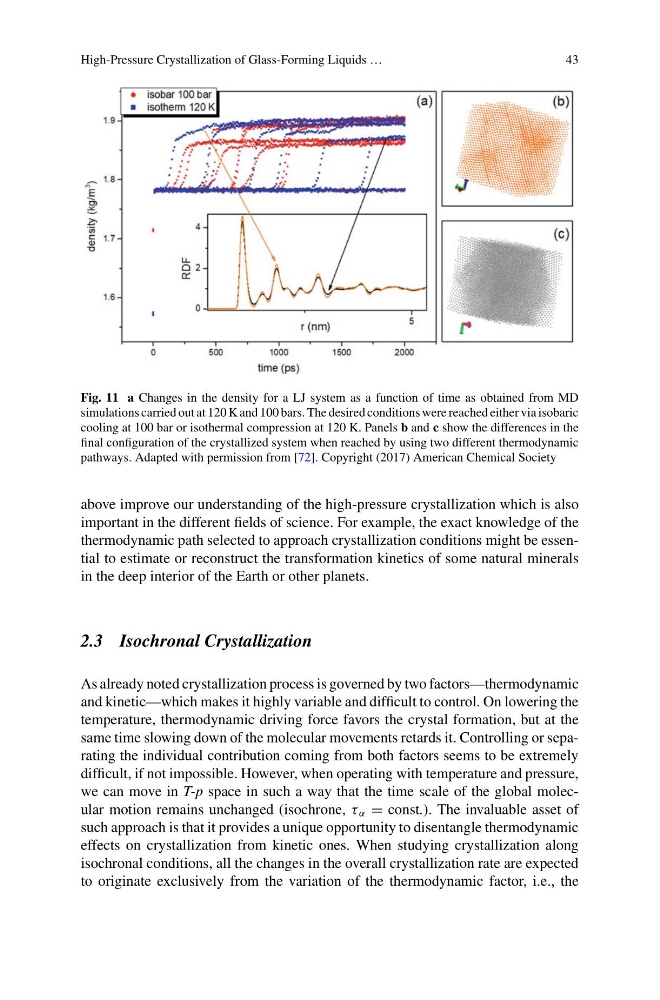
Fig. 11 a Changes in the density for a LJ system as a function of time as obtained from MD
simulations carried out at 120 K and 100 bars. The desired conditions were reached either via isobaric
cooling at 100 bar or isothermal compression at 120 K. Panels b and c show the differences in the
final configuration of the crystallized system when reached by using two different thermodynamic
pathways. Adapted with permission from [72]. Copyright (2017) American Chemical Society
above improve our understanding of the high-pressure crystallization which is also
important in the different fields of science. For example, the exact knowledge of the
thermodynamic path selected to approach crystallization conditions might be essential to estimate or reconstruct the transformation kinetics of some natural minerals
in the deep interior of the Earth or other planets.
2.3 Isochronal Crystallization
As already noted crystallization process is governed by two factors—thermodynamic
and kinetic—which makes it highly variable and difficult to control. On lowering the
temperature, thermodynamic driving force favors the crystal formation, but at the
same time slowing down of the molecular movements retards it. Controlling or separating the individual contribution coming from both factors seems to be extremely
difficult, if not impossible. However, when operating with temperature and pressure,
we can move in T-p space in such a way that the time scale of the global molecular motion remains unchanged (isochrone, τ α = const.). The invaluable asset of
such approach is that it provides a unique opportunity to disentangle thermodynamic
effects on crystallization from kinetic ones. When studying crystallization along
isochronal conditions, all the changes in the overall crystallization rate are expected
to originate exclusively from the variation of the thermodynamic factor, i.e., the
43
Fig. 11 a Changes in the density for a LJ system as a function of time as obtained from MD
simulations carried out at 120 K and 100 bars. The desired conditions were reached either via isobaric
cooling at 100 bar or isothermal compression at 120 K. Panels b and c show the differences in the
final configuration of the crystallized system when reached by using two different thermodynamic
pathways. Adapted with permission from [72]. Copyright (2017) American Chemical Society
above improve our understanding of the high-pressure crystallization which is also
important in the different fields of science. For example, the exact knowledge of the
thermodynamic path selected to approach crystallization conditions might be essential to estimate or reconstruct the transformation kinetics of some natural minerals
in the deep interior of the Earth or other planets.
2.3 Isochronal Crystallization
As already noted crystallization process is governed by two factors—thermodynamic
and kinetic—which makes it highly variable and difficult to control. On lowering the
temperature, thermodynamic driving force favors the crystal formation, but at the
same time slowing down of the molecular movements retards it. Controlling or separating the individual contribution coming from both factors seems to be extremely
difficult, if not impossible. However, when operating with temperature and pressure,
we can move in T-p space in such a way that the time scale of the global molecular motion remains unchanged (isochrone, τ α = const.). The invaluable asset of
such approach is that it provides a unique opportunity to disentangle thermodynamic
effects on crystallization from kinetic ones. When studying crystallization along
isochronal conditions, all the changes in the overall crystallization rate are expected
to originate exclusively from the variation of the thermodynamic factor, i.e., the